
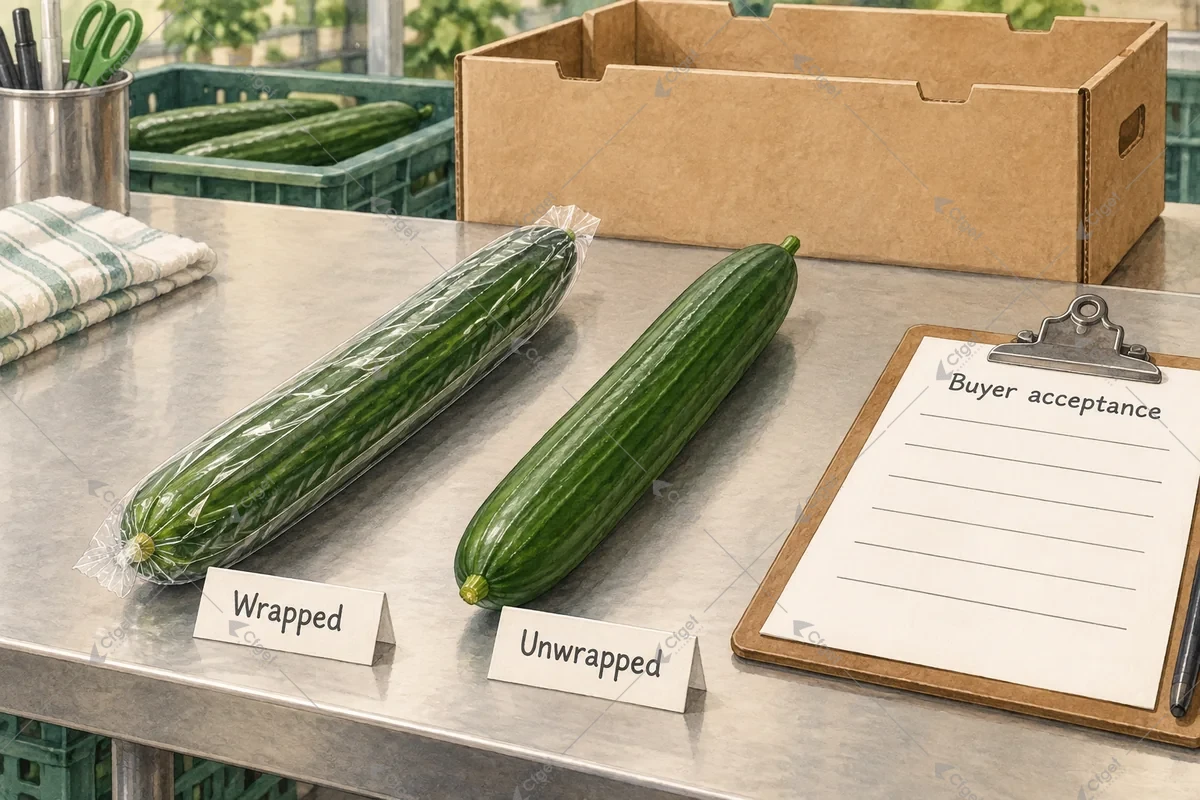
Suppose a buyer asks for long greenhouse cucumbers without individual wrap, while keeping the same delivery schedule and quality expectation. The grower should review the changed product before agreeing, even if the cold room and transport arrangements are unchanged.
The question is specific: will this cucumber, in the proposed package or unwrapped presentation, meet the buyer’s standard at the agreed acceptance point? Retaining weight is part of that question, but it is not the whole answer.
Cooling does not settle the packaging choice
The UF/IFAS greenhouse cucumber handbook chapter distinguishes thin-skinned European-type long cucumbers from mini cucumbers and links individual wrapping of the long type with limiting moisture loss. That crop-type distinction matters. An unwrapped mini-cucumber offer is not evidence that a different long cucumber will behave the same way.
In a study published in 2013 by Fatih Şen, commercially mature Baccara F1 long cucumbers from an Anamur greenhouse in Türkiye were compared at Ege University. The paper reports a December harvest without identifying its calendar year. The randomized experiment used four replicates of ten fruit.
Unwrapped fruit, individually shrink-wrapped fruit and a specified modified-atmosphere packaging (MAP) procedure shared storage conditions of 10 ± 0.5°C and 90% relative humidity. These were experimental conditions, not a handling recommendation. The MAP procedure included precooling before closure, so the comparison concerns the tested packaging procedures.
Best weight retention did not mean best longer-window quality
| Tested treatment | Weight loss |
|---|---|
| Unwrapped | 11.43% |
| Individual shrink wrap | 1.34% |
| Tested MAP procedure | 3.46% |
Five trained assessors also scored overall quality on a five-point scale, with three as the study’s acceptance boundary. All treatments were above that boundary at day 20. At day 30, the unwrapped and individually wrapped treatments were below it, while the tested MAP treatment remained above.
The individual wrap retained mass best but did not keep overall quality above the longer-window criterion. Equally, the shorter observation does not support saying unwrapped cucumbers are never viable. Weight loss is not the percentage of fruit rejected, and this research score is neither an actual buyer acceptance test nor food-safety validation.
Define what the buyer wants to receive
Clarify whether the request removes only the individual film, changes the outer pack as well, or introduces another packaging procedure. Name the cucumber type, cultivar where relevant, pack quantity and presentation. “Less packaging” is too incomplete to describe the revised deliverable.
Then establish where quality will be assessed. Does the buyer require acceptance on arrival, after an outer package is opened, or through a later display period? What will count as unacceptable shriveling, color change, loss of firmness or other defects? Use the buyer’s own criteria, not the study’s three-point score.
The point at which a package opens deserves particular attention. Evidence collected while a case remains closed does not establish the same outcome after the fruit is removed and displayed. Bring that stage into the commercial discussion before making a continued-quality promise.
Choose a supported presentation
The Turkish experiment gives a reason to examine the proposed change. It does not establish a delivery life for every film, MAP pack, cultivar or route. Its day-20 and day-30 observations also do not locate an exact failure day between them.
Have the proposed product and package assessed through the actual delivery and acceptance chain before extending the existing promise to the new presentation. Keep approved handling and food-safety requirements in place. Where the real unresolved issue is cooling duty, use the separate precooling and cold-storage review; a packaging decision should not quietly become an improvised refrigeration change.
The result may support retaining the current pack, validating a specific alternative or agreeing an unwrapped presentation for a defined route and acceptance point. If the evidence does not support the buyer’s original quality window, revise the proposal before committing supply. The aim is to agree on the cucumber the buyer will actually receive, rather than choosing a package solely from its weight-loss result.