Skip to content
I see many growers jump into aquaponics for “high margin,” then get hit by heat stress, pH swings, fish losses, and slow sales. One weak link can destroy your whole system.
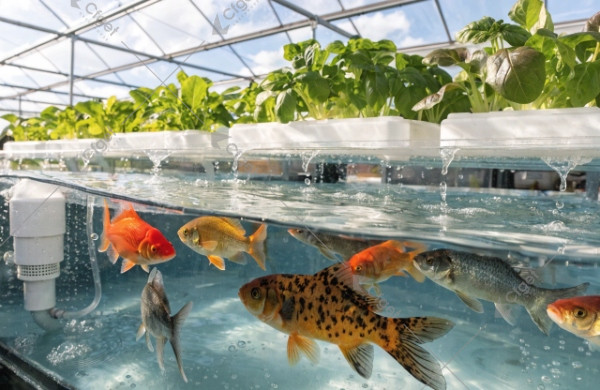
Aquaponics can be profitable when I design it as one balanced production line: stable water quality, stable greenhouse climate, stable food safety routine, and a clear sales plan. The fastest way to fail is to copy a hobby setup and scale it blindly. FAO Small-scale Aquaponic Food Production Manual (Integrated Fish + Plant Farming)<1>
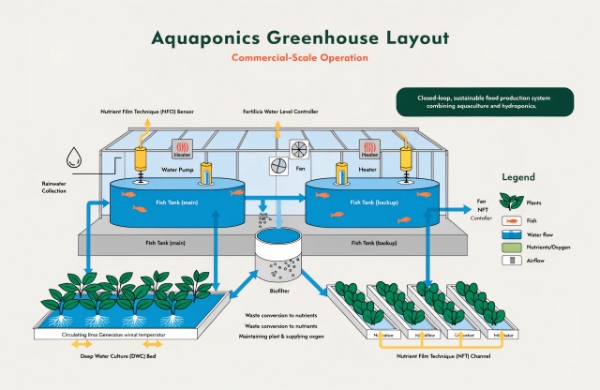
I write this like I am the operator. I want predictable harvests. I want calm mornings. I want to know my risk points before I spend money. So I will walk through cost structure, design choices, and the “failure traps” most pages skip.
What is the real cost structure of a commercial aquaponics greenhouse (CAPEX + OPEX)?
Many cost pages list only “greenhouse cost.” That hides the real problem: aquaponics is two systems in one. If I under-budget one side, the whole project fails.
Aquaponics greenhouse cost is a structure: greenhouse shell + climate systems + recirculating aquaculture system (RAS) + biofiltration + crop system + monitoring + food safety. I plan CAPEX and OPEX together so I can estimate payback with fewer surprises. FAO “Seven rules of thumb” (key water parameters + system basics)<2>
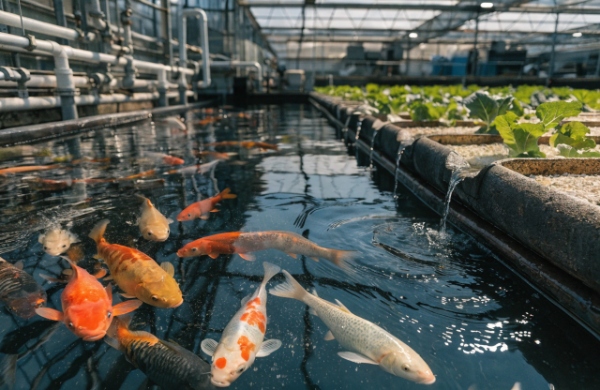
Cost logic I use before I ask for quotations
- Greenhouse shell is not my profit engine. It is my stability engine.
- Cooling + dehumidification + ventilation decide if summer becomes a profit season or a loss season.
- Pumps + aeration + backup power decide if fish survive the night.
- Biofilter sizing decides if ammonia becomes a silent killer.
A practical CAPEX checklist (what many pages miss)
| CAPEX item | Why it matters | Common mistake |
|---|---|---|
| RAS tanks + plumbing | fish density and flow stability | “bigger tank = better” without turnover design |
| Biofilter media + solids removal | controls ammonia / nitrite | under-sizing to save money |
| Aeration (air blowers, diffusers) | protects DO and fish health | no redundancy |
| Climate control (fans, pads, fog, shade, vents) | protects plants and fish from heat stress | copying open-field cooling ideas |
| Automation + alarms | prevents “late discovery” disasters | no alert plan at night |
If I operate in extreme heat, I plan cooling and humidity together. Some industrial research in arid zones shows that combining evaporative cooling with shading and mechanical cooling can be necessary, and dehumidification can even recover water in some designs. Wageningen University & Research: Industrial Aquaponics in Arid Zones (2025)<3>
What water-quality targets keep fish alive and plants growing in the same loop?
Most “how-to” pages explain the nitrogen cycle, but they do not give me daily operating targets that work in a greenhouse reality. I need a compromise range that keeps fish, plants, and bacteria stable.
I keep a simple weekly routine around these core parameters: dissolved oxygen, pH, temperature, nitrogen compounds, and alkalinity buffering. FAO guidance on key aquaponics water parameters (DO, pH, temperature)<2>
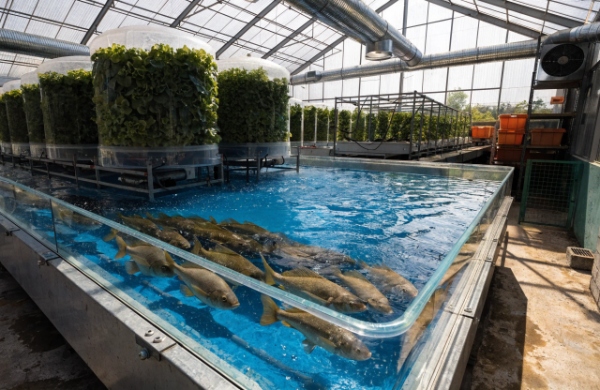
The “stable compromise” mindset (not perfection)
- Fish want stability.
- Nitrifying bacteria need the right conditions to work.
- Plants need nutrients available in the root zone.
Cornell’s aquaponics greenhouse research notes that alkalinity is continuously consumed by nitrifying bacteria and must be replaced, and it highlights the challenge of balancing pH and alkalinity between RAS and hydroponics. USDA NIFA / Cornell Aquaponics Greenhouse Project (alkalinity and pH notes)<4>
How I reduce “ammonia surprise”
| Risk point | What I watch | What I change first |
|---|---|---|
| Overfeeding | uneaten feed, morning DO dip | reduce feed, remove waste, check solids |
| Biofilter overload | rising TAN / nitrite trend | add media, reduce stocking, improve flow |
| pH crash | alkalinity falling | buffer slowly, protect bacteria |
| Heat waves | temp spikes, DO drops | increase aeration, reduce feeding, cool greenhouse |
I also keep basic dissolved oxygen awareness because DO is the first thing that kills fish during hot nights or power issues. US EPA: Dissolved Oxygen (why low DO causes fish stress/kills)<5>
Which greenhouse type and climate system works best for aquaponics in hot or humid regions?
Many pages recommend “any greenhouse.” That is not true. Aquaponics is sensitive because both fish and plants suffer when heat and humidity run out of control.
I choose greenhouse structure and equipment based on climate behavior:
- Hot + dry: evaporative cooling can be strong, but humidity control still matters at night.
- Hot + humid: ventilation design, airflow, and dehumidification planning become critical.
- Big day–night swing: buffering and insulation reduce system shocks.
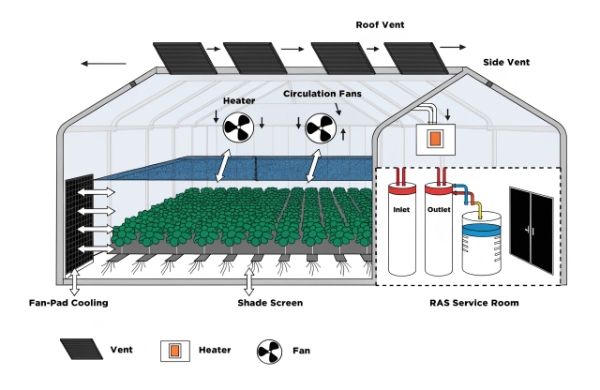
The climate mistake I see most
People cool the air, then forget humidity. High humidity increases disease pressure for many crops, and it also makes cooling less effective. If I design for extreme heat, I combine shade strategy, airflow strategy, and cooling strategy as one plan. Wageningen arid-zone aquaponics findings on cooling options<3>
Internal link I use when planning structure
If I am still choosing structure types, I review CFGET structure options first:
- Multi-span Film Greenhouse (structure + climate integration)
- Wide-span Greenhouse (mechanized space + automation readiness)
How do I manage food safety and water reuse risks in a recirculating aquaponics greenhouse?
Aquaponics feels “clean,” but recirculation means risks can spread fast if I get sloppy. Many ranking pages avoid this topic, but buyers and inspectors care.
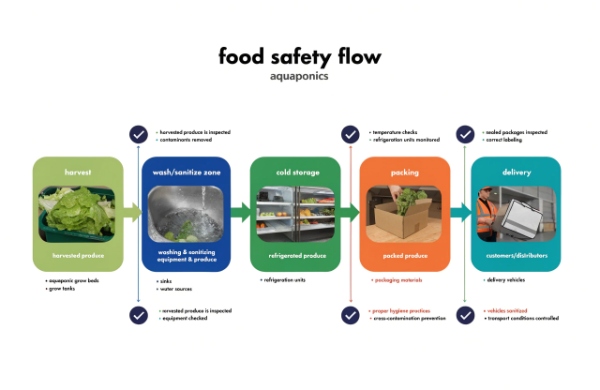
I run a simple food safety system:
- clean harvesting tools
- clean hands and surfaces
- controlled storage temperature for cut leafy greens
- a water-risk assessment mindset
For leafy greens handling, FDA guidance emphasizes cold holding at 41°F (5°C) or less for cut leafy greens in retail and handling contexts, which aligns with the idea that temperature control reduces pathogen growth risk. FDA: Temperature Control for Cut Leafy Greens (41°F / 5°C)<6>
If I sell into regulated markets, I pay attention to agricultural water risk management. FDA’s FSMA Produce Safety Rule updates moved toward systems-based agricultural water assessments, with clear compliance dates listed for different farm sizes. FDA: FSMA Final Rule on Pre-Harvest Agricultural Water (effective July 5, 2024; compliance dates)<7>
I do not want to copy competitors. I want standards from public authorities:
- Codex standards on fresh fruits and vegetables provide a global reference for hygiene codes and trade expectations. FAO/WHO Codex: Fresh Fruits and Vegetables (includes hygienic practice references)<8>
- WHO reminds that food safety is a shared responsibility and links directly to public health and trade trust. WHO Food Safety Fact Sheet (updated Oct 4, 2024)<9>
If I consider recycled water or local reuse rules, I also check government resources. For example, EPA summarizes state reuse rules and treatment categories for agriculture, which helps me frame risk discussions with local partners. US EPA: Summary of California Water Reuse Rules for Agriculture<10>
How do I size the system for profit: crop choice, stocking density, and yield planning?
Many pages talk about “tilapia + lettuce” and stop there. I plan my system like a business:
- What product sells fast in my market?
- What price is stable?
- What grade rate can I achieve?
- What is my target weekly output?
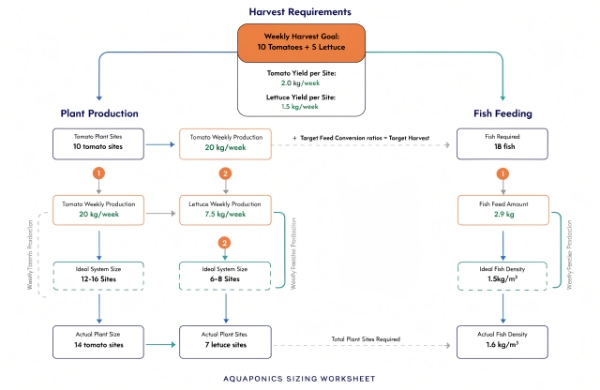
A worksheet connects biology to profit.
A simple sizing conversation I use with myself
1) I choose the crop category (fast cash vs premium niche).
2) I set a weekly harvest target (not a yearly dream).
3) I size plant sites for that weekly target.
4) I size fish feed rate and filtration to support nutrient supply safely.
5) I add contingency because biology is not perfect.
If I am new, I start with simpler, faster crops first. I also use hydroponic ROI logic because aquaponics still needs ROI discipline. This internal CFGET guide helps me think in break-even and payback, not feelings:
YouTube (See the projects)
Conclusion
If I want aquaponics profit, I design for stability first: climate, water quality, food safety, and weekly harvest targets. Then I scale with data and alarms, not hope.
Commercial Aquaponics Greenhouse Design Guide (2026): Cost, Climate Control, Water Quality, and ROI for Growers
A commercial aquaponics greenhouse can be profitable if you design for stable climate, stable water quality, and safe operations. This guide covers real cost structure, key water targets, hot-climate strategies, food safety basics, and sizing logic that drives consistent harvests.
External Links (Footnotes)
1> https://www.fao.org/family-farming/detail/en/c/1743023/
<2> https://www.fao.org/newsroom/story/Seven-rules-of-thumb-to-follow-in-aquaponics/en
<3> https://research.wur.nl/en/publications/environmental-assessment-of-industrial-aquaponics-in-arid-zones-u/
<4> https://portal.nifa.usda.gov/web/crisprojectpages/1010413-development-of-aquaponic-systems-for-the-production-of-lettuce-and-strawberries.html
<5> https://www.epa.gov/caddis/dissolved-oxygen
<6> https://www.fda.gov/food/retail-food-industryregulatory-assistance-training/program-information-manual-retail-food-protection-recommendations-temperature-control-cut-leafy
<7> https://www.fda.gov/food/food-safety-modernization-act-fsma/fsma-final-rule-pre-harvest-agricultural-water
<8> https://www.fao.org/4/a1389e/a1389e00.htm
<9> https://www.who.int/news-room/fact-sheets/detail/food-safety
<10> https://www.epa.gov/waterreuse/summary-californias-water-reuse-guideline-or-regulation-agriculture
<11> https://www.youtube.com/watch?v=W6EvT6U68ew
## Internal Blog References (Related CFGET Articles)
– **Hydroponic Greenhouse Systems: Investment vs Yield, ROI Models, and Payback Periods**
Hydroponic Greenhouse System Investment vs Yield: Real ROI Models, Break-Even Yield & Payback Years?
– **Greenhouse Irrigation Systems: Complete Guide to Drip & Fertigation**
Greenhouse Irrigation Systems: The Ultimate Guide to Boosting Yields & Saving Water
– **How Much Does It Cost to Build a Smart Greenhouse? Hidden Costs You Should Know**
How Much Does It Cost to Build a Smart Greenhouse? What Are the Hidden Costs?
– **Multi-span Film Greenhouse (Structure Overview)**
– **Wide-span Greenhouse (Structure Overview)**
https://cfgreenway.com/wide-span/