Skip to content
Your tomato greenhouse can look busy and still lose money. Heat spikes, uneven irrigation, and weak airflow quietly cut fruit set and taste.
In Almería, Spain, I increase tomato yield and Brix by reducing solar heat load first, stabilizing VPD second, and running precise drip fertigation third. These three moves raise marketable rate and reduce cracking.
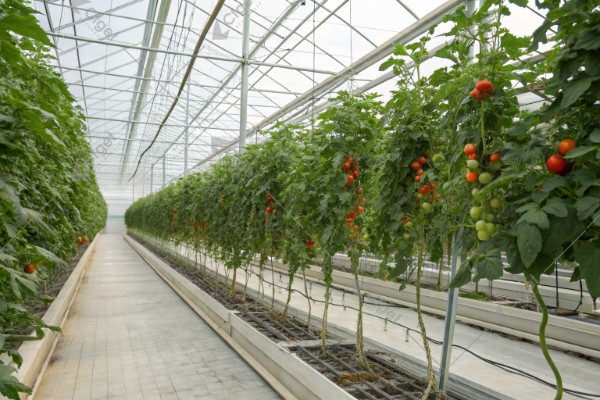
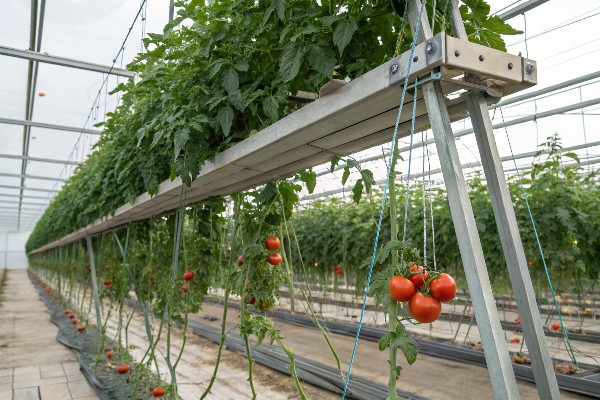
A tomato greenhouse using data to protect quality.
I grow for results, not for theories. In Almería, the greenhouse scale is huge, and that means buyers compare quality every week. NASA highlights how Almería’s greenhouse system links plastic cover and irrigation to large production gains. NASA Earth Observatory<1> I use that context as a reminder: the region rewards efficiency, but it punishes instability.
Why does tomato yield drop in Almería even when I have “enough sun”?
More sun is not always more yield. If canopy temperature and plant water balance drift, fruit set collapses and Brix falls.
Tomato yield drops in Almería when solar load raises canopy temperature and the greenhouse cannot remove heat and moisture evenly, which destabilizes VPD and reduces pollination success.
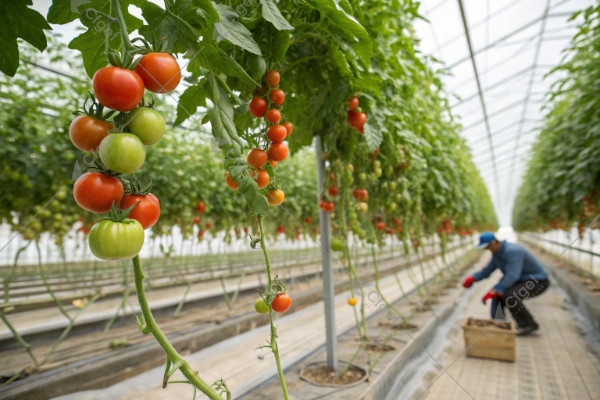
I keep airflow stable across the crop.
Dive deeper
I diagnose yield loss with a simple sequence, because most “top ranking” pages skip this logic and jump straight to equipment. I focus on the root cause: plant balance.
First, I track canopy temperature and VPD rather than only “air temperature” and “RH.” VPD is a better indicator of how hard the plant is transpiring and how stable its water movement is. Michigan State University Extension explains why VPD matters and how it connects to plant stress and water loss. Michigan State University Extension<2>
Second, I look at “where the heat stays.” Many Almería film greenhouses have strong sun, but weak airflow distribution. That creates hot pockets. Hot pockets reduce pollen viability and reduce fruit set, even if the average greenhouse temperature looks fine.
Third, I check whether my cooling strategy adds moisture. In humid moments, evaporative cooling can raise RH and push the crop toward leaf wetness and disease. Fan-and-pad cooling behavior and limits are explained by University of Florida IFAS Extension<3>. I use that to avoid the classic mistake: adding water to air that already cannot absorb much more.
When I follow this chain, I can decide what to fix first. In Almería tomatoes, I nearly always fix heat load and airflow before I change fertilizer recipes.
What greenhouse structure and shading strategy work best for tomatoes in Almería?
If the structure cannot breathe, no fertigation program can save it. If shading is wrong, I either burn the crop or kill Brix.
For Almería tomatoes, the best greenhouse strategy is strong ventilation plus staged shading, so I reduce heat load without reducing photosynthesis too much.
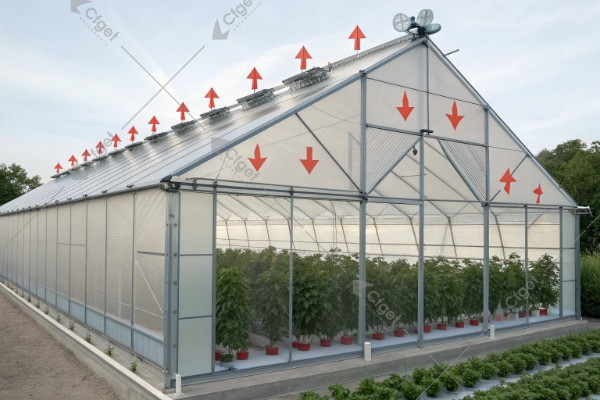
Structure and shading decide how stable the crop can be.
Ventilation must be uniform.
Dive deeper
I choose structure based on climate load and operational scale. For many Almería-style operations, multi-span film is common because it scales fast. On our site, I use these pages as reference anchors when I plan structure choices:
- Multi-span Film Greenhouse
- Wide-span Greenhouse
- Sawtooth Greenhouse: Beat Heat with Natural Ventilation
My rule is: reduce heat load before chasing cooling. That means shading strategy matters.
I stage shading based on canopy response, not on feelings. If I shade too much, Brix drops and clusters stay small. If I shade too little, fruit set drops and cracking rises. I often pair ventilation planning with shading options using Shade Net & Rain Shelter Systems as a practical reference for load reduction approaches.
I also build pest risk into structure planning. If I cannot block pests well, I spend more on chemical control and still lose quality. Physical exclusion support is the first layer. Pest Barriers is where I connect structure decisions to pest pressure.
Here is the decision table I use:
| Design decision | If I choose wrong | What I see | What I adjust |
|---|---|---|---|
| Vent capacity | weak exchange | heat pockets | vents + airflow fans |
| Shading level | too heavy or too light | low Brix or fruit drop | staged screens |
| Air circulation | dead zones | uneven fruit size | circulation layout |
| Pest exclusion | gaps and leaks | more pest pressure | barrier strategy |
When structure and shading are correct, the crop becomes “easy to manage.” That is how I protect marketable rate.
How do I run drip fertigation to increase Brix and reduce cracking?
Many growers try to “push” Brix with nutrients, but Brix is often a water-balance problem first.
I increase Brix and reduce cracking by stabilizing root-zone EC, keeping irrigation pulses frequent and controlled, and maintaining pH in a crop-safe range for nutrient uptake.
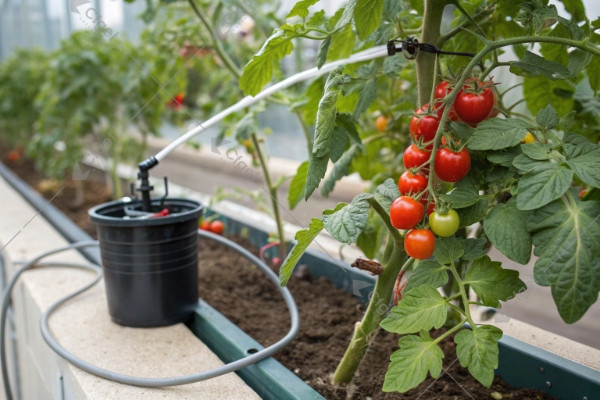
Precision fertigation supports flavor and firmness.
Stable pulses protect fruit.
Dive deeper
I treat fertigation as quality control. Cracking often comes from irrigation noise: long dry periods followed by heavy watering. In Almería, solar load can change fast, so my irrigation must respond smoothly.
I anchor pH strategy to credible greenhouse tomato guidance. Mississippi State University Extension provides practical targets for nutrient solution pH in greenhouse tomato systems. Mississippi State University Extension<4> I do not copy a number blindly, but I use it as a safe baseline and then adjust by my water source and substrate.
For irrigation efficiency and yield effects, I also reference research collections like FAO AGRIS<5> to validate that drip fertigation management is a proven yield lever, not a marketing story.
My grower routine looks like this:
Pulse irrigation rules I follow
- More frequent pulses during high radiation
- Stable drain percentage to prevent salt buildup
- Drain EC tracking to avoid creeping stress
EC and pH tracking rules I follow
- Measure feed EC, drain EC, and trend over time
- Keep pH stable to prevent lockouts
- Adjust gradually, not aggressively
A quick control table:
| Metric | If it drifts | What happens | My fix |
|---|---|---|---|
| Drain EC rises | salinity stress | cracking risk increases | increase pulses + drain % |
| Drain EC drops too low | weak flavor | Brix falls | raise feed carefully |
| pH too high | uptake issues | leaf symptoms | adjust acid injection |
| pH too low | root stress | weaker growth | correct dosing and retest |
To reduce human error, I prefer automation. That is why I connect climate + irrigation logic through Smart Auto & Control Solutions.
How do I stabilize VPD to improve fruit set and reduce disease risk?
If I only chase temperature, I often create humidity problems. VPD is the bridge between temperature and humidity that growers can actually use.
I stabilize VPD by controlling solar load, maintaining consistent airflow, and preventing dew point events, so transpiration stays steady and fruit set becomes predictable.
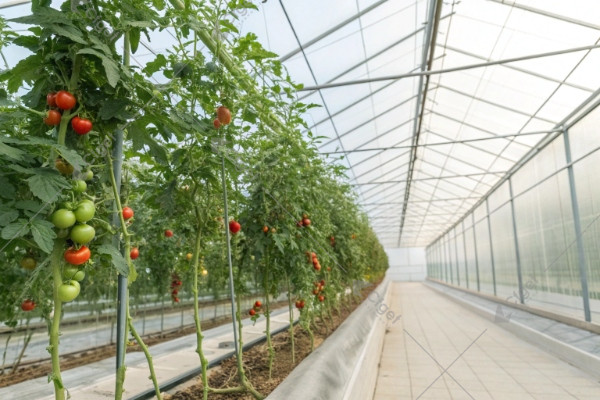
VPD stability supports fruit set and quality.
Stable VPD supports pollination.
Dive deeper
I do not want VPD to swing wildly, because tomato is sensitive during flowering and early fruit set. Michigan State University Extension explains how VPD influences plant water loss and stress. Michigan State University Extension<2> I treat that as a practical tool: VPD tells me whether my crop is too “wet and lazy” or too “dry and stressed.”
In Almería, the outside climate can shift quickly. To understand seasonal risk and extreme patterns, I use climate references like World Bank Climate Change Knowledge Portal<6>. This helps me plan when shading and ventilation should be aggressive, and when they can be relaxed.
My daily VPD routine:
Morning reset
- Vent early to dry the canopy
- Keep airflow stable across the crop
Midday protection
- Shade first to cut load
- Vent second to exchange air
- Avoid pushing evaporative cooling when humidity is already high
Night risk control
- Avoid heavy late irrigation
- Keep circulation steady to prevent condensation pockets
This routine reduces botrytis risk and improves pollination conditions. It also supports higher marketable rate because fruit development stays consistent.
Conclusion
In a commercial tomato greenhouse in Almería, Spain, I win with stability. I reduce solar load, stabilize VPD, and run precise drip fertigation. This increases yield and Brix while reducing cracking and quality loss.
External Links Footnotes (Authority Sources)
1> https://science.nasa.gov/earth/earth-observatory/almerias-sea-of-greenhouses-150070
<2> https://www.canr.msu.edu/news/why_should_greenhouse_growers_pay_attention_to_vapor_pressure_deficit_and_n
<3> https://edis.ifas.ufl.edu/publication/AE069
<4> https://www.extension.msstate.edu/agriculture/crops/commercial-horticulture/greenhouse-tomatoes/what-ph-should-i-use
<5> https://agris.fao.org/
<6> https://climateknowledgeportal.worldbank.org/
—
## Internal References (CFGET)
– **[CFGET Homepage](https://cfgreenway.com/)**
– **[Commercial Greenhouse Systems](https://cfgreenway.com/greenhouse/)**
– **[Multi-span Film Greenhouse](https://cfgreenway.com/multi-span/)**
– **[Wide-span Greenhouse](https://cfgreenway.com/wide-span/)**
– **[Sawtooth Greenhouse: Beat Heat with Natural Ventilation](https://cfgreenway.com/sawtooth/)**
– **[Shade Net & Rain Shelter Systems](https://cfgreenway.com/shade-net-rainshelter/)**
– **[Pest Barriers](https://cfgreenway.com/solutions/pest-barriers/)**
– **[Smart Auto & Control Solutions](https://cfgreenway.com/solutions/smart-auto-control/)**
– **[Contact](https://cfgreenway.com/contact/)**
—
## Internal Blog References (Related CFGET Articles)
– **Choosing the Best Greenhouse for Tomato Plants: Key Design and Climate Considerations**
Choosing the Best Greenhouse for Your Tomato Plants: Key Considerations?
– **How to Set Up a Commercial Greenhouse: An Essential Guide for Growers and Agribusinesses**
How to Set Up a Commercial Greenhouse: Essential Guide for Growers & Businesses?
– **Hydroponic Greenhouse Systems: Investment vs Yield, ROI Models, and Payback Periods**
Hydroponic Greenhouse System Investment vs Yield: Real ROI Models, Break-Even Yield & Payback Years?
– **How Much Does It Cost to Build a Smart Greenhouse? Hidden Costs You Should Know**
How Much Does It Cost to Build a Smart Greenhouse? What Are the Hidden Costs?
– **Why Sawtooth Greenhouses Beat the Heat with Zero-Energy Natural Ventilation**
https://cfgreenway.com/sawtooth-greenhouses-beat-the-heat-with-zero-cost-natural-ventilation/