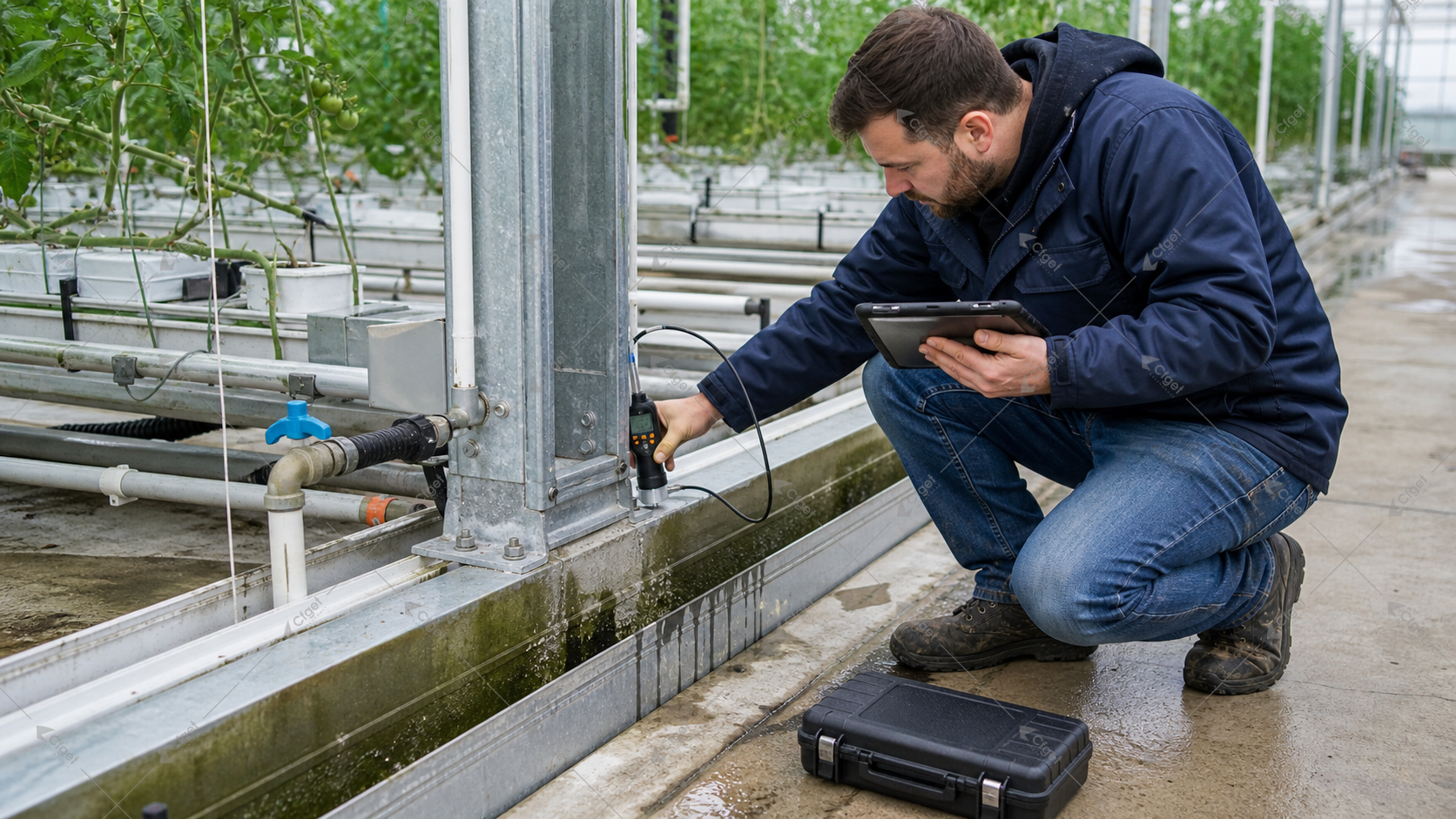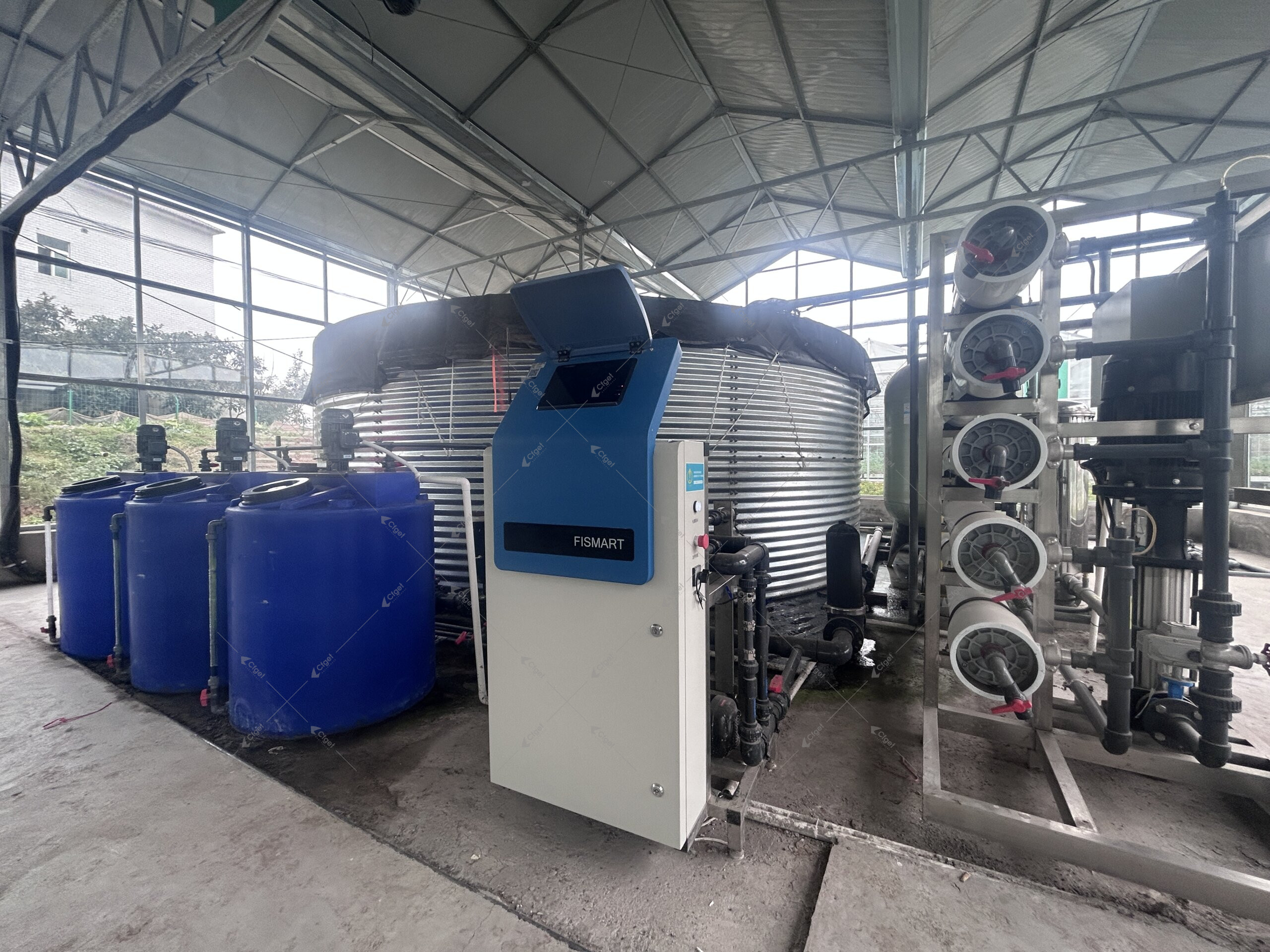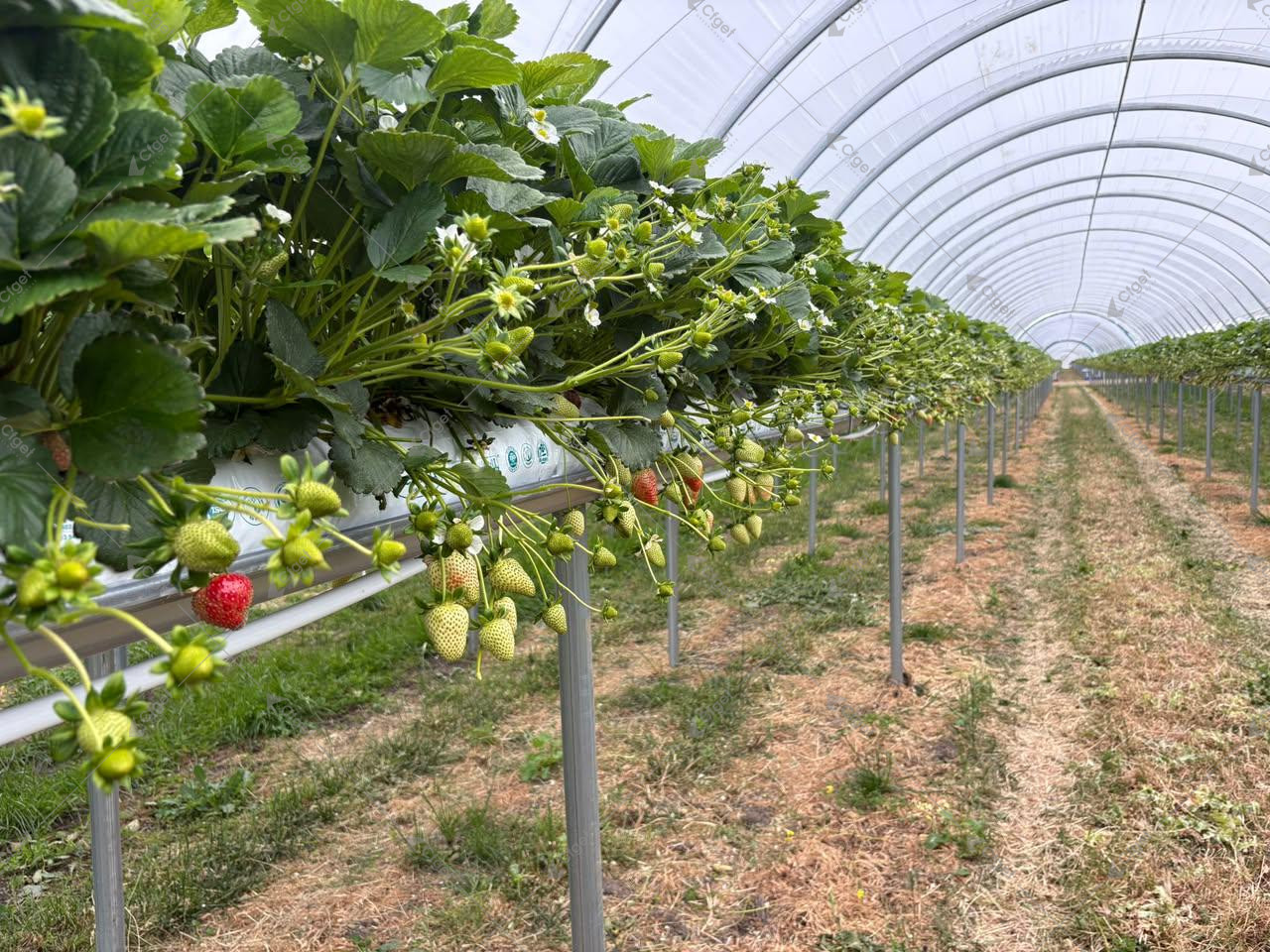
Export basil can look profitable until one interception, one warm shipment, or one paperwork gap wipes out the margin. If my greenhouse is built for yield only, I will still lose money.
A profitable Kenya basil export greenhouse is a compliance + cold-chain system: greenhouse climate discipline, clean harvest workflow, and export documentation that matches KEPHIS rules and buyer standards like GLOBALG.A.P. IFA. KEPHIS Phytosanitary Services<1> GLOBALG.A.P. IFA for fruit and vegetables<2>
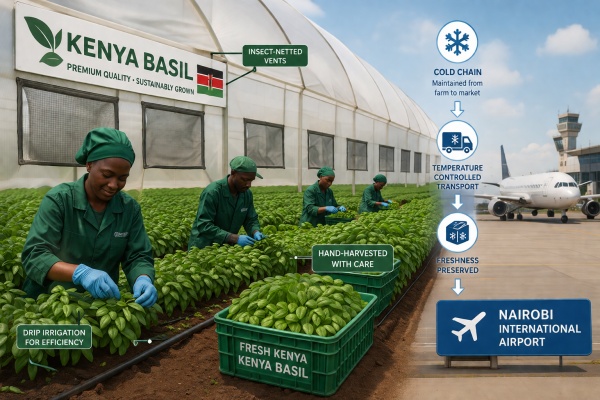
Export basil is a system, not a crop.
YouTube (CFGET Video Module)
This video is useful because basil export success depends on daily climate and workflow discipline, not only on “greenhouse type.”
What is the fastest path to an export-ready basil greenhouse in Kenya?
Many people try to export first, then fix quality. That order is expensive. Export success needs “built-in” compliance.
The fastest path is: design greenhouse airflow + hygiene zones first, then build a harvest-to-cold-chain routine, then align documents to KEPHIS phytosanitary steps and buyer standards. KEPHIS Phytosanitary Services<1>
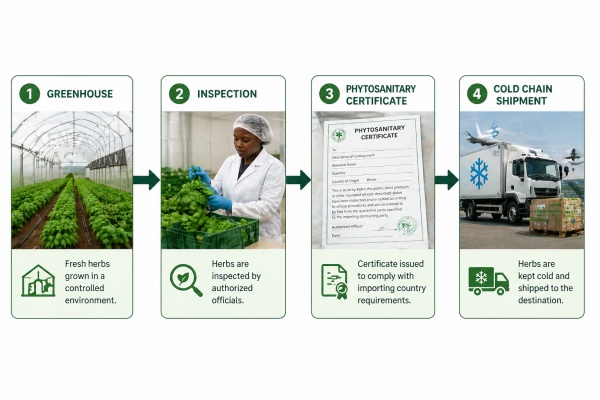
A simple export flow prevents costly surprises.
Export basil is a “paperwork + freshness” product. KEPHIS explains that phytosanitary certification involves inspections and activities leading to issuance of phytosanitary certificates by KEPHIS plant inspectors. It also describes active growth inspections and inspection at exit/entry points, checking standards like freedom from pests/disease, MRL compliance, and grading/packaging. KEPHIS Phytosanitary Services<1>
This matters because a basil greenhouse that ignores pest exclusion and hygiene will fail at exactly the points KEPHIS says are checked.
What I build first (before I chase yield)
1) Airflow that dries leaves fast
Wet basil is fragile basil. If the canopy stays wet, quality drops fast.
2) A harvest workflow that protects leaves
Basil bruises easily. A “rough harvest” becomes black leaves and downgrade.
3) A compliance routine that produces proof daily
Buyers do not trust words. They trust records.
| Export readiness item | What buyer/inspector cares about | What I set up |
|---|---|---|
| Pest freedom | visible pests and damage | insect netting + scouting logs |
| Chemical safety | residue compliance | spray records + preharvest control |
| Quality | leaf damage and moisture | harvest SOP + rapid cooling |
| Documents | interception risk | KEPHIS doc checklist discipline |
Which certifications and documents do EU herb buyers actually expect?
Growers often treat certification as “marketing.” In export herbs, it is “market access.”
EU herb buyers commonly expect farm-level assurance like GLOBALG.A.P. IFA for fruit and vegetables, because it covers traceability, food safety, water management, and integrated pest management at primary production. GLOBALG.A.P. IFA overview<2>
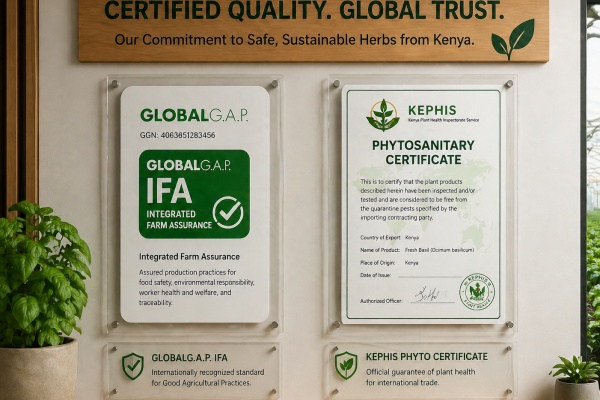
Certifications reduce buyer friction.
GLOBALG.A.P. describes IFA for fruit and vegetables as a global standard addressing key topics like food safety, environment, workers’ health and welfare, production processes, and traceability. It also notes IFA is recognized by GFSI (in IFA v6 GFS) and is relevant across production systems including controlled environment agriculture. GLOBALG.A.P. IFA for fruit and vegetables<2>
This is why I consider IFA a “buyer language” tool. It makes your farm easier to approve.
On the Kenya side, KEPHIS is the authority that certifies plant and plant products for export and describes inspections during the active growing period, and checks at export points including pests, diseases, MRL compliance, grading, and packaging. KEPHIS Phytosanitary Services<1>
So my plan is not “one certificate.” It is a system that produces compliant product and compliant documents.
A simple “export documents” mindset I follow
KEPHIS even ran a training highlighting “document related interceptions” and the need for exporter document checklists. KEPHIS exporter training on phytosanitary documentation<3>
So I do not rely on memory. I build a checklist.
| Document / proof | Who needs it | Why it matters |
|---|---|---|
| Field inspection proof | inspector / buyer | shows pest and disease control |
| Phytosanitary certificate | importing country | reduces border rejection risk |
| Traceability records | buyer | supports recall and trust |
| Harvest + cooling log | buyer | protects shelf life claims |
What greenhouse design and climate routine keeps basil fresh and export-grade?
Basil is not a tomato. Basil quality can fall in hours if moisture and temperature are wrong.
To keep basil export-grade, I design for gentle airflow, stable temperature, and fast drying after irrigation. I also prevent pest entry with netting and clean entry flow, because exported herbs are inspected aggressively. KEPHIS Phytosanitary Services<1>
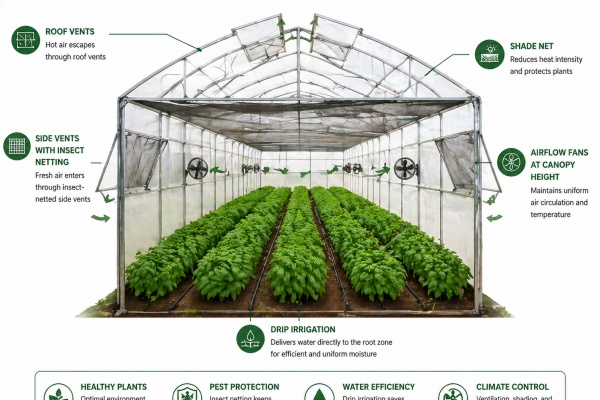
Basil quality is controlled by air and handling.
Here is the logic I use:
Step 1: Reduce stress before it happens
- Shade and ventilation prevent heat peaks that increase transpiration stress.
- Stress basil bruises and discolors faster.
Step 2: Keep leaves dry without “drying the plant”
- I avoid long wet hours on leaves.
- I use airflow at canopy height to dry moisture films.
Step 3: Irrigation timing is part of quality
- I avoid late heavy irrigation that creates wet nights.
- I keep pulses consistent and predictable.
Step 4: Netting must be designed, not added
Netting increases resistance. If vent area is too small, humidity rises and quality drops.
| Climate problem | What I see | My first fix | My second fix |
|---|---|---|---|
| Heat spikes | wilting, fast yellowing | shade early | increase air exchange |
| Wet canopy | dark spots, decay risk | airflow at canopy | irrigation timing shift |
| Pest pressure | leaf damage, interceptions | netting + entry control | monitoring and records |
For CFGET structure/system references that match basil export needs:
- https://cfgreenway.com/multi-span/
- https://cfgreenway.com/sawtooth/
- https://cfgreenway.com/solutions/pest-barriers/
- https://cfgreenway.com/solutions/temperature/
How do I build a cold-chain and packing routine that prevents black leaves and rejects?
Many “export herb” pages talk about greenhouse only. That is incomplete. Basil loses value after harvest if cooling is slow or handling is rough.
I protect basil by harvesting gently, removing field heat fast, and packing to prevent crushing and excessive moisture. If the cold chain is weak, export grade becomes local grade.
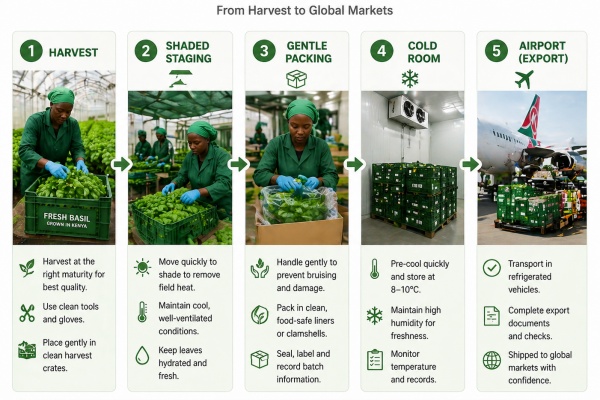
Postharvest discipline protects export profit.
I run a simple routine that workers can follow:
1) Harvest discipline
- Clean gloves and clean tools.
- No over-stuffing crates.
- Shade immediately.
2) Sorting is profit
I remove bruised and damaged leaves early. That reduces decay spread.
3) Cold chain is a daily KPI
I track time to cooling. I track reject rate.
4) Proof, not promises
I log harvest time, packing time, and temperature control steps. Buyers trust logs.
KEPHIS explicitly checks packaging and quality at exit points, including “freedom from pests,” “properly graded,” “no excessive moisture,” and “packaging clearly labelled, clean and well ventilated.” KEPHIS Phytosanitary Services<1>
So my packing SOP is designed to pass those checks, not to look pretty.
| Packing failure | What it causes | What I change |
|---|---|---|
| Too wet | decay and rejections | drying airflow + packing timing |
| Too tight packing | bruising and black spots | crate fill rules |
| Weak labeling | compliance delays | label SOP tied to batch ID |
| No logs | buyer distrust | daily checklist and sign-off |
Conclusion
A Kenya basil export greenhouse wins when I build a compliance and cold-chain system: airflow that protects leaf quality, pest exclusion that reduces inspections risk, and documentation aligned with KEPHIS and GLOBALG.A.P. IFA.
External Links (Footnotes)
1> https://www.kephis.go.ke/phytosanitary-services
<2> https://www.globalgap.org/what-we-offer/solutions/ifa-fruit-and-vegetables/
<3> https://www.kephis.go.ke/index.php/kephis-trains-exporters-documentation-process-phytosanitary-certificate
—
## Internal References (CFGET)
– **CFGET Homepage**
– **Commercial Greenhouse Systems**
– **Multi-span Film Greenhouse**
– **Sawtooth Greenhouse**
– **Temperature Solutions**
– **Pest Barriers**
– **Smart Auto & Control Solutions**
– **Contact**
—
## Internal Blog References (Related CFGET Articles)
– **How to Set Up a Commercial Greenhouse: An Essential Guide for Growers and Agribusinesses**
How to Set Up a Commercial Greenhouse: Essential Guide for Growers & Businesses?
– **How to Build an Efficient Greenhouse in Hot Regions: Cooling, Materials & Energy-Saving Secrets**
How to Build an Efficient Greenhouse in Hot Regions: Cooling, Materials & Energy-Saving Secrets?
– **Greenhouse Climate Control Systems for Extreme Heat: Why Your Greenhouse Still Overheats and What to Do**
– **Greenhouse Irrigation Systems: The Ultimate Guide to Boosting Yields & Saving Water**
Greenhouse Irrigation Systems: The Ultimate Guide to Boosting Yields & Saving Water
– **How Much Does It Cost to Build a Smart Greenhouse? Hidden Costs You Should Know**
https://cfgreenway.com/how-much-does-it-cost-to-build-a-smart-greenhouse-what-are-the-hidden-costs/