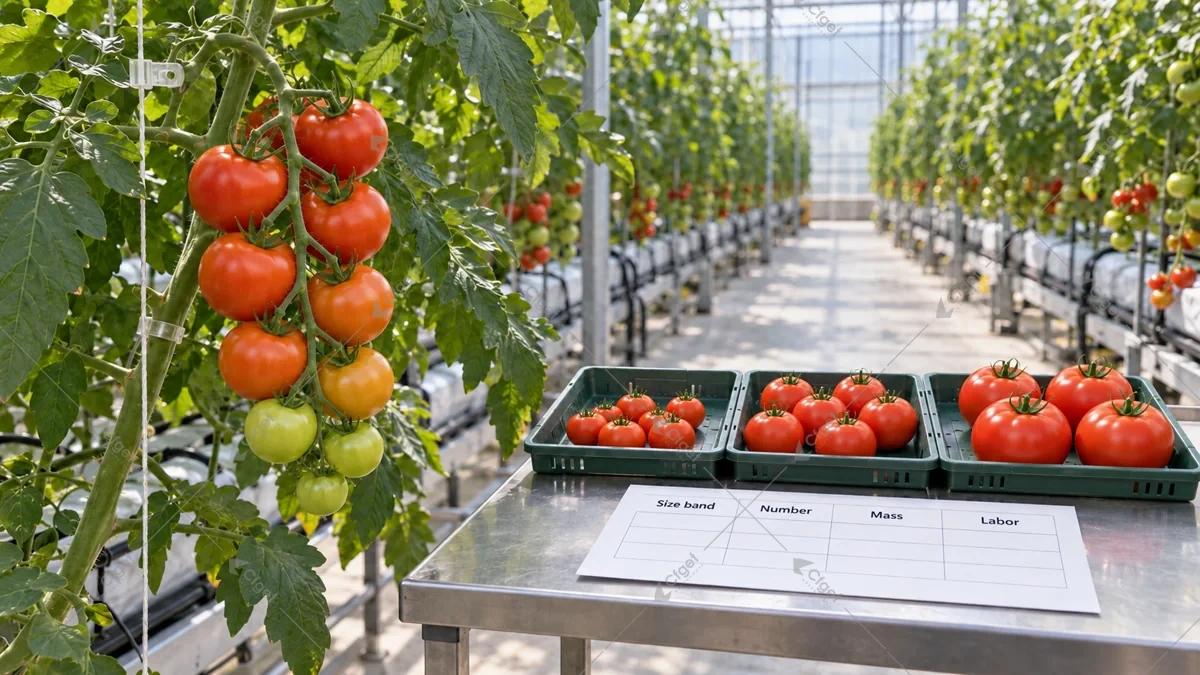
Do not routinely assign ripening tomatoes to shared air with cucumbers or lettuce. Ripening tomatoes produce ethylene, and the UC Davis guidance advises against storing or shipping them with those sensitive commodities. Fitting in the same cold room or vehicle does not establish compatibility. The actual lots still need a separate temperature and handling review.
Before allocating a mixed load, identify the products and their maturity, then check each pair. A shared temperature range does not cancel an ethylene conflict. An unresolved pairing needs separation, a revised dispatch sequence or a documented product-specific decision from the postharvest specialist.
Give each lot its own requirements
“Tomato” is not a complete storage specification. The UC Davis tomato factsheet distinguishes maturity stages and advises against co-storage or shipment of ripening tomatoes with ethylene-sensitive commodities such as lettuce and cucumber.
The UC Davis cucumber factsheet identifies both chilling sensitivity and sensitivity to ethylene. Its discussion also notes that chilling injury is cumulative and may begin before harvest. A fresh entry on the warehouse log therefore does not establish a fresh exposure history.
Use the reference for the actual lettuce type too. UC Davis’s romaine and loose-leaf lettuce guidance, updated in 2025, describes ethylene sensitivity and variation among cultivars. Do not substitute a generic “leafy greens” label for the product-specific review.
For each lot, retain the current buyer or specialist requirement and its source. If references conflict, ask the responsible postharvest adviser to resolve the difference for the maturity, package, route and duration involved. Do not average two temperatures and call the result suitable.
| Field | Lot information | Source, date or open question |
|---|---|---|
| Lot ID, crop/product type and relevant cultivar | ________ | ________ |
| Maturity, initial condition and intact/cut/processed state | ________ | ________ |
| Package, liner and documented airflow limitations | ________ | ________ |
| Temperature and humidity requirements for this product/stage | ________ | ________ |
| Chilling sensitivity and known prior temperature history | ________ | ________ |
| Ethylene production and sensitivity, recorded separately | ________ | ________ |
| Buyer/specialist restrictions and review owner | ________ | ________ |
| Separate food-safety hold/release reference | ________ | ________ |
Test the pairs, not just the room setting
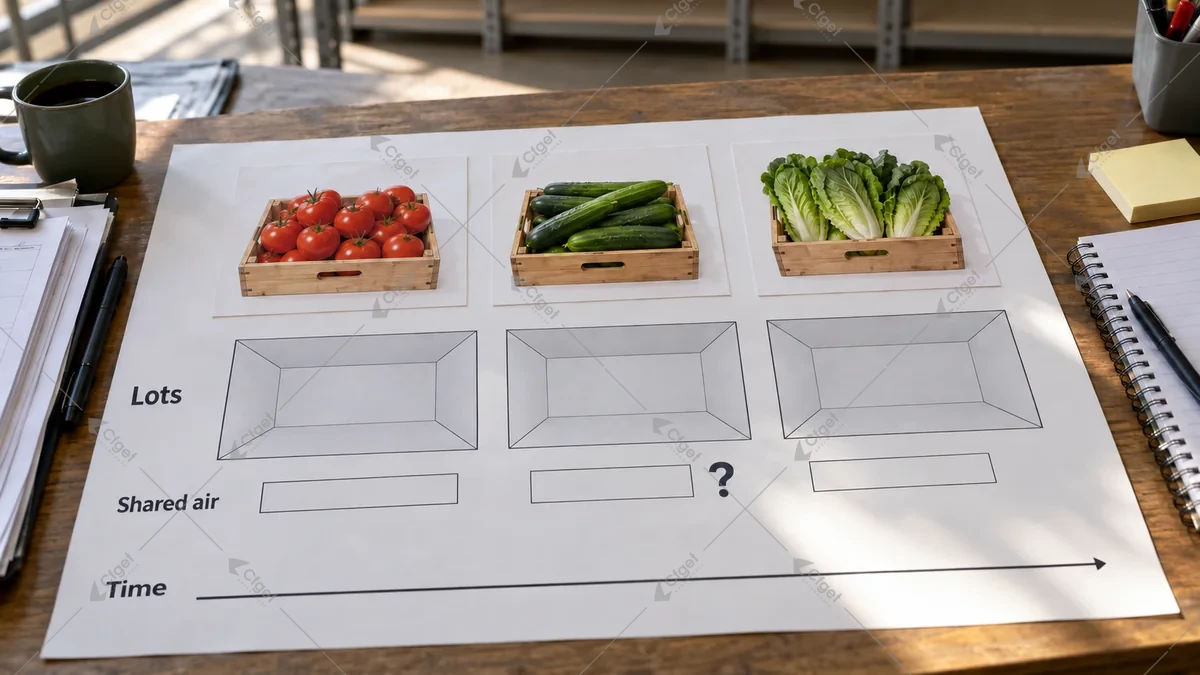
Consider a hypothetical dispatch with one tomato lot, one cucumber lot and one romaine lot. Leave their actual maturity, quantity, package and route fields blank until supplied. Check tomato–cucumber, tomato–romaine and cucumber–romaine separately. Finding one acceptable pair cannot approve all three together.
The tomato references already identify an ethylene concern for the first two pairings. A planner should carry that concern into the allocation decision instead of hiding it inside a temperature-overlap column. The remaining pairing still needs its own temperature, package and handling assessment.
| Pair and proposed air space | Temperature compatibility evidence | Ethylene compatibility evidence | Allocation, conditions and owner |
|---|---|---|---|
| Illustration only: ripening tomato lot + cucumber lot; proposed shared air | Unresolved for the actual lots | Conflict identified in the cited UC Davis guidance | Do not approve shared air on this evidence; use verified separation or obtain a product-specific plan. Owner: ________ |
| Lot IDs: ________ Space: ________ | Supported / conflict / unknown: ________ | Supported / conflict / unknown: ________ | ________ |
| Lot IDs: ________ Space: ________ | Supported / conflict / unknown: ________ | Supported / conflict / unknown: ________ | ________ |
| Lot IDs: ________ Space: ________ | Supported / conflict / unknown: ________ | Supported / conflict / unknown: ________ | ________ |
Record package/airflow limitations alongside the decision. The FAO produce-handling manual explains how mixed loads can combine biological incompatibilities with mismatched packages and ventilation openings. Its historical grouping examples do not approve a particular modern shipment.
A closed carton is not evidence of gas isolation. Neither is a curtain between stacks. If a proposal relies on separate air spaces, obtain evidence for the actual compartment arrangement and how it operates during loading, storage and transit. Do not infer isolation from a floor-plan line.
Carry the timeline through every move
Map staging, storage, loading and transport. For each stage, identify the room, vehicle or compartment and the lots that actually share its air. Keep planned and actual times distinguishable. A loading delay may change the shared dwell even when the dispatch destination stays the same.
| Timeline field | Planned record | Actual record and review |
|---|---|---|
| Lot IDs, stage and room/vehicle/compartment | ________ | ________ |
| Arrival and departure, including date and time zone | ________ | ________ |
| Shared dwell during this stage | ________ | ________ |
| Earlier shared dwell and known temperature/chilling history | ________ | ________ |
| Cumulative shared dwell through this stage | ________ | ________ |
| Conditions/monitoring evidence and missing records | ________ | ________ |
| Allocation decision, supporting plan, owner and review time | ________ | ________ |
Add successive shared periods without counting overlapping intervals twice. Keep distinct temperature histories visible rather than collapsing them into a single supposedly safe total. A move to a new room does not erase earlier exposure. The worksheet does not calculate a universal permissible mixing duration.
Choose a workable allocation
For an unresolved or conflicting pairing, the practical options are separate verified air spaces, a different loading or dispatch sequence, or a product-specific plan reviewed by the responsible specialist. Record which option is chosen and what conditions must remain true. “Only a short trip” is not supporting evidence.
A sequence change needs another timeline check. It helps only if it changes the relevant shared exposure and still meets each lot’s other handling requirements. Do not solve a room conflict by leaving another sensitive lot in an undocumented staging condition.
This is a quality-allocation review. It does not validate food safety, authorize release of held produce or predict shelf life. Fresh-cut and minimally processed products require their own applicable controls; they should not inherit a whole-produce shortcut. Keep those release decisions separate even when the same team maintains both records.
Source date note: the UC Davis tomato and cucumber factsheets identify original fact content from May 1997; the romaine and loose-leaf lettuce content was updated in 2025. These are references to interpret for the actual products, not a new delivery trial or a shelf-life guarantee.
The final allocation should name the lots, actual air spaces, timeline and decision owner. That is the evidence dispatch staff need when the available space, arrival time or product maturity changes.
Download the working files
Use these CSV files with the instructions in this article.