Before placing the next strawberry replacement-plant order, ask whether the current fruiting cohort should be removed or considered for another crop. Neither surviving plants nor an annual ordering routine settles that choice.
The question is whether those particular plants, with an appropriate renewal and crop-health plan, can supply the fruit the next buyer program needs. Retaining them keeps an established crop in the plan; replacing them begins a different establishment route.
Two cultivars moved in opposite directions
A 2014 Brazilian study in soil beds under low tunnels, published in 2019 by Zeist and colleagues, compared first- and second-cycle strawberries at UNICENTRO in Guarapuava, Paraná. It evaluated six cultivars with four randomized-block replications and twelve useful plants per plot. This was not a climate-controlled greenhouse trial.
Two entries from Table 3 show why a single “keep or replace” rule is unhelpful:
| Cultivar | New plants, first cycle | Retained plants, second cycle |
|---|---|---|
| Aromas | 160.0 | 343.7 |
| Albion | 784.3 | 105.0 |
The retained Aromas cohort produced more marketable fruit mass in that comparison; the retained Albion cohort produced less. Marketable meant fruit over 10 g without the specified defects. These are experimental grams per plant, not annual yields or the reader’s buyer-accepted output.
The cohorts had different histories and establishment or renewal programs. The result therefore does not isolate plant age as the cause, recommend one cultivar over another, or predict controlled-greenhouse performance. Its value is showing that the decision needs evidence for the actual cohort and production system.
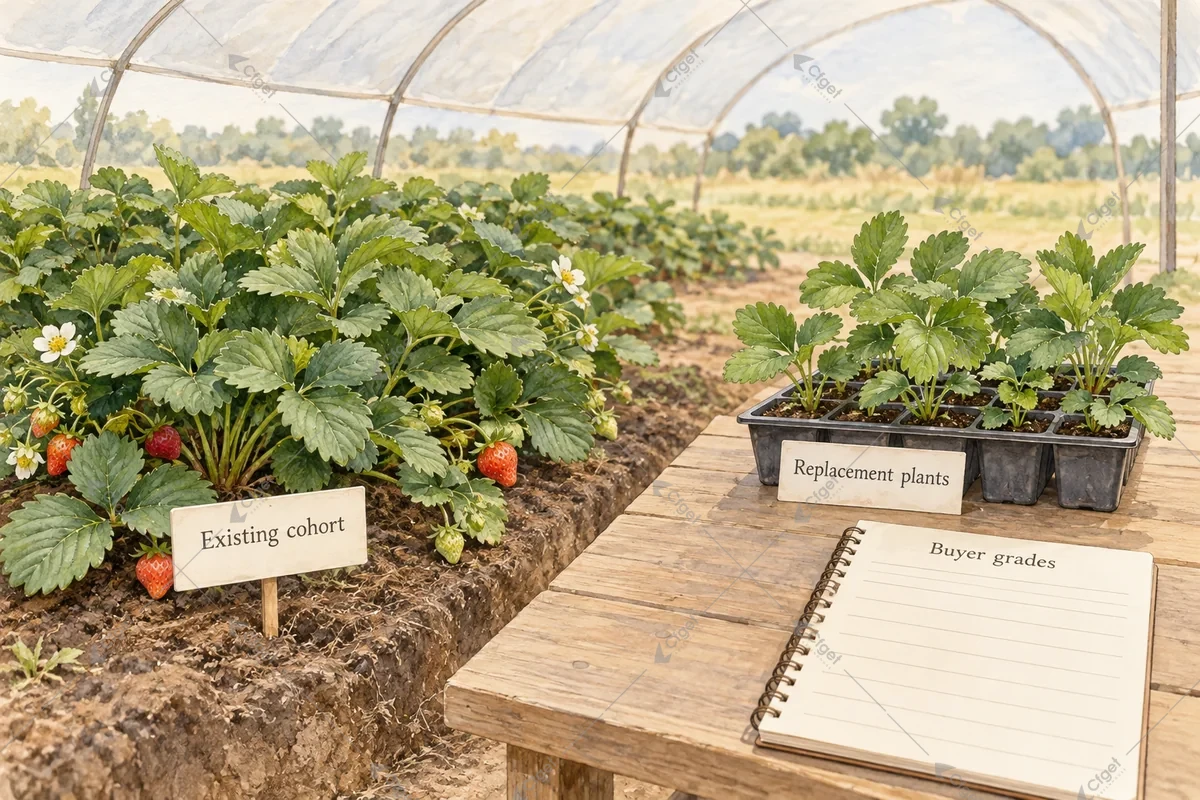
Start with the existing plants and the next product
Identify the group being considered for retention: cultivar, location, establishment history and completed fruiting cycle. Review its condition with the grower and relevant plant-health adviser. Existing health concerns and required crop-reset conditions come before any plan to extract another harvest.
Then describe the next buyer’s product. Which sizes, appearance and quality are accepted, and in what selling window? A total harvested mass cannot answer whether the retained crop would deliver the required grade mix.
Use the current crop’s records where they are relevant, keeping accepted fruit distinct from all fruit picked. Those records help define the question, but they do not make the next cycle a repeat of the first. Where local second-crop evidence is weak, say what is still unknown before committing the whole area.
Account for the work between crops
Keeping plants does not mean leaving the crop untouched until it bears again. Ask the grower to specify the proposed renewal work, support and ongoing crop management for this cohort. Establish whether the site can carry out that program within its required health and operating conditions.
Compare it with the real replacement route: suitable new plants, their availability, establishment and the work needed to prepare the growing area. Avoid declaring retention cheaper solely because it removes a plant order. The Brazilian study did not measure the reader’s work requirements, crop receipts or profit.
Do not copy the paper’s renewal pruning or input program as a local recipe. The operating proposal needs its own crop-specific assessment, including what would make the retained plants unsuitable for further production.
Keep the replacement route available while deciding
Confirm the actual deadline for obtaining suitable replacement plants and work backward from the next crop window. If the retention decision is postponed beyond that point, the business may lose a practical alternative before the evidence is clear.
Where a retained second crop is plausible but unproven, consider a bounded retained area alongside the replacement plan rather than making an all-area assumption. Agree which accepted-fruit observations and operating findings would justify a larger commitment.
Once the crop-renewal choice is supported, connect it to the wider strawberry greenhouse planning discussion where facility questions arise. The immediate outcome should be a clear decision to retain, replace or obtain defined local evidence, with the buyer’s fruit requirement and the replacement deadline still visible.