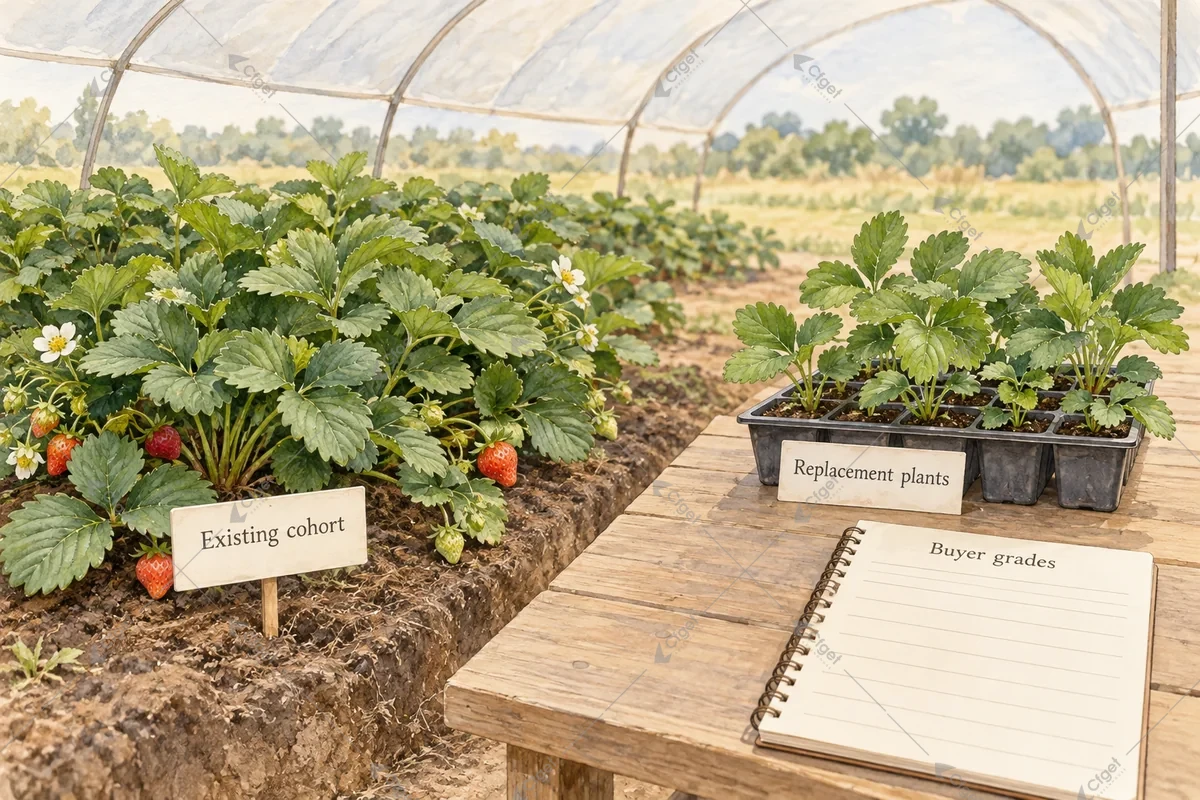
Waiting until the finishing tomato crop is removed before establishing its replacement leaves a period when the new plants are growing but not yet supplying fruit. Interplanting takes a different approach: the next cohort begins beside plants that are still being harvested.
For a grower who values an earlier next harvest, the choice is whether that overlap is worth testing in the existing production area. It adds an operating period with two crop generations, rather than simply moving a date on the planting calendar.
What one Japanese experiment observed
Kinoshita and colleagues’ 2019 NARO paper included a 2014–2015 experiment in Morioka, Iwate, Japan. This comparison uses that first experiment only: Super Yubi tomatoes in one 120 m² greenhouse, with four randomized blocks and 12 plants per treatment replicate. Fruit yield was recorded from six plants per plot.
The greenhouse was heated at night without supplemental lighting or carbon-dioxide enrichment. The earliest interplanting treatment established the second cohort while the first crop remained; the sequential treatment established it after the first crop was removed.
| Observed result | Overlap | Remove, then replant |
|---|---|---|
| Second-crop harvest began in 2014 | August 9 | September 22 |
| Marketable fruit over the full study window, kg per cultivation m² | 28.9 | 25.6 |
The first crop finished on July 31, so even the earlier second harvest was not gap-free. Both second crops ended on March 11, 2015. Marketable fruit meant more than 80 g without physiological damage under the study definition.
Earlier establishment and coexistence were tested together. The higher study-window output cannot be assigned to overlap alone or treated as an annual yield forecast for another greenhouse.
Keep the empty-bay requirement visible
Before considering the timing benefit, establish whether the site needs complete crop removal and an empty production area for its required reset. If so, an overlap proposal that cannot accommodate that requirement is not suitable.
The experiment does not prove that keeping an old crop beside new plants is safe for every plant-health situation or that a required sanitation step can be skipped. Keep the site’s crop-changeover requirements with the decision, rather than treating them as a detail to resolve after seedlings arrive.
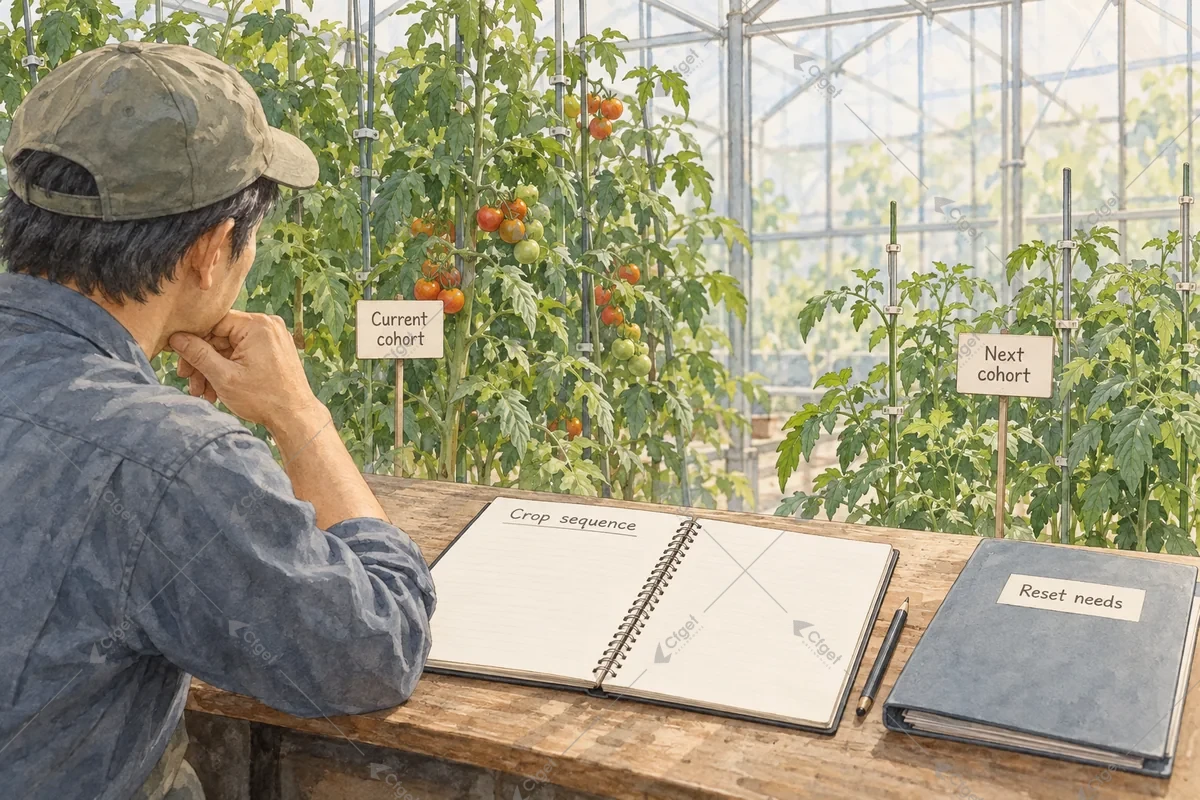
Examine the work created by coexistence
The next crop needs care while harvest and finishing work continue on the older plants. Ask the grower to describe how the two cohorts would be identified, reached and managed, and how removal of the old crop would affect the young one. Establish whether the proposed arrangement is workable with the actual crop and access conditions.
The study also gives a reason to inspect the later crop-work commitment. Reported second-crop stem-lowering frequency was 7.5 in A1 and 5.0 in A4. These are average operation frequencies, not recorded labor hours, worker shifts or payroll costs.
Use that difference to ask what additional recurring work a local overlap program might involve. Do not turn it into a staffing or profit calculation without actual task-time and operating evidence. More frequent operations can matter even when the harvest result looks promising.
Value the earlier window in the actual market
An earlier return to picking has value only if it supports the intended product and selling period. Identify which part of the next harvest the business wants to bring forward and what buyer-accepted output is needed there.
Keep that question separate from a promise of uninterrupted weekly supply. The Japanese observations describe their own crop window and grade definition. They do not establish the shape or reliability of another farm’s harvest.
If an earlier window matters and the physical overlap is feasible, consider a bounded local comparison of the complete crop sequence. Follow accepted fruit, harvest timing and the work that changes together. Use the grower’s site-specific plan rather than copying the study’s planting dates, density or temperature settings.
Retain remove-then-replant where the reset requirement or operating burden rules overlap out. Where the evidence supports further investigation, define the limited commitment before establishing the next cohort. The useful decision balances an earlier next harvest against what it takes to keep two generations in the same production area.