Skip to content
Most commercial aquaponics failures do not start with plants. They start with filtration that is too small, too hard to clean, or sized by guessing. Then ammonia rises, oxygen drops, and fish losses follow.
I size aquaponics greenhouse filtration from one number: daily feed rate. Feed drives waste. Waste drives ammonia. Ammonia drives biofilter demand. When I size solids removal + biofilter for peak feed, the system stays stable and scalable. FAO: Small-scale aquaponic food production (includes tools for ammonia and biofilter media sizing)<1>
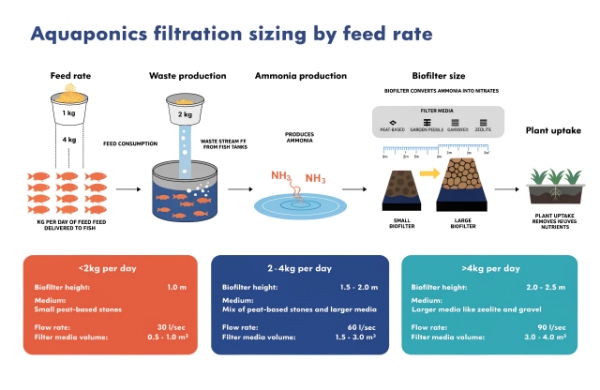
One flow diagram shows why sizing starts with feed.
I am writing this as an operator who wants predictable harvests and fewer emergencies. I will not sell you theory. I will show the sizing logic and the practical checks that keep water clear, fish calm, and plants growing fast.
How do I calculate daily feed rate so filtration sizing is not guesswork?
Many online pages skip this step and jump straight to “buy a bigger biofilter.” That is how people waste money and still crash the system.
My daily feed rate is my design anchor because it predicts total waste load. I size filtration for peak feed, not average feed. The FAO aquaponics manual gives practical system ratios based on feed rate and also provides calculation tools for ammonia and biofilter media needs. FAO aquaponics manual (open access)<2>
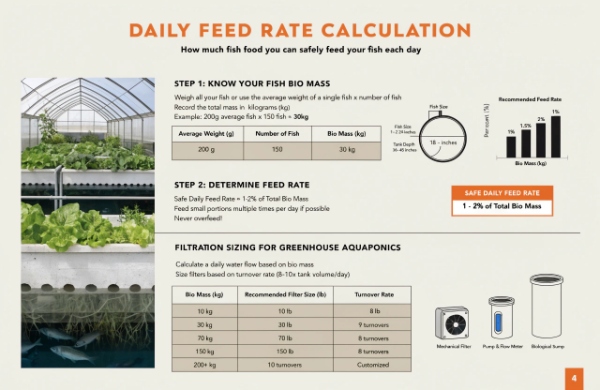
A worksheet turns biology into numbers.
Here is the simple method I use:
| Input | What I write down | Why it matters |
|---|---|---|
| Fish biomass (kg) | total live fish weight | determines feed demand |
| Feeding rate (%) | typical 1–2% depending on fish size and temperature | changes with season and growth |
| Daily feed (g/day) | biomass × feeding rate × 1000 | drives waste and ammonia |
| Peak feed (g/day) | the highest expected daily feed in the hottest / fastest growth month | this is what breaks systems |
| Safety factor | +20–40% | bacteria are not perfect every day |
A practical FAO design table also links fish tank size, feed rate, pump flow rate, and minimum biofilter media volume. It even notes that mechanical separator and biofilter volumes are often 10–30% of fish tank volume in small-scale designs. FAO design table reproduced with permission (FarmHub resource)<3>
When I plan commercial units, I still use the same logic. I just scale it and add redundancy.
How do I size solids removal so the biofilter does not choke and water stays clear?
A common mistake is to overspend on biofilter media but ignore solids removal. Then the biofilter gets coated, oxygen transfer drops, and nitrification slows.
I treat solids removal as “biofilter protection.” If I remove solids early, I keep biofilter performance stable and reduce labor. The FAO guidance highlights the role of mechanical filtration in NFT and DWC systems and why it matters at higher stocking densities. FAO aquaponics manual (mechanical separation guidance)<2>
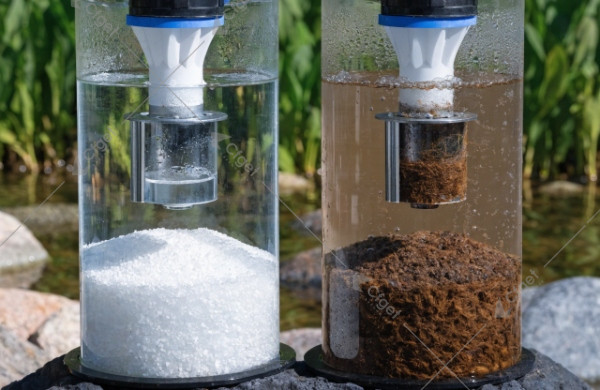
Solids control is water stability control.
I size solids removal by asking three operator questions:
1) Can I remove solids fast without stopping the system?
2) How many minutes per day will cleaning take at peak feed?
3) What happens if I skip cleaning for one day?
A practical solids plan usually includes:
- a primary separator (settling / swirl / radial flow style)
- a fine mechanical step (screen, cartridge, or drum-type approach in higher budgets)
- a sludge handling plan (where does it go, and how often)
Here is my “operator-first” table:
| Solids handling part | What it prevents | My commercial rule |
|---|---|---|
| Primary separator | heavy solids buildup | easy to open, easy to drain |
| Fine filtration | cloudy water, root fouling | cleanable without stress |
| Sludge routine | smell, pathogens, anaerobic zones | scheduled removal, not “when it’s bad” |
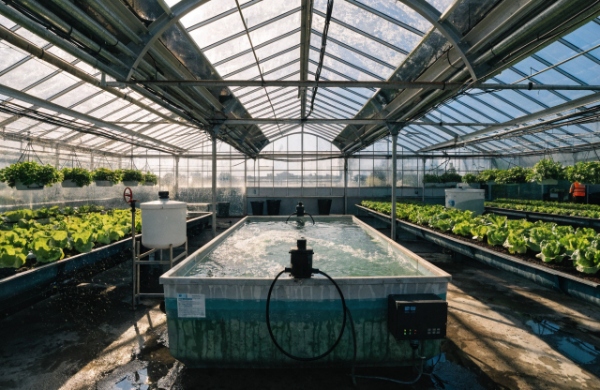
If you want fewer labor hours per week, layout matters as much as equipment. That is why I also plan greenhouse walkways, service access, and a dry maintenance corner when choosing structure:
- Wide-span Greenhouse (clean service space and mechanized workflow)
- Multi-span Film Greenhouse (cost-effective scale with upgrade options)
How do I size the biofilter so ammonia and nitrite never become a “surprise”?
Many pages talk about nitrification but do not explain sizing with real-world limits: temperature swings, pH compromise, and oxygen demand.
I size the biofilter “close to recirculating aquaculture recommendations” because plant roots and grow beds are not guaranteed treatment capacity. Then I run at conservative loads until the bacteria mature. A Southern Regional Aquaculture Center (SRAC) publication explains that aquaponic biofilters should be sized fairly close to recirculating system recommendations because plant contributions vary and are not fully studied. SRAC 454: Recirculating Aquaculture Tank Production Systems—Aquaponics (PDF)<4>
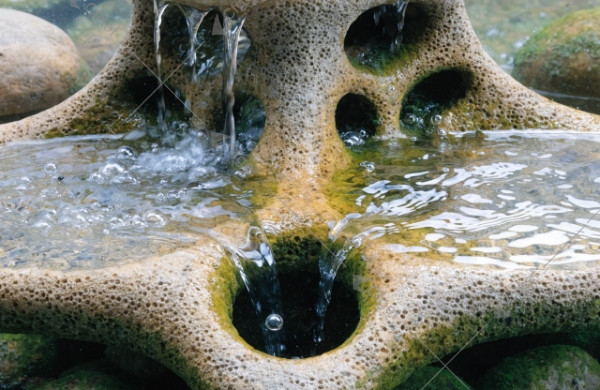
Biofilter performance depends on oxygen and surface area.
This is the practical logic I follow:
- Feed increases → ammonia production increases.
- Nitrification consumes oxygen and alkalinity.
- If oxygen is low, nitrification slows and ammonia rises.
EPA explains clearly that warm water holds less dissolved oxygen, and oxygen is consumed as ammonia is oxidized during nitrification. That is exactly why hot-climate aquaponics needs stronger aeration and filtration buffers. US EPA: Dissolved oxygen and nitrification links<5>
I also plan around pH compromise. Nitrifying bacteria prefer higher pH, while many hydroponic crops prefer lower pH ranges. SRAC 454 explains this conflict and why pH affects nitrification efficiency and nutrient availability. SRAC 454 (pH ranges and nitrification efficiency)<4>
A practical “biofilter sizing buffer” plan I trust
| Scenario | What changes | What I do in design |
|---|---|---|
| Winter water colder | bacteria slower | add media buffer / reduce feed |
| Summer heat | DO lower, fish stress higher | stronger aeration + shade + cooling |
| pH compromise | nitrification efficiency drops | avoid aggressive feeding increases |
| New system | bacteria immature | ramp feed slowly for 4–6 weeks |
When buyers ask, “Can you size this for faster growth?” I say yes, but only if they also buy the stability: air, alarms, and climate control.
What pump flow and turnover rate keeps filtration working in a greenhouse reality?
Many systems fail because flow is too low, dead zones form, and solids settle where they should not. Or flow is too high and causes stress and inefficient filtering.
I design flow so the system turns over reliably and filters see consistent loading. I avoid dead zones in tanks and in grow lines. The FAO design table gives pump flow rate examples tied to fish tank volume and feed rate for practical designs. FAO table with pump flow examples (FarmHub)<3>
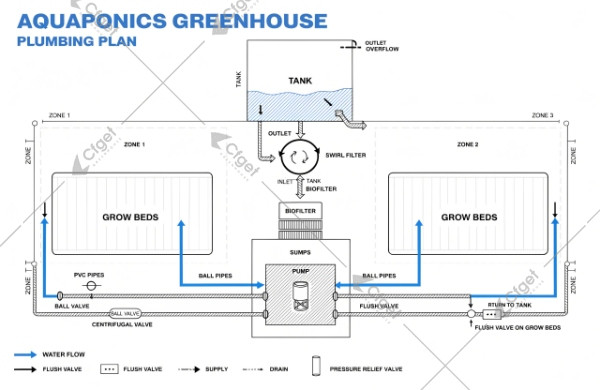
A clean plumbing plan makes maintenance faster.
Here is the flow checklist I use:
- Is the fish tank self-cleaning or does waste accumulate in corners?
- Can I isolate any component with valves without stopping the whole farm?
- Is the sump sized so pump intake never starves?
- Is the return flow designed to improve mixing and oxygen transfer?
This is also where greenhouse structure and ventilation matter. If greenhouse heat spikes, fish metabolism and oxygen demand change. In hot climates, I plan staged heat control (shade → venting → cooling) so water temperature and DO stay stable.
CFGET Video
Conclusion
I size aquaponics greenhouse filtration from daily feed rate, then I protect the biofilter with solids removal, strong aeration, and stable flow. If I fund stability first, scaling becomes safe and predictable.
External Links (Footnotes)
1> https://www.fao.org/family-farming/detail/en/c/1743023/
<2> https://www.fao.org/3/a-i4021e.pdf
<3> https://learn.farmhub.ag/resources/small-scale-aquaponic-food-production/8-management-and-troubleshooting/component-calculations-and-ratios/
<4> https://shellfish.ifas.ufl.edu/wp-content/uploads/Handout-4_SRAC-454_Recirculating-AquacultureTank-Production-Systems-Aquaponics_Recirculating-Aquaculture-System.pdf
<5> https://www.epa.gov/caddis/dissolved-oxygen
## Internal Blog References (Related CFGET Articles)
– **How to Set Up a Commercial Greenhouse: An Essential Guide for Growers and Agribusinesses**
How to Set Up a Commercial Greenhouse: Essential Guide for Growers & Businesses?
– **Hydroponic Greenhouse Systems: Investment vs Yield, ROI Models, and Payback Periods**
Hydroponic Greenhouse System Investment vs Yield: Real ROI Models, Break-Even Yield & Payback Years?
– **How Much Does It Cost to Build a Smart Greenhouse? Hidden Costs You Should Know**
How Much Does It Cost to Build a Smart Greenhouse? What Are the Hidden Costs?
– **Why Sawtooth Greenhouses Beat the Heat with Zero-Energy Natural Ventilation**
Sawtooth Greenhouses: Beat the Heat with Zero-Cost Natural Ventilation?
## Internal References (CFGET Pages)
– **CFGET Homepage**
– **Multi-span Film Greenhouse**
– **Wide-span Greenhouse**
– **Temperature Solutions (Cooling / Shading / Ventilation)**
– **Smart Auto & Control Solutions**
https://cfgreenway.com/solutions/smart-auto-control/