Skip to content
Many cucumber greenhouses in China look productive at first. Then heat stress, disease pressure, and uneven growth start to appear. Yields become unstable, and operating cost rises faster than expected.
For commercial cucumber production in China, the best greenhouse type is usually a well-designed multi-span film greenhouse or a Venlo-style glass greenhouse, depending on climate zone, production intensity, and how much uniformity the market demands.
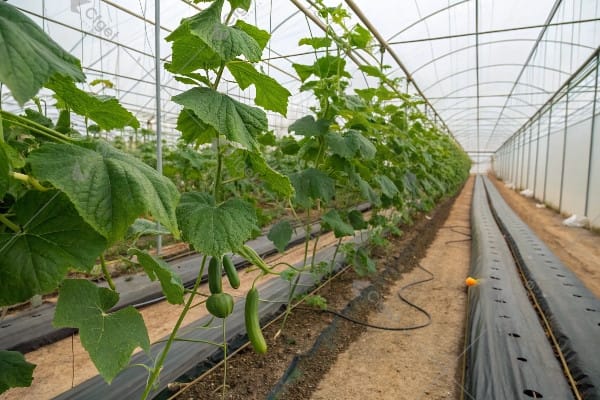
Commercial cucumber production requires uniform and stable conditions.
I write this from a practical evaluation angle. China is one of the world’s largest cucumber producers, serving both domestic fresh markets and processing chains. Regions such as Shandong, Hebei, and parts of Northwest China have intensive protected cucumber production. This scale makes greenhouse choice a business decision, not a technical hobby.
Why do cucumbers need a different greenhouse strategy than tomatoes or leafy greens?
Cucumbers grow fast, transpire heavily, and react quickly to climate stress.
Cucumbers demand strong ventilation, humidity control, and uniform airflow, which makes greenhouse type selection especially sensitive.
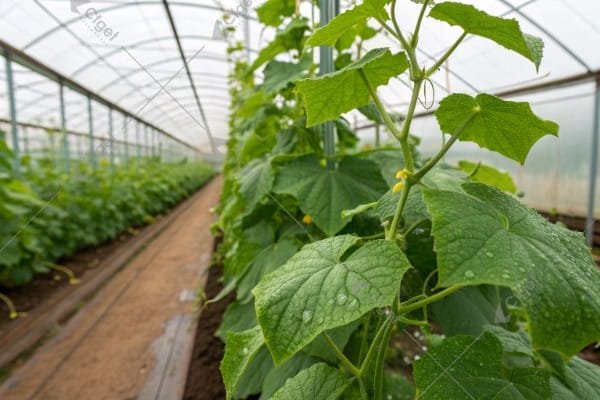
High transpiration makes climate control critical.
Dive deeper
Many articles group cucumbers with tomatoes as “fruiting vegetables.” This is misleading. Cucumbers have much higher transpiration rates. They raise humidity quickly, especially in dense planting systems. If airflow is weak, condensation and disease pressure increase rapidly.
Research and greenhouse climate principles summarized by Wageningen University & Research – Greenhouse Horticulture emphasize that crops with high transpiration require stronger air exchange and better humidity management. This makes greenhouse geometry and ventilation capacity more important than covering material alone.
In China, many cucumber projects fail not because the structure is poor, but because ventilation area is too small or airflow paths are blocked. So when I evaluate greenhouse types for cucumbers, I start with airflow and humidity removal capacity, not price per square meter.
Which greenhouse types dominate commercial cucumber production in China?
The market has already filtered out many weak options.
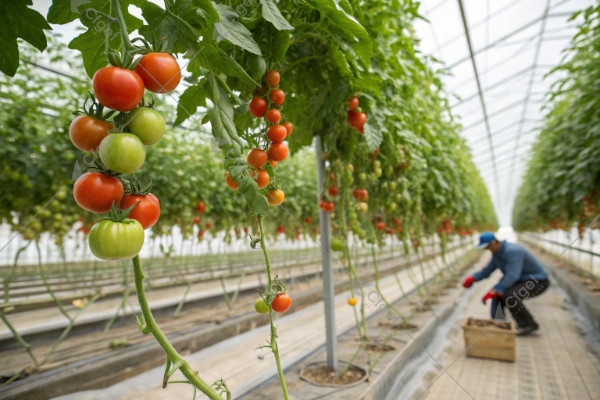
In China, commercial cucumbers are mainly produced in multi-span film greenhouses, with Venlo glass greenhouses used in high-end or demonstration projects.
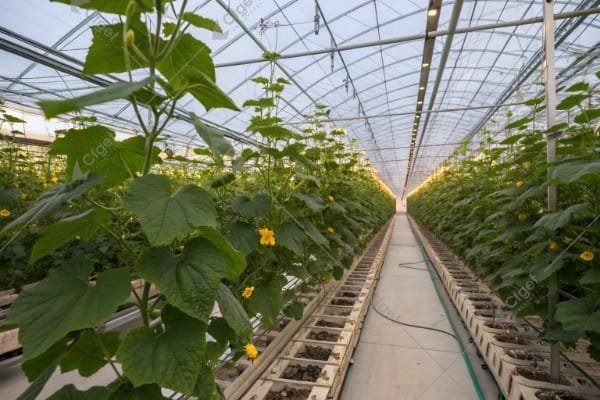
Multi-span film greenhouses are widely used.
Dive deeper
Single tunnels are still used in some regions, but they struggle with scale, airflow uniformity, and labor efficiency. For commercial volumes, multi-span structures dominate because they allow:
- large roof and side ventilation
- zoning and compartment management
- integration of shading and insect control
- scalable automation
Film greenhouses are popular because they balance cost, ventilation flexibility, and fast construction. Polycarbonate greenhouses appear in some colder or hail-prone regions, but for cucumbers, airflow usually matters more than insulation.
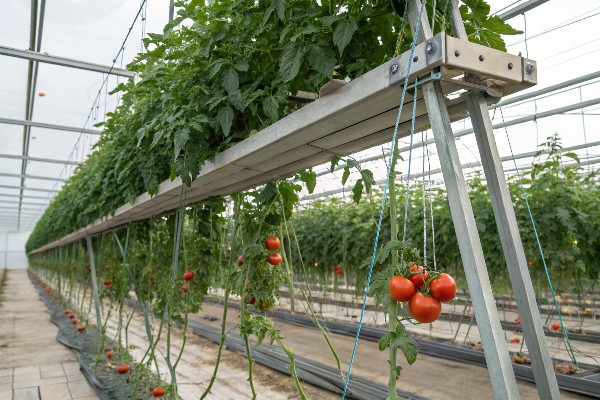
Venlo glass greenhouses are chosen when the project targets:
- year-round production
- export or premium domestic markets
- strict quality and uniformity standards
However, they require higher investment and more advanced operation skills. This is why Venlo is not the default “best” choice for most cucumber producers in China.
CFGET’s internal platform pages show these structural options clearly:
How does China’s climate influence the best greenhouse type for cucumbers?
China covers multiple climate zones. This changes everything.
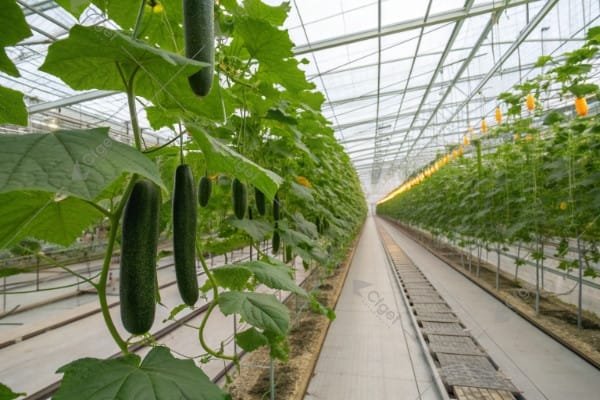
Hot summers, humid monsoon periods, and regional winter cold make ventilation-focused greenhouse types more reliable for cucumbers.
Dive deeper
In eastern and southern China, summer heat and humidity are the main risks. Cucumbers suffer quickly when humidity stays high and night temperatures remain elevated. Evaporative cooling helps only when humidity allows it.
Guidelines from University of Florida IFAS Extension explain why evaporative cooling performance drops in humid conditions. The same principle applies in China’s monsoon regions. This means greenhouse types that rely only on fan-and-pad cooling without sufficient ventilation and shading often fail during peak summer.
In northern China, winter heating becomes a factor. Here, multi-span film greenhouses with good sealing and thermal screens are often preferred, because they reduce heating cost while maintaining airflow options during warmer periods.
Long-term climate patterns from the World Bank Climate Change Knowledge Portal confirm increasing variability. This reinforces the need to design for peak heat and humidity, not average conditions.
Is ventilation capacity the key factor for cucumber greenhouse success?
Yes, more than many growers expect.
For cucumbers, insufficient ventilation is the most common reason greenhouse performance collapses under commercial scale.
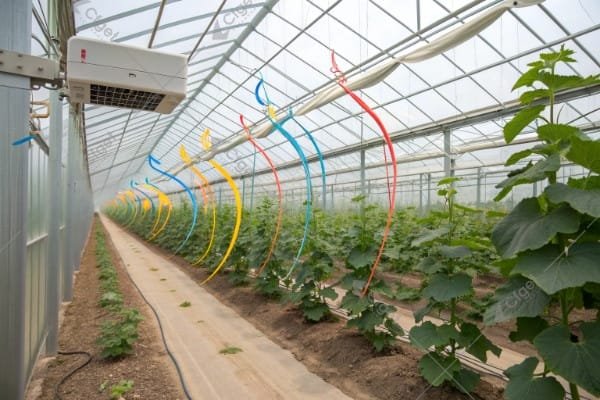
Airflow determines disease risk and yield.
Dive deeper
Cucumbers transpire heavily. If moist air is not removed fast enough, humidity builds up, leaf surfaces stay wet, and disease pressure increases. Ventilation must keep pace with transpiration, especially during peak growth stages.
Fan performance and ventilation efficiency standards discussed by ASABE show that real airflow is often much lower than rated airflow. Pressure losses, poor sealing, and short-circuit airflow reduce effectiveness.
Multi-span greenhouses allow higher total ventilation area, but only if vents are designed and controlled correctly. In long structures, temperature and humidity gradients appear if airflow paths are not balanced. For cucumbers, this results in uneven growth and uneven harvest timing.
This is why I consider ventilation design part of “greenhouse type.” A greenhouse shape that cannot support strong, uniform ventilation cannot be the best choice for cucumbers, regardless of material.
How should I balance CAPEX, OPEX, and yield stability for cucumbers?
Cucumbers reward stability more than extreme technology.
The best greenhouse type for cucumbers is the one that delivers stable yield with manageable operating cost, not the one with the most advanced systems.
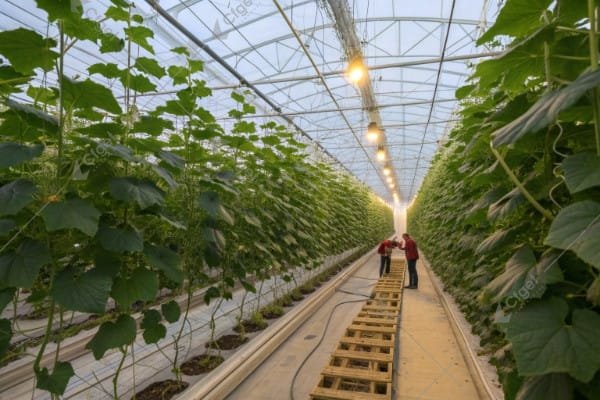
Stable cost per kilogram matters most.
Dive deeper
I evaluate cucumber greenhouses using cost per kilogram, not build cost. Cucumbers have high turnover and frequent harvest. Labor efficiency and disease control strongly affect profitability.
High-tech glass greenhouses can deliver excellent results, but they require:
- skilled operators
- reliable energy supply
- precise climate control
Mid-tech multi-span film greenhouses often deliver better ROI for many Chinese producers because they reduce complexity while still allowing good ventilation and shading. Energy planning insights from the Cornell University Controlled Environment Agriculture (CEA) Program support this logic: technology must match crop value and operational capacity.
Data trends from USDA Economic Research Service also show that operating cost management is central to controlled environment success.
How do production systems affect greenhouse choice for cucumbers?
Structure and system must work together.
Hydroponic and substrate cucumber systems increase the need for uniform airflow and humidity control.

Production system raises climate sensitivity.
Dive deeper
Many commercial cucumber projects in China use substrate systems. These systems improve root control and yield but increase sensitivity to air conditions. High humidity slows transpiration and increases disease risk.
Guidance from Rutgers University explains how humidity and airflow influence plant health, even though the document focuses on cooling.
This reinforces why greenhouse type selection cannot ignore production system. A structure that performs well for soil-grown cucumbers may struggle with dense substrate systems.
For integrated planning, CFGET’s internal resources support system matching:
So what is the best greenhouse type for cucumbers in China?
The answer depends on realistic constraints.
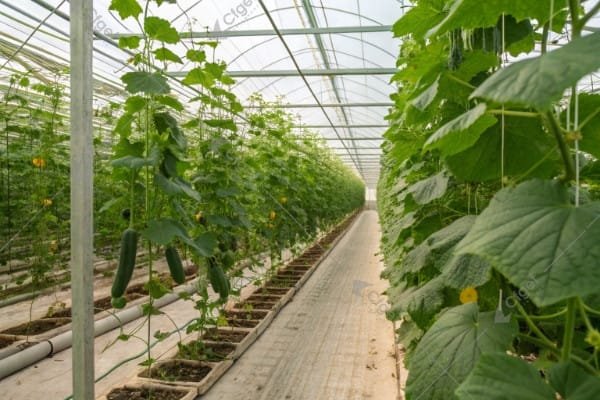
For most commercial cucumber projects in China, a well-ventilated multi-span film greenhouse offers the best balance of cost, airflow, and yield stability. Venlo glass becomes the best option only when premium uniformity and year-round production are required.
Dive deeper
I summarize the decision like this:
| Decision factor | If YES | Best greenhouse direction |
|---|---|---|
| Hot, humid summers | Yes | Multi-span film with large vents + shading |
| Need year-round premium supply | Yes | Venlo glass + advanced control |
| Limited budget, fast scale | Yes | Multi-span film (mid-tech) |
| High labor cost pressure | Yes | Automation-ready multi-span |
| Weak power stability | Yes | Ventilation-first design, less energy dependence |
This is where greenhouse type, system design, and business model meet. For most cucumber producers, simplicity plus good airflow wins.
If you want a starting point, CFGET’s platform pages help frame options:
Conclusion
The best greenhouse type for commercial cucumber production in China is the one that controls humidity, supports strong ventilation, and keeps operating cost predictable. Multi-span film greenhouses usually meet these needs better than overly complex structures.
External References (Authority Sources)
-
FAO – Climate Change and Agriculture
https://www.fao.org/climate-change/en/ -
World Bank – Climate Change Knowledge Portal
https://climateknowledgeportal.worldbank.org/ -
Wageningen University & Research – Greenhouse Horticulture
https://www.wur.nl/en/research-results/research-institutes/plant-research/greenhouse-horticulture.htm -
University of Florida IFAS Extension – Fan and Pad Cooling Systems
https://edis.ifas.ufl.edu/publication/AE069 -
Rutgers University – Greenhouse Evaporative Cooling Guide
https://nj-vegetable-crops-online-resources.rutgers.edu/wp-content/uploads/2015/06/Greenhouse-Evaporative-Cooling.pdf -
Cornell University – Controlled Environment Agriculture Energy Resources
https://cea.cals.cornell.edu/energy/ -
USDA Economic Research Service – Controlled Environment Agriculture Trends
https://www.ers.usda.gov/data-products/charts-of-note/chart-detail?chartId=109422 -
ASABE – Agricultural Engineering Standards & Publications
https://elibrary.asabe.org/
Internal References (CFGET)
-
Commercial Greenhouse Systems
https://cfgreenway.com/greenhouse/ -
Polycarbonate Greenhouse Systems
https://cfgreenway.com/polycarbonate/ -
Venlo Greenhouse
https://cfgreenway.com/venlo/ -
Smart Auto & Control Solutions
https://cfgreenway.com/solutions/smart-auto-control/ -
Growing Systems
https://cfgreenway.com/growing-systems/
Internal Blog References (Related CFGET Articles)
-
Polycarbonate Greenhouse Systems
https://cfgreenway.com/polycarbonate/ -
Semi-Closed Greenhouse Systems
https://cfgreenway.com/semi-closed/ -
Retractable Roof Greenhouses
https://cfgreenway.com/retractableroof/