A grafted tomato can have a visible graft union and still develop a root pathway that bypasses the rootstock. Check where a root originates and whether it reaches the growing medium. The union’s visibility alone does not answer that question.
This matters after transplanting as well as at nursery handover. The purchased plant joins a fruiting scion to a selected rootstock; preserving that intended root pathway is part of using the combination as planned.
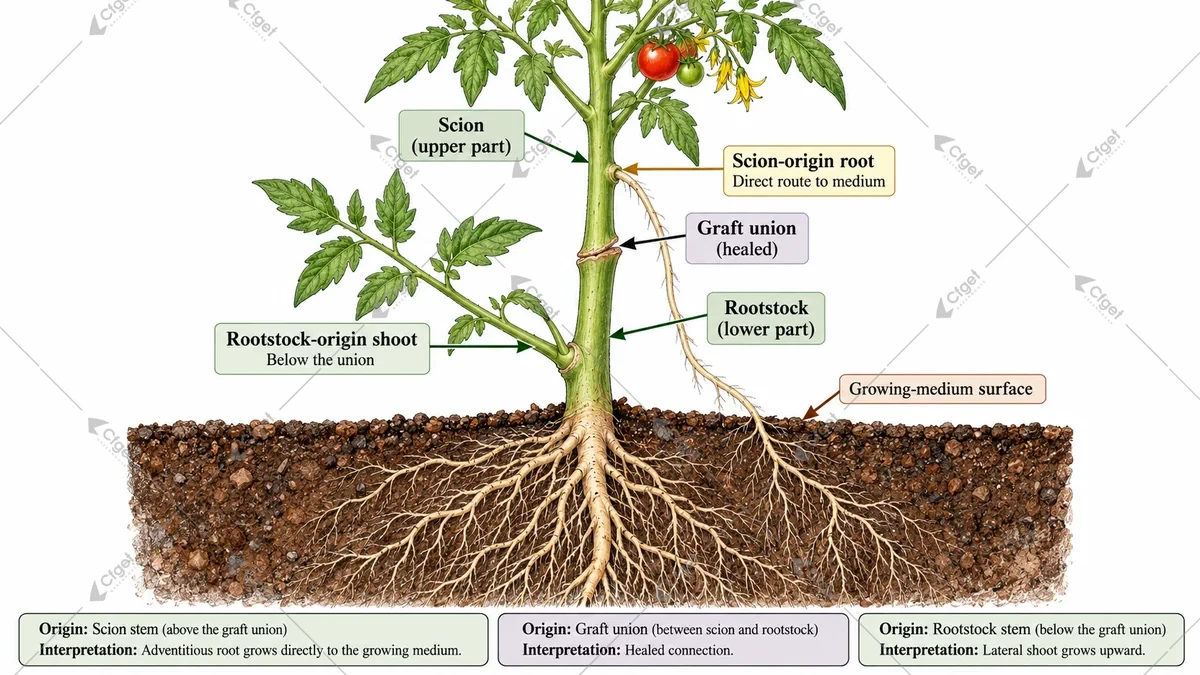
Identify the origin of each root or shoot
On a healed grafted tomato, the scion is above the union and the rootstock is below it. Roots emerging from the scion’s stem are adventitious roots. A leafy shoot emerging below the union is rootstock regrowth. These are different organs arising from different parts of the joined plant. Purdue’s tomato-grafting guide describes both scion roots and rootstock suckers.
A scion-origin root that grows into the medium creates a direct connection between the scion and that medium. It can bypass the selected rootstock. Penn State’s high-tunnel tomato discussion explains this route when the scion is covered or comes into contact with soil.
The concern is a potential alternate pathway, not proof that disease is present. Rootstock resistance or tolerance is specific to the actual combination and hazard. Neither the original graft nor the observation of one scion root establishes blanket immunity or a quantified loss of benefit.
| Observation | Anatomical interpretation | Useful next question |
|---|---|---|
| Root originates below the union | Rootstock-origin root pathway | Is the origin clearly identifiable? |
| Root originates above the union and reaches the medium | Scion has a direct connection to the medium | How should this plant be assessed under the nursery’s crop guidance? |
| Leafy shoot originates below the union | Rootstock regrowth | Has it been distinguished from the fruiting scion? |
| Origin cannot be identified | Unresolved observation | Can the nursery or adviser identify the plant parts? |
Why planting-depth habits need a second look
A practice intended to encourage additional rooting on an ungrafted tomato cannot automatically be transferred to a grafted plant. Encouraging the upper stem to root changes which plant supplies the roots.
Review the union and medium surface as they are now, not only as they appeared at dispatch. Potting position, settling and later additions of substrate can change their relationship. A photograph taken before those changes may no longer describe the current pathway.
Visible scion roots that have not reached the medium and scion roots already connected to it should also be recorded separately. The distinction gives the nursery something concrete to interpret, without requiring an assumption about hidden disease or a universal clearance distance.
A fictional handover with three different findings
Plant A has a visible union above the surface and identifiable roots arising below it. Plant B also has a visible union, but a root from above that union now reaches into the medium after more substrate was added. A third plant has a leafy shoot arising below the union.
A single checkbox saying “union visible” would treat A and B alike and miss the reason B needs review. A checkbox saying “extra growth” would also merge B with the third plant, even though one observation is a scion root and the other a rootstock shoot.
The useful handover separates them: plant identity, organ type, origin relative to the union, contact with the medium and the relevant potting history. Ask the nursery or crop adviser to interpret the actual plant and specify any response. The diagram is not an instruction to cut roots, remove shoots or disturb an established graft.
Keep this question separate from healing
A newly grafted plant that wilts during acclimation raises a different question about the developing graft connection and water delivery. The existing graft-healing transition guide covers that issue. Here the plant is already grafted and the task is to identify which root pathway it is using.
Download the root-pathway observation card
Download the grafted-tomato root-pathway CSV. This is a manual observation card with the fictional A/B/third-plant examples and blank actual-plant fields. There are no formulas, disease scores or treatment instructions. Import as UTF-8, comma-separated text, widen and wrap the columns, and save a spreadsheet copy. Keep root origin, shoot origin and medium contact separate; use “unresolved” when the origin cannot be identified.