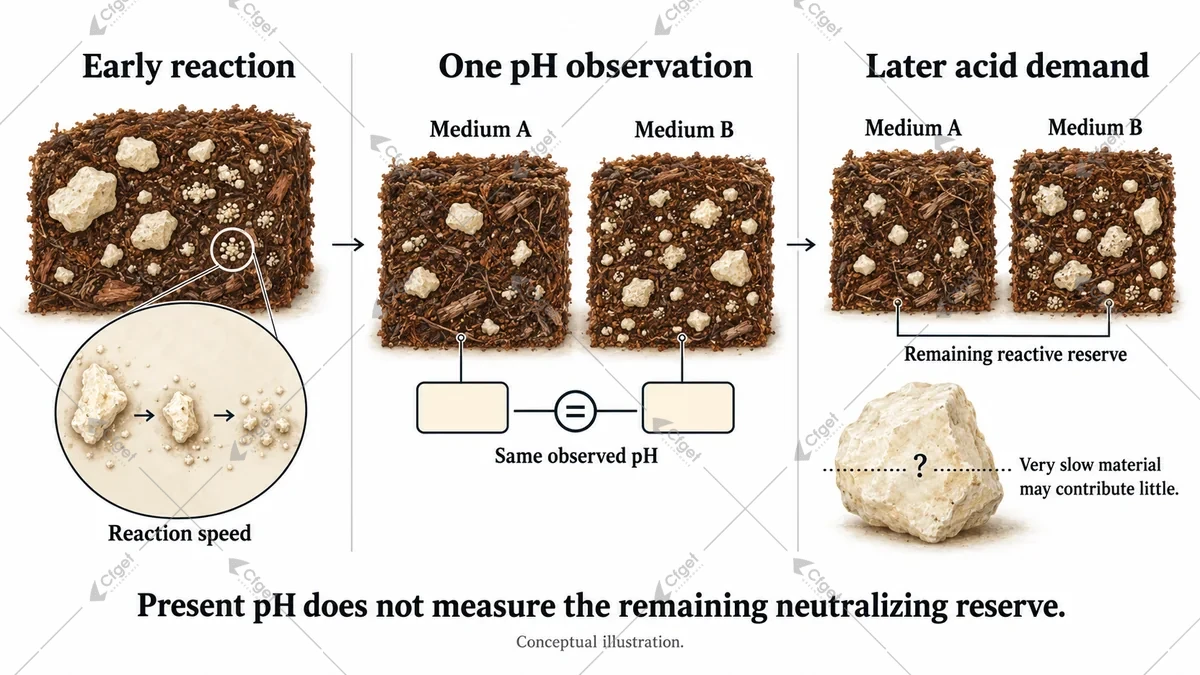
Two limed greenhouse media can have the same measured pH while retaining different amounts of useful neutralizing material. A starting pH describes the current condition under the test method. It does not show how much carbonate remains available to react with later acidity, or how quickly that reaction can occur during the crop.
When comparing a purchased medium or carbonate-limestone amendment, separate three questions: how much acidity can the material neutralize, how quickly does it react, and what useful reserve remains after the early response?
Separate early reaction from remaining reserve
Carbonate limestone reacts with acidity. Some of that material reacts during the initial adjustment; remaining reactive carbonate can contribute to resistance against a later acidifying load. The University of Arkansas substrate-amendment discussion separates reaction rate, the pH reached and the residual effect.
Particle-size distribution matters because finer carbonate particles generally react more quickly. However, “coarser” does not automatically mean “better long-term buffer.” Material that reacts too slowly to contribute within the crop period can remain physically present without providing the useful response the buyer expected. Carbonate composition, hardness, substrate properties and conditions also matter.
Think of the sequence as early reaction, a pH observation, then later acid demand. The middle observation does not reveal everything that happened before it or what capacity remains afterward.
Read capacity and speed as separate specifications
Calcium carbonate equivalent, or CCE, expresses acid-neutralizing capacity relative to calcium carbonate. It is different from a calcium percentage and different from a reaction-speed specification. Purdue’s explanation of limestone quality treats purity and fineness separately. That older Indiana field-soil publication supports the distinction; its field rates and timing should not be transferred to greenhouse containers.
| Information | Question it helps answer | What it cannot establish alone |
|---|---|---|
| Measured substrate pH and method | What condition was observed now? | Remaining neutralizing reserve |
| CCE and carbonate identity | What is the material’s neutralizing capacity basis? | Speed in this particular medium |
| Particle distribution and relevant response evidence | How does the material react over the relevant period? | The final pH under a different crop program |
| Residual-lime assessment with a stated method | What remaining neutralization is being characterized? | Automatic suitability for every crop |
Residual carbonate is also distinct from the medium’s cation-exchange capacity and from alkalinity arriving in irrigation water. Those can affect pH behaviour, but they are different properties and inputs. Calling all of them “buffering” without identifying the evidence makes offers harder to compare.
Interpret two matching readings without overreading them
In this fictional example, Medium A and Medium B both read pH 5.8 at one observation using the same extraction method. The number is invented to illustrate equality, not to recommend a crop target. Suppose supplier evidence documents different carbonate particle distributions and different residual-lime characteristics.
The equal readings support a narrow conclusion: the observed pH matched on that basis at that time. They do not erase the documented reserve difference. Under the same subsequent crop and water program, that difference can matter to the later response, but the information given does not justify inventing a final pH for either medium.
A useful follow-up is to ask the supplier which evidence characterizes the early adjustment and which characterizes remaining reserve over the intended production period. If the only evidence is the two pH readings, the reserve comparison remains unanswered. If a residual assessment is supplied, preserve its method and units rather than treating it as another pH measurement.
Make the decision about the whole production period
Do not choose between the offers solely because one has a larger calcium number or a coarser description. Compare the documented carbonate response with the actual medium and anticipated acidifying influences. A short crop and a long crop may pose different questions about how much of a slow-reacting fraction becomes useful.
For the water input to that discussion, see water alkalinity and media-pH drift. The decision here is whether the amendment or medium evidence supports the proposed crop program, rather than how to mix a corrective dose.
Download the early-response and reserve comparison
Download the limestone reaction-and-reserve CSV. This is a manual evidence comparison with the two fictional pH readings clearly labeled. It has no formulas, rate calculation or future-pH prediction. Import as UTF-8, comma-separated text, widen and wrap the columns, and save a spreadsheet copy. Record the present-pH conclusion separately from the residual-reserve conclusion; keep unsupported comparisons open for the supplier or substrate adviser.