Dead spots in your greenhouse are silently destroying your crops and profits. These stagnant air pockets create perfect conditions for disease and uneven growth.
Circulation fans eliminate dead spots by moving air horizontally throughout the greenhouse, creating uniform temperature, humidity, and CO2 distribution. This improved airflow can increase yields by 15-25% while reducing disease problems by up to 60%.

Strategic fan placement creates uniform airflow throughout the growing space.
After installing circulation systems in greenhouses across more than 20 countries, I have witnessed the dramatic transformation these fans create. The difference becomes visible within days of installation. Plants in previously stagnant areas suddenly show improved growth rates and healthier appearance. Our CFGET greenhouse designs now include circulation fans as standard equipment because the benefits are so significant. These systems work equally well in our tunnel houses, multi-span structures, and specialized growing facilities.
The Science of Airflow: How Circulation Fans Create Perfect Temperature & CO2 Uniformity?
Temperature variations of just 5°F across your greenhouse can reduce yields and create stress conditions. Most growers do not realize how much these variations cost them.
Horizontal airflow fans create a gentle, continuous air movement that eliminates temperature stratification and ensures even CO2 distribution. This uniform environment can improve photosynthesis rates by 20% and reduce plant stress significantly.
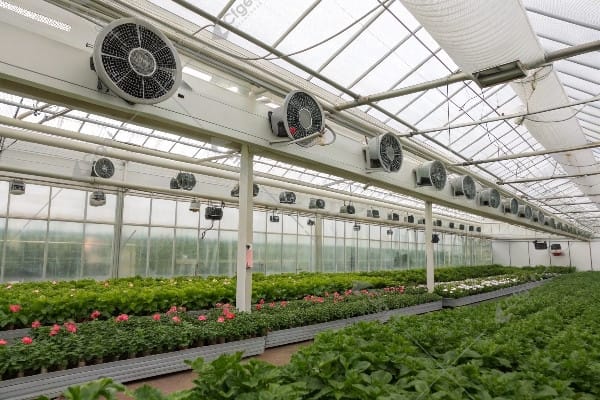
Circulation fans create uniform temperature and CO2 levels throughout the space.
Understanding air movement physics helps explain why these systems work so effectively. Without circulation, warm air naturally rises and creates layers of different temperatures throughout the greenhouse. The top areas become too hot while lower areas remain cooler. This stratification prevents plants from experiencing consistent growing conditions.
Circulation fans break up these temperature layers by moving air horizontally across the greenhouse. The fans create a gentle mixing action that distributes warm and cool air evenly. We typically see temperature variations drop from 15-20°F to just 2-3°F after installing proper circulation systems.
CO2 distribution becomes equally important for maximizing photosynthesis. Plants consume CO2 during daylight hours, creating pockets of depleted air around dense foliage. Without air movement, these low-CO2 zones limit plant growth even when overall greenhouse CO2 levels are adequate.
Our circulation systems ensure CO2 moves continuously throughout the growing space. This constant mixing prevents the formation of depleted zones and maintains optimal CO2 levels at leaf surfaces. The result is more efficient photosynthesis and faster plant growth.
Humidity control improves dramatically with proper air circulation. Stagnant air allows moisture to accumulate in pockets, creating conditions perfect for fungal growth. Moving air carries away excess moisture before it can condense on plant surfaces or greenhouse structures.
The velocity of air movement matters significantly. We design systems to create air speeds of 50-100 feet per minute at plant level. This gentle movement is strong enough to mix air effectively but not so strong that it stresses plants or interferes with pollination activities.
Your #1 Defense Against Greenhouse Disease, Mold, and Condensation?
Fungal diseases can destroy entire crops within days when conditions are right. Stagnant air creates the perfect environment for these problems to develop and spread.
Continuous air movement from circulation fans prevents moisture accumulation on plant surfaces and eliminates the humid microclimates where diseases thrive. This airflow reduces fungal problems by 60-80% compared to greenhouses without circulation systems.

Proper airflow prevents disease by eliminating humid stagnant conditions.
Disease prevention starts with understanding how pathogens establish themselves in greenhouse environments. Most fungal spores require moisture and still air to germinate and spread. When we keep air moving constantly, we disrupt these conditions and make it nearly impossible for diseases to take hold.
Condensation control becomes critical during temperature fluctuations. When warm, humid air contacts cooler surfaces, water droplets form on leaves, stems, and greenhouse structures. These water droplets provide the moisture that fungal spores need to germinate. Circulation fans prevent condensation by maintaining air movement across all surfaces.
The boundary layer effect plays a crucial role in plant health. Every leaf surface has a thin layer of still air that surrounds it. In stagnant conditions, this boundary layer becomes saturated with moisture from plant transpiration. Moving air constantly refreshes this boundary layer, removing excess moisture and preventing fungal establishment.
Our experience across different climates has shown that circulation fans are especially important in humid regions like Southeast Asia. In these areas, the combination of high temperatures and humidity creates perfect conditions for rapid disease spread. Circulation systems have reduced crop losses by more than 70% in these challenging environments.
Mold prevention extends beyond plant surfaces to greenhouse structures themselves. Stagnant air allows moisture to accumulate on walls, benches, and equipment. This moisture supports mold growth that can contaminate the entire growing environment. Continuous air movement keeps these surfaces dry and prevents mold establishment.
Early detection becomes easier when air circulation systems are working properly. Diseased plants release volatile compounds that moving air carries throughout the greenhouse. This distribution makes it easier to detect problems before they spread to healthy plants.
A Pro’s Guide: 3 Rules for Sizing & Placing Your HAF (Horizontal Airflow) System?
Improper fan sizing and placement can make circulation systems completely ineffective. Many growers waste money on systems that do not provide adequate air movement.
Effective HAF systems require proper fan capacity (1 CFM per 10 square feet), strategic placement every 50-75 feet, and correct mounting height 8-10 feet above crops. These three rules ensure complete air circulation without dead spots or excessive turbulence.
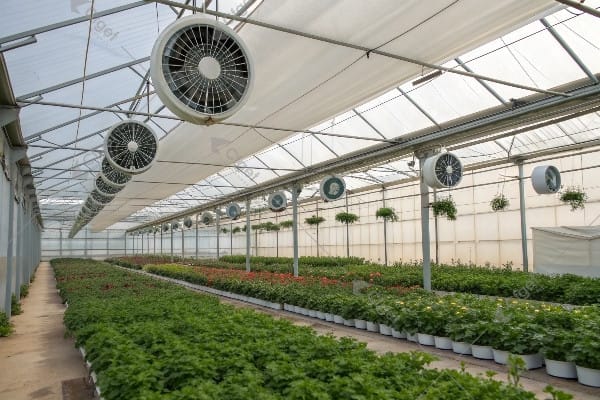
Professional installation follows specific spacing and height requirements for optimal performance.
Fan capacity calculations form the foundation of effective circulation design. We use a standard formula of 1 CFM (cubic foot per minute) for every 10 square feet of greenhouse floor area. For a 30×100 foot greenhouse (3,000 square feet), this means we need 300 CFM of total fan capacity. However, this baseline increases in high-density plantings or areas with poor natural ventilation.
Strategic placement creates the circulation patterns needed for complete air mixing. We position fans to create a circular airflow pattern throughout the greenhouse. Fans should be spaced no more than 75 feet apart to ensure overlapping air streams. In narrow houses, we mount fans along one sidewall directing air toward the opposite wall. In wider structures, we create multiple circulation loops.
| Greenhouse Width | Fan Placement Strategy | Spacing Requirements |
|---|---|---|
| Under 30 feet | Single wall mounting | Every 50-60 feet |
| 30-60 feet | Alternating sides | Every 60-75 feet |
| Over 60 feet | Multiple circulation loops | Every 50 feet |
Mounting height determines how effectively fans mix air throughout the growing space. We typically mount circulation fans 8-10 feet above the crop canopy. This height allows air to move freely above plants while still creating circulation at plant level. Mounting too low creates excessive turbulence that can damage plants. Mounting too high reduces effectiveness at crop level.
The direction of airflow creates circulation patterns that eliminate dead spots. We design systems to move air in the same direction around the greenhouse perimeter. This creates a large circulation loop that prevents stagnant areas from forming. Fans should never blow directly against each other, as this creates turbulence and reduces effectiveness.
Variable speed controls allow fine-tuning of air movement based on crop needs and weather conditions. During hot weather, we run fans at full speed to maximize cooling. During cooler periods, we reduce fan speed to maintain gentle air movement without overcooling plants. This flexibility ensures optimal conditions throughout the growing season.
Maintenance requirements stay minimal when systems are properly designed. We recommend monthly cleaning of fan blades and annual inspection of motors and mounting hardware. Proper installation with adequate electrical supply ensures reliable operation for many years.
The Smart Greenhouse Advantage: Automating Airflow for Maximum Efficiency?
Manual fan control leads to inconsistent growing conditions and wasted energy. Modern growers need systems that respond automatically to changing conditions.
Automated circulation fan controls adjust airflow based on temperature, humidity, and time schedules, reducing energy costs by 30-40% while maintaining optimal growing conditions. These smart systems ensure fans operate only when needed for maximum efficiency.
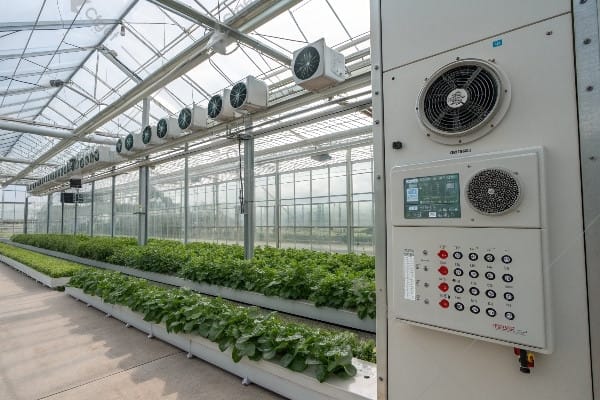
Advanced controls optimize fan operation based on real-time environmental conditions.
Temperature-based controls form the most common automation approach. We install sensors throughout the greenhouse that monitor temperature variations. When temperature differences exceed preset limits, the control system activates circulation fans to restore uniformity. This prevents both overheating and energy waste from unnecessary fan operation.
Humidity sensors add another layer of intelligent control. High humidity levels trigger fan operation to prevent condensation and disease problems. Low humidity conditions may reduce fan speeds to prevent excessive moisture loss from plants. This dual approach maintains optimal humidity ranges while minimizing energy consumption.
Time-based scheduling ensures circulation during critical periods. We program systems to increase airflow during peak photosynthesis hours when CO2 demand is highest. Nighttime operation may reduce to minimum levels needed for disease prevention. This scheduling approach can reduce energy consumption by 40% compared to continuous operation.
Integration with other greenhouse systems creates comprehensive environmental control. Circulation fans work together with heating, cooling, and CO2 systems to maintain optimal conditions. When heating systems operate, circulation fans distribute warm air evenly. During cooling periods, fans help natural ventilation systems work more effectively.
Variable frequency drives provide precise control over fan speeds. Instead of simple on/off operation, these drives allow gradual speed adjustments based on environmental needs. This precision control reduces energy consumption while providing exactly the right amount of air movement for current conditions.
Remote monitoring capabilities allow growers to track system performance from anywhere. Modern control systems send alerts when fans malfunction or when environmental conditions exceed preset ranges. This early warning system prevents crop damage and reduces maintenance costs through predictive service.
Data logging features help optimize system performance over time. Controllers record temperature, humidity, and fan operation data that reveals patterns and opportunities for improvement. This information helps fine-tune control settings for maximum efficiency and crop performance.
Conclusion
Circulation fans eliminate dead spots and create uniform growing conditions, making them essential equipment for maximizing greenhouse yields and preventing disease problems.