Your greenhouse floor space costs thousands per square foot, yet traditional fixed benches waste 40-50% of that valuable area on permanent aisles. This inefficiency directly impacts your bottom line.
Rolling benches eliminate wasted aisle space by creating moveable growing areas that increase plant capacity by 50-90% in the same footprint. This space optimization can boost annual profits by $15,000-30,000 per 1,000 square feet of greenhouse area.
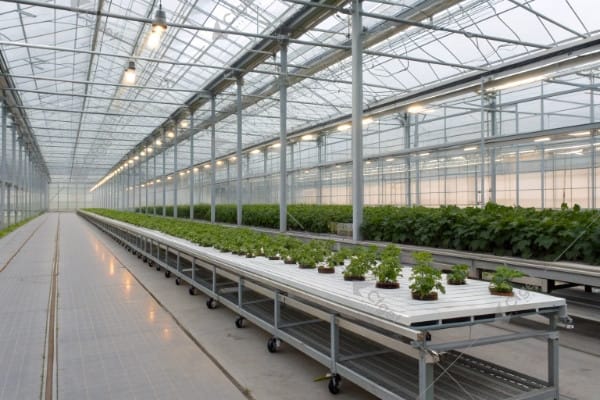
Rolling benches transform wasted aisle space into profitable growing area.
Throughout my 29 years of designing greenhouse systems, I have watched growers struggle with the fundamental challenge of maximizing production in limited space. Traditional fixed bench systems require permanent aisles that consume nearly half of your expensive greenhouse floor area. When we introduced rolling bench systems as part of our CFGET intelligent greenhouse management solutions, the transformation was immediate and dramatic. Growers could suddenly fit twice as many plants in the same space while maintaining full access for maintenance and harvesting.
From Wasted Aisles to Profitable Rows: The Science of Space Optimization?
Fixed benches force you to dedicate 40-50% of your greenhouse to permanent walkways that generate zero revenue. This represents thousands of dollars in wasted potential every growing season.
Rolling bench systems reduce aisle space from 40-50% to just 15-20% of total floor area by creating one moveable aisle that provides access to all growing areas. This optimization increases plant capacity from 60% to 80-85% of total greenhouse space.
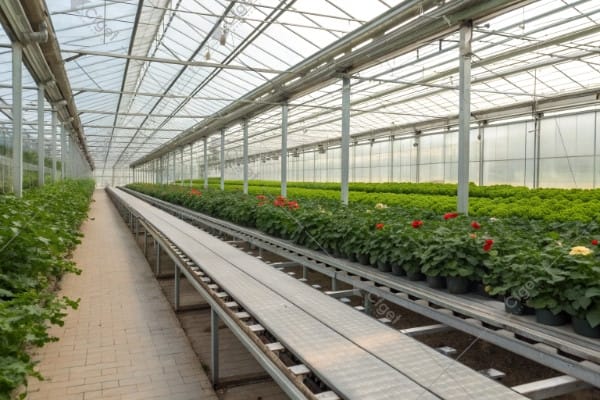
Single moveable aisle replaces multiple permanent walkways for maximum efficiency.
Understanding the mathematics of space utilization reveals the true potential of rolling systems. In a traditional setup, a 30-foot wide greenhouse requires 4-foot aisles between 8-foot wide benches. This creates a pattern of bench-aisle-bench-aisle that dedicates 16 feet of the 30-foot width to non-productive walkways. That equals 53% of your expensive floor space generating zero income.
Rolling bench systems eliminate this waste by consolidating all aisle space into one moveable pathway. The same 30-foot greenhouse can accommodate four 6-foot wide rolling benches with just one 6-foot working aisle. This reduces non-productive space to 20% while increasing growing area to 80% of total floor space.
The physics of the rolling mechanism makes this optimization possible. Each bench section rides on tracks or rails that allow smooth horizontal movement. When you need access to a specific area, adjacent benches roll apart to create a working aisle exactly where needed. After completing your work, the benches roll back together to maximize growing density.
Load distribution becomes critical for proper system function. We design rolling systems to distribute plant weight evenly across the entire track system. This prevents binding and ensures smooth operation even when benches carry full crop loads. Our experience across different greenhouse types has taught us to calculate weight loads carefully and select appropriate track systems for each application.
The consolidation of aisle space also improves workflow efficiency. Instead of walking long distances through multiple fixed aisles, workers can position the moveable aisle exactly where they need to work. This reduces labor time and makes maintenance tasks more efficient.
Calculating the ROI: How Rolling Benches Pay for Themselves in Production Gains?
Rolling bench systems require significant upfront investment that makes many growers hesitant. The key question becomes whether increased production justifies the additional cost.
Rolling benches typically increase plant capacity by 60-80%, generating additional revenue of $20,000-40,000 annually per 1,000 square feet. With installation costs of $8-12 per square foot, most systems pay for themselves within 12-18 months through increased production.
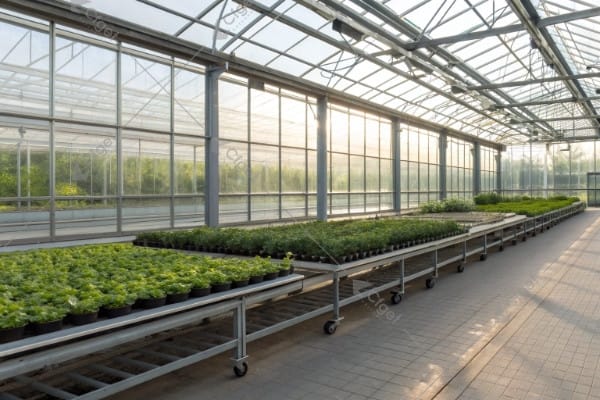
Increased production capacity creates rapid payback on rolling bench investment.
Real-world calculations demonstrate the financial benefits clearly. Consider a 1,000 square foot greenhouse section currently producing 2,000 plants per crop cycle with fixed benches. The same space with rolling benches can accommodate 3,200-3,600 plants per cycle, representing a 60-80% increase in production capacity.
| System Type | Plants per 1000 sq ft | Crops per Year | Annual Production | Revenue at $3/plant |
|---|---|---|---|---|
| Fixed Benches | 2,000 | 4 | 8,000 plants | $24,000 |
| Rolling Benches | 3,200 | 4 | 12,800 plants | $38,400 |
| Net Gain | 1,200 | 4 | 4,800 plants | $14,400 |
Installation costs for rolling bench systems typically range from $8-12 per square foot of greenhouse area. For our 1,000 square foot example, total investment would be $8,000-12,000. With additional annual revenue of $14,400, the payback period becomes 8-10 months in this scenario.
The calculation improves further when you consider multiple crop cycles per year. High-value crops like seedlings or propagation materials may turn over 6-8 times annually. Each additional crop cycle multiplies the revenue benefit from increased plant capacity.
Labor efficiency gains add another layer of financial benefit. Rolling systems reduce the time needed for watering, fertilizing, and maintenance because workers can position aisles exactly where needed. This efficiency can reduce labor costs by 15-20% while improving work quality.
Property value increases represent a long-term financial benefit. Greenhouses equipped with rolling bench systems command higher sale prices and rental rates because of their superior production capacity. This added value becomes important for growers planning expansion or considering facility upgrades.
Energy efficiency improvements also contribute to ROI. Rolling benches allow more precise environmental control because plants are positioned more uniformly throughout the greenhouse. This uniformity can reduce heating and cooling costs by 10-15% compared to fixed bench layouts with irregular spacing.
The Professional’s Choice: Why Nurseries & Seedling Growers Rely on Mobile Benches?
Commercial nurseries and seedling operations face unique challenges that make rolling benches particularly valuable. These operations require maximum plant density while maintaining easy access for frequent handling.
Professional growers choose rolling benches because they increase production density by 70-90% while providing complete access to every plant. This combination of maximum capacity and full accessibility makes rolling systems essential for profitable commercial operations.

Professional operations depend on rolling benches for maximum productivity.
Nursery operations require frequent plant handling that makes accessibility crucial. Seedling growers must reach every plant for transplanting, grading, and shipping activities. Rolling benches provide this access without sacrificing growing density. Workers can create aisles exactly where needed and close them when work is complete.
The uniformity of growing conditions improves significantly with rolling systems. Plants positioned closer together experience more consistent temperature, humidity, and light levels. This uniformity reduces crop variability and improves overall quality. Professional growers report 15-25% improvements in crop uniformity after installing rolling bench systems.
Inventory management becomes more efficient with mobile bench systems. Plants can be organized by variety, size, or shipping date, then accessed easily when needed. This organization reduces handling time and minimizes plant damage during selection and shipping processes.
Quality control improves when every plant remains easily accessible. Inspectors can examine entire crops without struggling to reach plants in the back of deep fixed benches. This thorough inspection capability helps maintain the high standards required for commercial plant sales.
Water and fertilizer distribution becomes more uniform with rolling bench layouts. Irrigation systems can be designed to provide equal coverage to all plants because benches can be positioned consistently during watering cycles. This uniformity improves plant quality and reduces input waste.
Our experience with commercial growers across different regions shows that rolling benches are especially valuable for high-value crops. Seedling operations producing vegetable transplants, bedding plants, or specialty varieties benefit most from the increased capacity and improved handling efficiency.
Climate control optimization works better with rolling bench systems because plants are distributed more evenly throughout the greenhouse. This even distribution eliminates hot spots and cold zones that can develop around fixed bench arrangements with irregular spacing patterns.
5 Key Design Features of a High-Performance Rolling Bench System?
Poor design choices can make rolling bench systems difficult to operate and maintain. Professional installations require specific features that ensure reliable long-term performance.
High-performance rolling systems require heavy-duty track systems, smooth-operating mechanisms, proper drainage design, integrated irrigation connections, and safety features that prevent accidents. These five elements determine system reliability and user satisfaction.
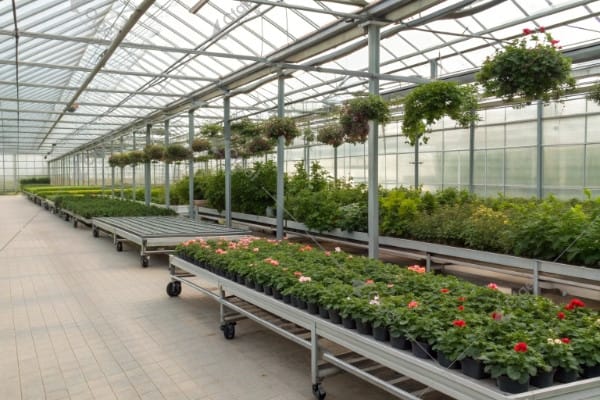
Professional systems include heavy-duty tracks, drainage, and safety features.
Track system design forms the foundation of reliable rolling bench operation. We use heavy-duty steel tracks that can support full crop loads without flexing or binding. The track gauge must match the expected load capacity, with wider tracks for heavier applications. Proper installation requires precise leveling to ensure smooth rolling action throughout the system’s operational life.
Rolling mechanisms determine how easily benches move and how long the system will operate reliably. We prefer gear-driven systems with manual hand wheels for precise positioning control. These mechanisms provide mechanical advantage that makes moving heavy plant loads manageable for operators. Sealed bearings protect against moisture and contamination in greenhouse environments.
Drainage design prevents water accumulation that can damage both plants and equipment. Rolling benches require integrated drainage systems that move with the benches while maintaining proper water flow. We design systems with removable drain trays that allow thorough cleaning and maintenance. Proper drainage also prevents standing water that can harbor disease organisms.
Irrigation integration ensures plants receive consistent water and fertilizer regardless of bench position. We install flexible irrigation connections that move with the benches while maintaining reliable water delivery. Quick-disconnect fittings allow easy maintenance and system modifications. Overhead irrigation systems must be designed to provide uniform coverage as benches move to different positions.
Safety features protect workers and prevent accidents during system operation. We include locking mechanisms that secure benches in position during maintenance work. Safety barriers prevent workers from being caught between moving benches. Clear sight lines and proper lighting ensure operators can see potential hazards before moving benches.
| Feature Category | Professional Standard | Budget Alternative | Performance Impact |
|---|---|---|---|
| Track System | Heavy-duty steel rails | Aluminum channels | Durability, load capacity |
| Rolling Mechanism | Gear-driven with hand wheels | Direct push systems | Ease of operation |
| Drainage | Integrated removable trays | Fixed drainage channels | Maintenance, plant health |
| Irrigation | Flexible connections | Fixed overhead only | Water uniformity |
| Safety Features | Locks, barriers, lighting | Basic stop mechanisms | Worker protection |
Load capacity calculations ensure the system can handle expected plant weights plus safety margins. We calculate maximum loads based on fully mature plants, saturated growing media, and bench structure weight. This comprehensive approach prevents overloading that can damage tracks or create safety hazards.
Modular design allows system expansion and reconfiguration as needs change. Professional rolling bench systems use standardized components that can be added, removed, or rearranged easily. This flexibility helps growers adapt to changing crop requirements or facility modifications.
Conclusion
Rolling benches maximize greenhouse profitability by converting wasted aisle space into productive growing area, typically paying for themselves within 12-18 months through increased plant capacity.