Growing strawberries in a greenhouse is hard work. Are you tired of seeing low fruit yields and poor quality berries during the dark winter months?
To get more strawberries, you must stop looking at lumens. You need to measure PPFD (light intensity) and DLI (daily light total). This guide shows you the exact light numbers for every growth stage to help you grow bigger, sweeter fruit.
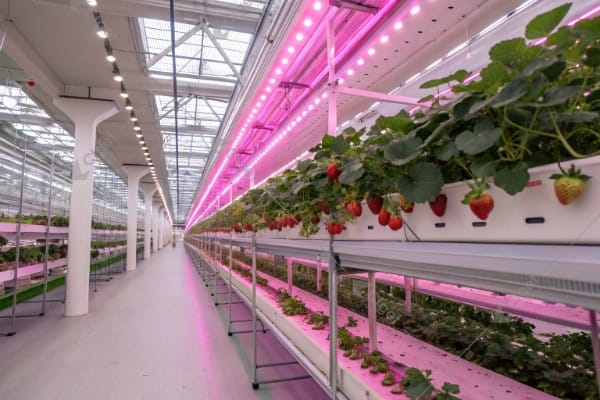
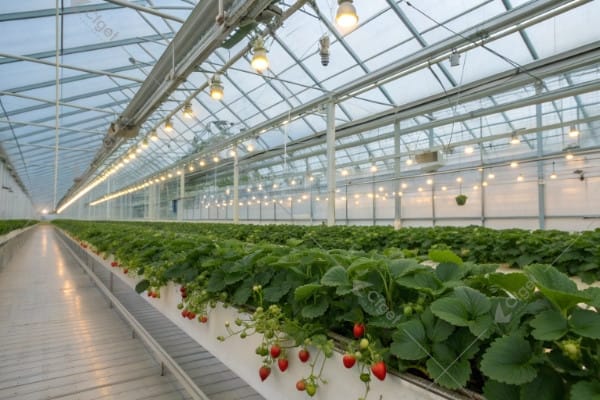
Strawberries growing under professional supplemental LED lighting.
At CFGET, we have spent 29 years helping growers like you. We know that guessing your light levels is a bad idea. It wastes money and hurts your plants. Today, we will share the specific math and science we use to help our clients in over 20 countries. Let’s look at the real numbers you need for success.
Quantifying Light Needs: What Are the Precise PPFD & DLI Targets for Different Strawberry Growth Stages?
Guessing light levels hurts your plants. Do you know exactly how much light a baby seedling needs versus a big fruiting plant?
Strawberries need specific light levels to grow well. Seedlings need a DLI of about 12 mol/m²/day. Fruiting plants need a DLI of 20-25 mol/m²/day. Matching these targets prevents weak stems and ensures you get big, sweet berries every time.

Let’s dive deeper into these numbers. You might think all light is the same, but plants do not see it that way. We use two main words: PPFD and DLI. Think of light like rain. PPFD is how hard the rain is falling right now. DLI is how much water is in the bucket at the end of the day. For strawberries, the "bucket" needs to be full, but not overflowing.
If the DLI is too low, your strawberries will be small and sour. If it is too high, you might burn the leaves. We have created a simple table below based on our experience with growers in Europe and America. This helps you set your lights correctly.
| Growth Stage | PPFD Target (μmol/m²/s) | DLI Target (mol/m²/day) | Why it matters |
|---|---|---|---|
| Seedling / Nursery | 200 – 300 | 10 – 12 | Helps roots grow strong without stressing the young plant. |
| Vegetative (Leaves) | 300 – 450 | 15 – 20 | Builds big leaves to catch energy for future fruit. |
| Flowering & Fruiting | 450 – 600 | 20 – 25 | Critical for making flowers turn into heavy, sweet fruit. |
When we design systems for our clients, we look at these numbers first. A grower in cloudy England needs more help from lights than a grower in sunny Spain. You must measure the natural light you get from the sun first. Then, you use your lights to fill the rest of the "bucket" to reach the target DLI. This is the secret to keeping your production high all year round.
Light Quality Dictates Quality: How Does Spectral Customization (R:B:FR) Affect Flavor & Flower Bud Differentiation?
Bright light is not enough. Did you know the wrong light color can actually stop your strawberries from tasting sweet?
Red light helps stems grow tall. Blue light makes roots strong and leaves thick. Far-red light is the secret trigger for flowering. Using the right mix, or "recipe," makes your fruit sweeter and ready to sell much faster.
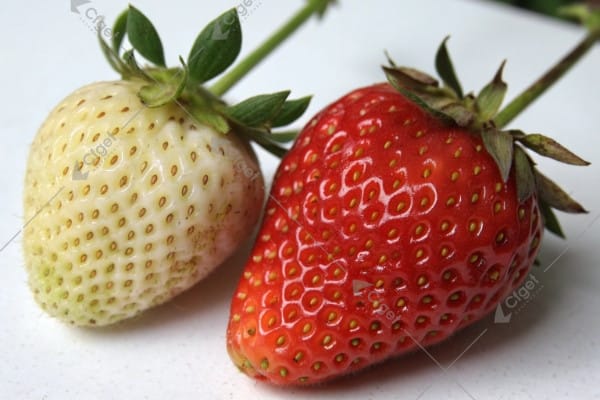
The right light colors create redder, sweeter strawberries.
We need to talk about "recipes" for light. Just like cooking, you need the right ingredients. Sunlight has all the colors of the rainbow. But grow lights can be special. We call this the "spectrum." For strawberries, we focus on Red, Blue, and Far-Red light.
Red Light (R): This is the main food for the plant. It helps the plant grow big and fast.
Blue Light (B): This is like a signal. It tells the plant to make strong roots and thick leaves. It also helps the plant make the chemicals that give strawberries their smell and taste.
Far-Red Light (FR): This is very important for berries. It tells the plant, "Hey, it is time to make babies!" This helps the plant make flowers earlier.
At CFGET, we often use a mix. For example, we might use 70% Red and 20% Blue, with a little bit of Far-Red. We call this the "R:B Ratio."
- High Blue: Good for young plants to keep them short and strong.
- High Red: Good for making fruit grow fast.
If you only use a simple white light, you might miss the Far-Red. This means your flowers might come late. If you are in a place like Central Asia with short winter days, using the right recipe is key. It helps the plant think it is summer. This improves the "Brix" level, which is just a fancy word for sugar. Higher Brix means your customers will love the taste and buy more.
Scientific Lighting Configuration: What Are the Rigorous Formulas and Layout Plans from Structure to Power Selection?
Buying lights without a plan is risky. Are you worried about dark spots in your greenhouse or wasting electricity on too many lights?
You calculate light needs by measuring your greenhouse area and target DLI. Then, we account for shadow from the roof. We place lights carefully to make sure every single plant gets the same amount of sunshine substitute.
Many people just buy a lamp and hang it up. This is a mistake. To get the best results, you need to do some math. Don’t worry, it is simple math. We use a step-by-step method to help our clients design the perfect system.
Step 1: Check your DLI Gap.
If your strawberries need a DLI of 25, but the winter sun only gives you 10, your "gap" is 15. Your lights need to provide that missing 15.
Step 2: Calculate Total Light Needed.
We look at the size of your greenhouse. If you have a big greenhouse, you need more "photons" (light particles). We use a formula:
Target PPFD × Area = Total Photons Needed.
Step 3: Choose the Lamp Power.
Not all lamps are the same. Some lamps use 100 watts but give very little light. We look for "efficiency." We want a lamp that turns electricity into light, not heat.
Step 4: The Layout.
This is where our 29 years of experience helps. If you hang lights too high, you lose light to the walls. If you hang them too low, you burn the tops of the plants. You also need to look at shadows. The metal frame of your greenhouse blocks some light. We place lamps to cover those shadows. We also make sure the light overlaps. This way, if one lamp breaks, the plants still get light from the neighbors. Uniformity is key. You want every strawberry to look the same so you can sell them all for a high price.
In-Depth Return on Investment (ROI): What Are the Cost-Benefit Analysis and Long-Term Advantages of LED vs. HPS Systems?
New lights cost a lot of money. Are you wondering if expensive LED lights are actually worth the high upfront price tag?
LEDs cost more to buy than old HPS lights, but they use 40% less electricity. They also last five times longer. Over three years, the energy savings and higher crop yields pay for the lights completely.
Let’s talk about money. We know that installing a new system is a big investment. Many growers ask us, "Why should I buy LEDs when HPS lights are cheaper?" It is true that the price tag on the box is lower for HPS. But let’s look at the real cost over time.
1. Electricity Bills:
This is your biggest cost. LEDs are very efficient. To get the same amount of light, an LED uses about 40% less power than an HPS bulb. In places like Europe where electricity is expensive, this saves you thousands of dollars every month.
2. Heat Management:
HPS lights get very hot. In a small greenhouse, this can cook your strawberries. You have to spend extra money on fans to cool the room down. LEDs run cool. This is great for Southeast Asia where it is already hot. You save money on cooling.
3. Lifespan:
An HPS bulb usually lasts about 10,000 hours. After that, it gets dim and you have to throw it away. An LED can last 50,000 hours. That is five times longer! You don’t have to pay for new bulbs or pay workers to climb up and change them.
4. Yield Value:
Because LEDs can have the special "recipes" we talked about earlier, your strawberries grow better. They are sweeter and you get more of them. If you get 10% more fruit, that is pure profit.
When we work with large agricultural producers, we do the math for them. Usually, the LEDs pay for themselves in about 2 to 3 years. After that, all the money you save on electricity is extra profit in your pocket. We want to help you make money for a long time, not just save a few pennies today.
Conclusion
To get the best strawberries, you must use science. Measure your DLI, choose the right light colors, and plan your layout carefully. We at CFGET are ready to help you build the perfect, high-yield system today.