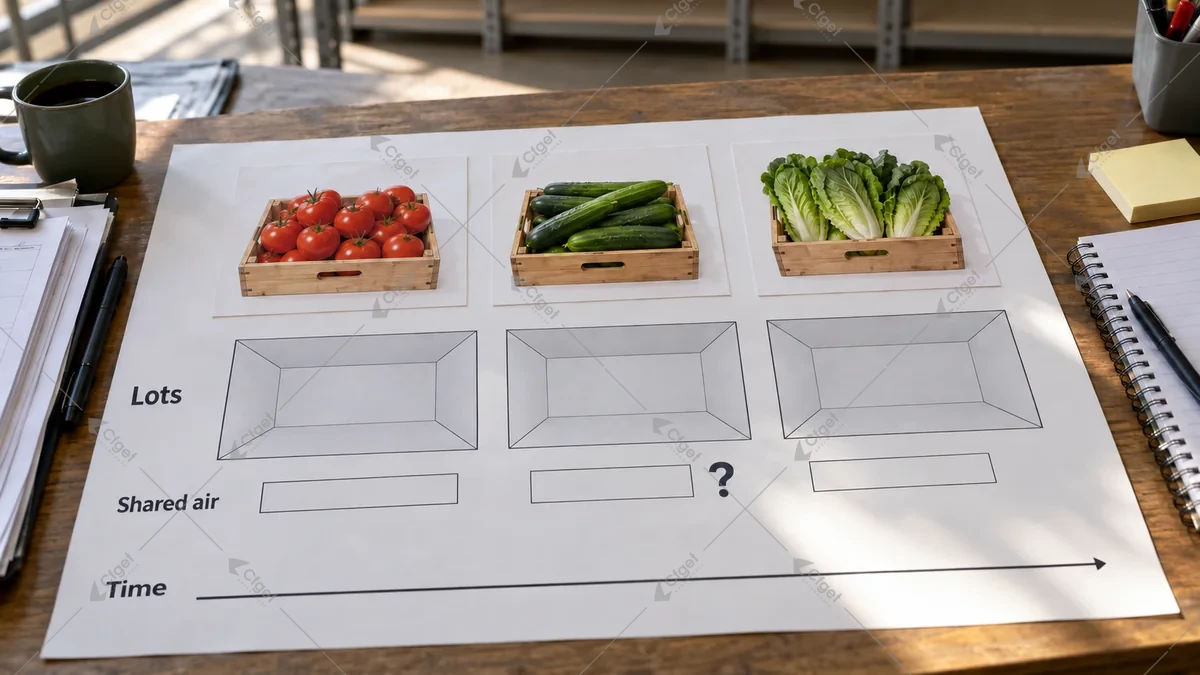
Tomato truss thinning is worth discussing when the current crop repeatedly misses a saleable size or harvest-format requirement. The decision should account for fruit number, grade distribution, rejected output and labor. A larger average tomato alone does not establish a better commercial result.
Begin with the cultivar, season and buyer specification. Then review comparable trusses and harvest records with the crop adviser. There is no single retained-fruit count that this article can prescribe for every greenhouse tomato.
Which product are you trying to sell?
A loose slicing tomato, a cherry or grape tomato, and a whole truss sold on the vine have different commercial requirements. Record the actual product type, accepted size bands, maturity and presentation. Ask the buyer to define these before treating “larger fruit” as an objective.
Alabama Cooperative Extension’s greenhouse tomato guidance treats thinning differently for larger slicing types and cherry or grape types, with whole-cluster harvesting adding another condition. That distinction supports a product-specific decision. Its suggested counts should not be exported as a universal rule.
Identify the recurring problem in your own grade records. Is there excessive undersize, excessive oversize, uneven fruit within a marketed cluster, or a different rejection reason? Thinning should not become the default response to every quality complaint.
Separate deliberate thinning from poor fruit set
This decision concerns intentionally reducing retained fruit after set. If fruit are missing because set or early retention failed, the investigation belongs first with pollination and fruit-set management.
Record the truss position, set date where known, fruit currently set and fruit retained under existing practice. Add the cultivar guidance, plant and canopy condition, and current light or seasonal context for the adviser’s review. Do not infer a thinning requirement from one photograph of a heavily loaded truss.
Use comparable historic cohorts where records exist. A later truss in another season may differ in several respects besides retained fruit number. Keep those differences visible rather than attributing all changes in size to the thinning practice.
What do the studies establish?
A 2013 long-term greenhouse study using cultivar Elegance found that the treatment with the largest average fruit was different from the treatment with the highest total yield. Thinning did not affect fruit Brix in that experiment. The result illustrates a size-versus-output tradeoff under its conditions, not the best count for your crop.
In a separate 2004 study of thinning and training, restricting fruit load did not increase total yield, marketable yield or soluble solids. These findings are a reason to preserve several outcome measures rather than promise that thinning automatically increases yield or sweetness.
Historic market assumptions also need care. AHDB project PC 065, conducted in 1991–1993, reported both size-distribution effects and production tradeoffs. Its stated market size preference is historical. Use today’s buyer specification for today’s commercial decision.
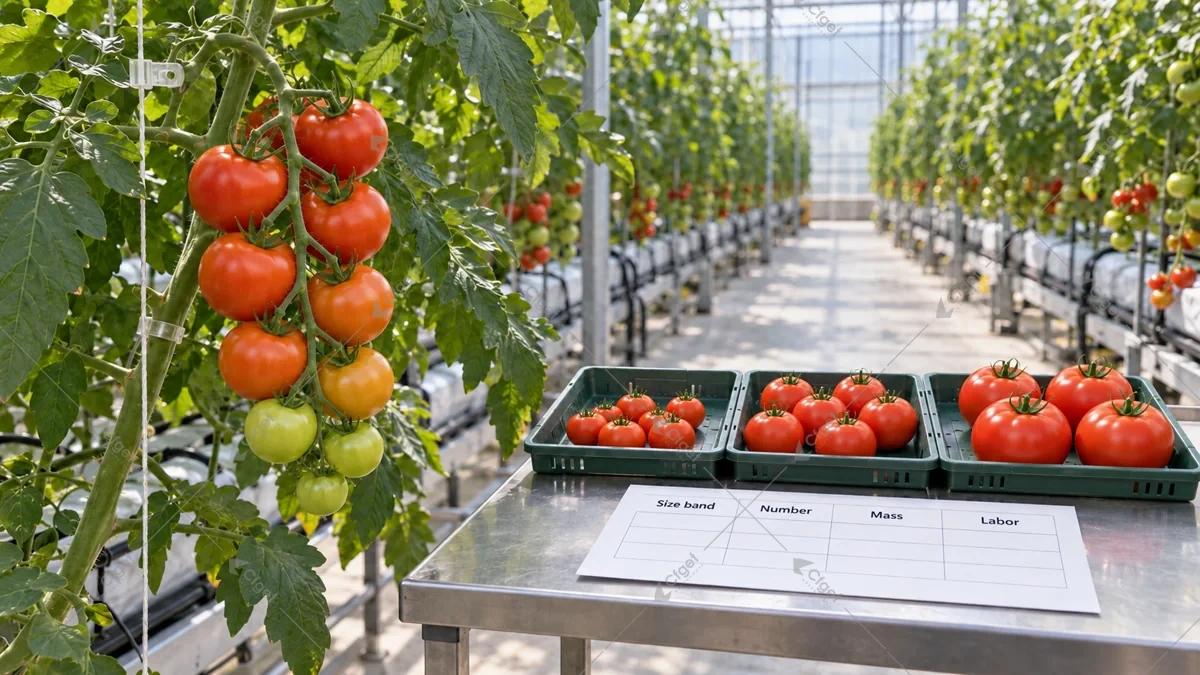
Keep a truss-load decision card
Download the decision card and the harvest outcome ledger. They organize the discussion without setting a pruning count or authorizing an intervention.
| Before a change | What to record |
|---|---|
| Commercial requirement | Product type, buyer size bands, grade, maturity and cluster presentation |
| Crop identity | Cultivar, block, crop stage and relevant cultivar guidance |
| Truss record | Truss position, set date or cohort, fruit set and fruit retained |
| Plant context | Plant/canopy observations and light or seasonal context |
| Existing evidence | Comparable historic cohorts, size distribution, culls and labor |
| Proposed decision | Retain practice, discuss a bounded change, or collect missing evidence |
| Responsibility | Adviser, approved scope if any, required observations and review date |
Keep the card linked to harvest records. An intervention record without its later grade results cannot answer whether the change helped the commercial objective.
Have the crop adviser specify any plant intervention and sanitation method. This article gives no schedule for removing fruit and no instruction to remove healthy foliage. Thinning must also never be used as a substitute for an engineer-approved crop-support structure.
Count saleable output, not just larger fruit
For each recorded cohort, retain total picked fruit count, number and mass in every agreed size/grade band, cull count and mass, harvest dates and the associated thinning labor. Define the observation unit, such as a documented group of trusses, and keep that unit consistent.
Calculate saleable mass by adding the weights of the accepted grades. Keep the rejected grades separate. If you report mean fruit weight, state which fruit are included and retain total fruit count beside it. A mean derived only from the best grade does not describe the whole harvest.
Record the harvest spread so that a shift in timing remains visible. Do not turn it into a sales commitment without the separate supply evidence. Equally, do not assume that a higher grade automatically receives a premium; use confirmed buyer terms if a revenue comparison is needed.
Include the labor actually attributable to thinning and any changed handling requirement. Record task time, crew basis and the completed observation unit, while separating extra recordkeeping from ordinary production work.
Choose one of three next steps
Retain the current practice when the crop meets the relevant grade and presentation requirements and the evidence does not support a change. A visually impressive comparison elsewhere is not enough to displace local records.
Discuss a bounded change when a repeated grade problem is documented and cultivar guidance and crop context make load adjustment a reasonable question. Let the adviser define the scope and evidence needed before expansion.
Collect missing evidence when the buyer requirement, fruit count, grade mass or labor record is absent. Without those fields, it is easy to mistake a size change for a commercial improvement.
Review all outcomes together. The decision should explain what changed in saleable quantity and size distribution, what it required from the team, and what remains uncertain. That is a stronger basis for truss management than repeating a fixed count for every tomato crop.