Manage greenhouse pollination by separating flower quality, pollen viability, transfer, fertilization, and early fruit retention. Match the method to crop biology, climate, pesticides, and local rules; diagnose tagged fruit-set data before adding hives or labour.
*By Coraline Liao, CEO, CFGET | Updated: September 18, 2026*
*Reviewed by CFGET Project Planning Team*
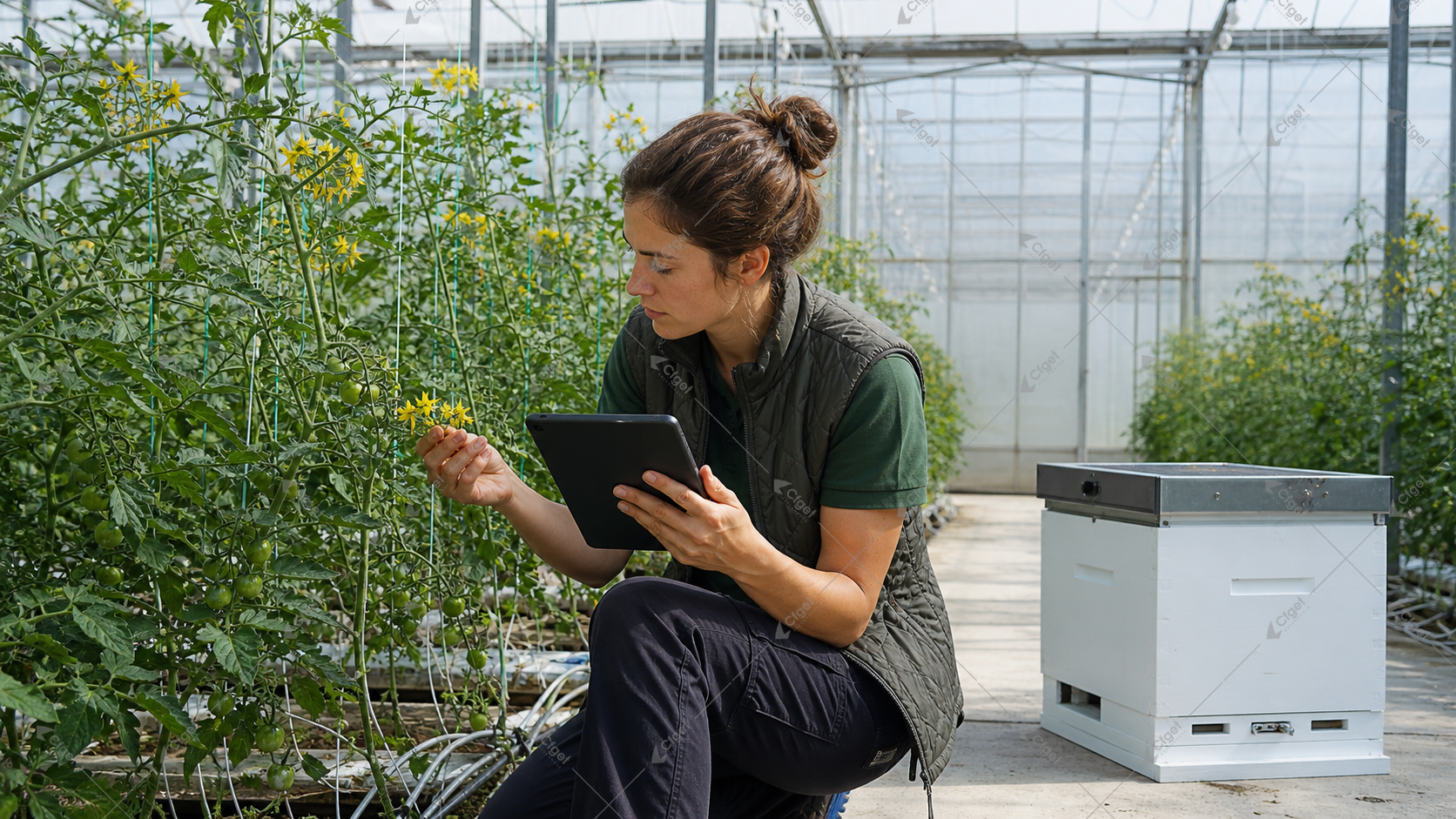
Poor fruit set is often blamed on too few pollinators, but adding hives or labour will not fix pollen damaged by temperature, humidity, crop nutrition, pesticide exposure, weak flowers, or a badly timed pollination window.
Use this with our Commercial Greenhouse Buying Guide topic cluster. For a full project, keep it beside Commercial Greenhouse Solutions so the structure, systems, and crop plan do not drift apart.
What should the buyer know first?
- Confirm the crop, cultivar, flower stage, pollen biology, compatibility, and need for self, cross, vibration, hand, or insect-assisted pollination.
- Record flower-zone temperature, humidity, condensation, air movement, and relevant stress before assuming pollen transfer is the only constraint.
- Coordinate hives or manual work with pesticide labels, re-entry rules, local biosecurity, flower availability, crop tasks, and escape prevention.
- Track flower cohorts through pollination evidence, initial set, seed or fruit quality where useful, and early abortion so the failure stage is not guessed.
Key facts worth checking
| Diagnostic stage | What to establish | Evidence |
| Flower and pollen | Flower quality, pollen release or viability, compatibility, and climate | Tagged flowers and local measurements |
| Transfer | Method, timing, activity, coverage, and pesticide compatibility | Observation route and work log |
| Outcome | Initial set, shape or seed evidence, abortion, and zone pattern | Cohort fruit-set record |
How I would test this before pricing
I would tag flower cohorts, locate the failure stage, overlay climate and pesticide events, verify actual transfer activity, then test one controlled correction before increasing hives or labour across the whole crop.
Notes from an early project review
- I would mark flowers by date and bay for a small diagnostic cohort; a whole-house fruit-set percentage can hide a three-day climate event or one weak zone.
- Hive entrance activity alone does not prove useful flower visits, and visible visit marks do not prove viable pollen or successful fertilization.
- Before increasing hive density, I would check pesticide timing, condensation, pollen release, cultivar compatibility, flower nutrition, and whether workers are closing or disturbing flowers during other crop tasks.
Questions to settle before the RFQ
| Buyer question | What to decide before requesting a price | Why it protects the project |
| Design basis | Flower and pollen: Flower quality, pollen release or viability, compatibility, and climate | Tagged flowers and local measurements |
| Difficult operating case | Transfer: Method, timing, activity, coverage, and pesticide compatibility | Observation route and work log |
| Acceptance evidence | Outcome: Initial set, shape or seed evidence, abortion, and zone pattern | Cohort fruit-set record |
Evidence pack
Use the following evidence to challenge the design basis. A checklist item is useful only when the supplier attaches a value, drawing, calculation, test, or named responsibility.
Climate and project assumptions to confirm
- Confirm the project-specific crop biology: Cultivar, flower stage, compatibility, and pollen-transfer need. State who verifies it and when.
- Confirm the project-specific active window: Flower-zone climate, work timing, and pesticide restrictions. State who verifies it and when.
- Confirm the project-specific coverage evidence: Visits, vibration or manual work by bay and date. State who verifies it and when.
Sources worth checking
- Pollination of Greenhouse Tomatoes
- Pollination of Greenhouse Tomatoes – Integrated Pest Management
- Improving Pollination Efficiency in Greenhouse…
Neutral source to keep beside the quote
CFGET project planning note
CFGET’s review would begin by reconciling flower quality, pollen release or viability, compatibility, and climate with tagged flowers and local measurements, then marking every unresolved interface on the drawings and responsibility matrix.
Buyer risk signal
Pause the comparison when every poor set is called insufficient pollination; hive count is managed separately from operations; or a whole-house impression triggers more hives.
Ask the supplier for these exact specs
Require a completed response for Crop biology, Active window, Coverage evidence, Outcome, supported by the relevant drawings, calculations, settings, or test records. Do not accept “standard” or “as required” where a project value can be stated.
Project video: crop production reference
This field video gives a crop production reference to read beside greenhouse height, irrigation, drainage, climate, and operation assumptions.
Which part of the pollination process is failing?
Break the process into flower formation, pollen production and release, transfer to the receptive flower part, fertilization, and retention of the young fruit. Heat, cold, humidity, condensation, nutrition, plant load, cultivar, and disease can act at different stages.
Use cultivar and crop-specific technical guidance. Do not apply one temperature, humidity, hive density, or manual frequency globally; record what was flowering, where, and under which climate when the problem began.
Technical reference for this decision: Pollination of Greenhouse Tomatoes.
How should climate, pollinator method, and crop work be coordinated?
Choose insects, vibration, manual transfer, or another method from crop biology, scale, labour, biosecurity, local rules, and production system. For managed pollinators, plan hive source, placement, orientation, food competition, replacement, heat protection, escape, disposal, and observation.
Build a pesticide compatibility process around label restrictions and supplier guidance. Share spray plans with the pollination owner, protect or remove hives when required, record active ingredient and timing, and avoid assuming a product is safe because mortality is not immediately visible.
Technical reference for this decision: Pollination of Greenhouse Tomatoes.
| Check | Good sign | Risk sign |
| Diagnosis | Flower, pollen, transfer, fertilization, and retention are separated | Every poor set is called insufficient pollination |
| Coordination | Climate, pesticides, crop work, and local rules are integrated | Hive count is managed separately from operations |
| Evidence | Tagged cohorts and zone-time records guide changes | A whole-house impression triggers more hives |
What to request from a supplier
Ask for crop and cultivar, flowering calendar, compatibility and pollination biology, climate records at flower height, proposed method and capacity, hive or labour placement and timing, local biosecurity requirements, pesticide compatibility process, observation route, tagged-cohort method, fruit-set definitions, replacement or corrective triggers, training, records, and contingency plan.
What monitoring distinguishes a pollination problem from later fruit loss?
Create fixed observation routes and tagged flower cohorts by bay, cultivar, and date. Record open flowers, method or visit evidence, local climate, pesticide or crop-work events, initial fruit set, malformed fruit where relevant, and early abortion.
When performance drops, compare zones and time windows. Run a small controlled correction such as climate adjustment, verified manual treatment, hive move, or work-timing change, while keeping an untreated comparison where practical. Add pollinators only when transfer capacity is the identified constraint.
Technical reference for this decision: Pollination of Greenhouse Tomatoes – Integrated Pest Management.
| Management field | Example | Why it matters |
| Crop biology | Cultivar, flower stage, compatibility, and pollen-transfer need | Sets the method |
| Active window | Flower-zone climate, work timing, and pesticide restrictions | Protects viable pollination |
| Coverage evidence | Visits, vibration or manual work by bay and date | Shows whether transfer occurred |
| Outcome | Tagged initial set and early retention by cohort | Locates the actual failure stage |
Practical next step
Prepare one page covering Crop biology, Active window, Coverage evidence, Outcome. Add the project city, crop, greenhouse area, available utilities, relevant drawings, and the party responsible for local work. Send that evidence to [email protected] for a first technical-scope review.
Before you use this recommendation
- Treat the article as a decision and RFQ guide, not a final engineering design.
- Replace every example with project-specific climate, crop, utility, code, and operating data.
- Require calculations, drawings, test records, or named assumptions for every important supplier claim.
How I researched this guide
This guide combines the current search evidence listed above with a greenhouse project planning checklist: define the failure case, trace the interfaces, identify measurements, and turn unresolved assumptions into RFQ fields. CFGET observations are labeled as project-review judgment; local engineering and operating data remain the final authority.
Coraline Liao is CEO of CFGET. Her public LinkedIn profile describes her as a Greenhouse Technical Director with more than 15 years in the greenhouse industry, focused on customized climate-control and greenhouse solutions. Her published technical topics include greenhouse structures, climate control, light management, hydroponics, and fertigation. Her article reviews begin with the crop, climate, site, project scope, installation boundaries, and operating constraints. Technical recommendations should be adapted to local climate data, crop plans, budgets, and professional engineering review before implementation.
Professional profile: Coraline Liao on LinkedIn
Company details
CFGET: Founded in 1996, CFGET designs, manufactures, and delivers greenhouse systems and smart farming solutions from its own factory in Sichuan, China.
Address: NO 108, South Area Chengdu Modern Industrial Park, Sichuan, China
Email: [email protected]
About the company: https://cfgreenway.com/about/
Company profile: GreenWay on LinkedIn
Technical videos: Greenhouse project channel on YouTube
Where this fits in the greenhouse buying cluster
Start with the hub, then open the system or crop pages that match your decision.