A proposed greenhouse budget says “seven workers per hectare.” Before multiplying that figure by the planned area, ask what those workers do, how many hours the estimate assumes and when the work occurs.
A staffing benchmark is useful only after its boundaries are clear. Convert comparable evidence to a stated hours basis, then check whether the available people can cover the required roles during the actual working windows. An annual labor total cannot establish that harvest, packing and crop care can all happen on Tuesday morning.
What does the published number include?
Protected Cropping Australia’s employment page gives an overseas estimate of 11,293 annual hours per hectare of high-tech structure. It excludes packing and other work outside the greenhouse. With an assumed 1,610 hours per worker-year, the page arrives at about seven workers per hectare. The underlying overseas study is not named there.
This is a useful example of why the denominator matters. The calculation describes annual greenhouse work on that assumed hours basis. It does not show seven people covering every duty of a particular business, and it does not identify the peak shift requirement.
The 2019 Greenhouse Cucumber Production manual, on printed page 13, discusses labor units that include production and postharvest. That boundary differs from the greenhouse-only estimate. Do not average the two figures or treat their similar-looking units as interchangeable. The manual’s historical technology and efficiency statements are not current guarantees.
Keep people, equivalent hours and area distinct
Headcount counts people. A full-time equivalent, or FTE, expresses an amount of work against a defined full-time hours basis. A “labor unit” needs its author’s definition before it can be converted to either one. Write down whether the source means paid hours, available hours or hours spent on the included work.
For example, four people each supplying twenty hours in a period provide eighty hours in total. That is an arithmetic description, not four full-time equivalents or a guarantee that their skills and schedules fit the work. Do not silently substitute your own annual hours assumption into a source that uses a different basis.
Check the area just as carefully. Gross building area, cropped area and occupied growing area may give different ratios for the same workforce. Use a defined measurement from the greenhouse growing-area plan. Record whether the benchmark and proposed facility include the same areas and periods of occupancy.
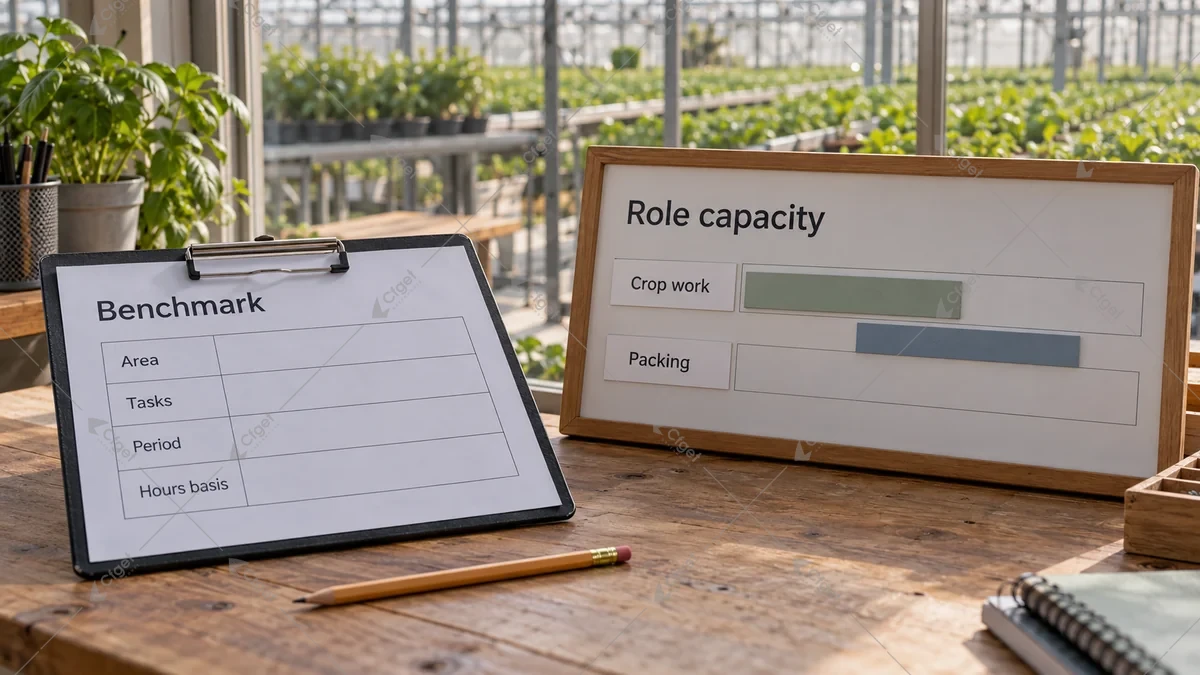
The benchmark boundary card keeps source date, country, crop, system, area denominator, included tasks, excluded tasks, period and hours basis together. Its final field asks whether the source is comparable, useful only as context or unresolved. Missing definitions stay visible.
Turn the benchmark into role-by-period capacity
Use the second tool, the role-and-period capacity sheet, to examine one defined working window. Duplicate the sheet for additional roles or windows, keeping the same role-pool identifier wherever the same people are shared.
Start with actual task quantities and work rates observed under relevant conditions. State the unit: plants checked, trays moved, kilograms packed or another defined task output. Identify whether the observed rate already includes setup, cleanup and ordinary interruptions. Add those hours separately only when they are excluded from the rate.
The sheet calculates task hours as quantity divided by the stated units per hour, then adds separately recorded setup and cleanup hours. Blank inputs remain unavailable. Enter an explicit zero when no separate allowance applies. This avoids counting the same time twice or treating an unanswered field as no work.
Enter available productive hours for the same period after accounting for the other commitments already assigned to that role pool. Keep the paid-hours roster alongside it. If the productive-hours estimate already allows for a particular loss of available time, do not deduct it a second time.
| Check | What would make the capacity claim misleading? |
|---|---|
| Task boundary | The rate covers only handling while the workload also requires preparation and cleanup. |
| Working window | Hours available later in the week are counted against a task due this morning. |
| Competency | General labor hours are counted as coverage for a role requiring skills or authorization those people do not have. |
| Shared people | The same available hours appear in both harvest and packing allocations. |
| Coverage | The total ignores supervision, equipment support or another required role during the window. |
A weekly total can conceal a morning shortfall
Take a hypothetical two-hour dispatch window. A defined packing task requires 120 units at an observed rate of 60 units per productive hour. Setup and cleanup add one hour, making three role-hours required. A second simultaneous task needs two hours from the same qualified team. The combined requirement is five role-hours.
Suppose two suitably trained people each have two productive hours available in that window. They supply four role-hours, leaving a one-hour shortfall. Available time on Wednesday cannot fill that Tuesday window. Assigning the same person to both tasks in the worksheet does not add capacity.
These figures only demonstrate the calculation. They are not commercial work-rate benchmarks. Replace them with observed quantities, rates and availability for the crop, equipment and handling method being planned. The file is blank so a reader cannot mistake illustrative numbers for recommended staffing.
A response might change the dispatch arrangement, provide qualified cover or alter the allocation of work. Record who has confirmed that response and whether it closes the specific window. Simply raising the annual FTE budget leaves the scheduling question unanswered.
Use the result to challenge the production plan
Review the windows that matter to the proposed crop calendar with the grower and operations manager. An observed rate from a stable mature crop may not describe crop establishment, a different package or a changed handling system. Keep the conditions beside the rate and flag an unmeasured new task.
If critical-role coverage remains unresolved, the production scale or system package is not yet supported by a workable staffing plan. Ask the relevant operations or technical specialist to examine that specific constraint. This is a planning decision about tasks, roles and time, not a score of individual employees.
The finished record should connect three things: what an external benchmark actually measured, what the planned operation requires and who can cover each required window. That connection is much more useful to an investor than a single staff-per-hectare number.