A tomato catalogue can list a long resistance package and still leave your farm’s main concern unanswered. The missing detail may be the organism, a race designation, the market’s coding convention or whether the claim belongs to the scion rather than the rootstock.
Keep a cultivar on the shortlist only after its exact claim has been compared with the named risk. Use a qualified crop adviser to interpret the diagnosis and the claim’s scope. High resistance does not mean immunity, and a resistance label does not establish the health of a supplied seed lot.
Begin with the concern the claim must answer
Record the concern in the form supported by the farm’s evidence. Keep a laboratory report, adviser assessment or documented regional risk distinct from an unexplained symptom description. “Wilt last season” is not yet a precise organism-and-race requirement.
The purpose of this record is procurement, not diagnosis. Where the identity of the problem remains uncertain, mark the claim comparison unresolved and ask the crop adviser what evidence is needed. Do not choose a disease name simply because it appears beside a desirable cultivar.
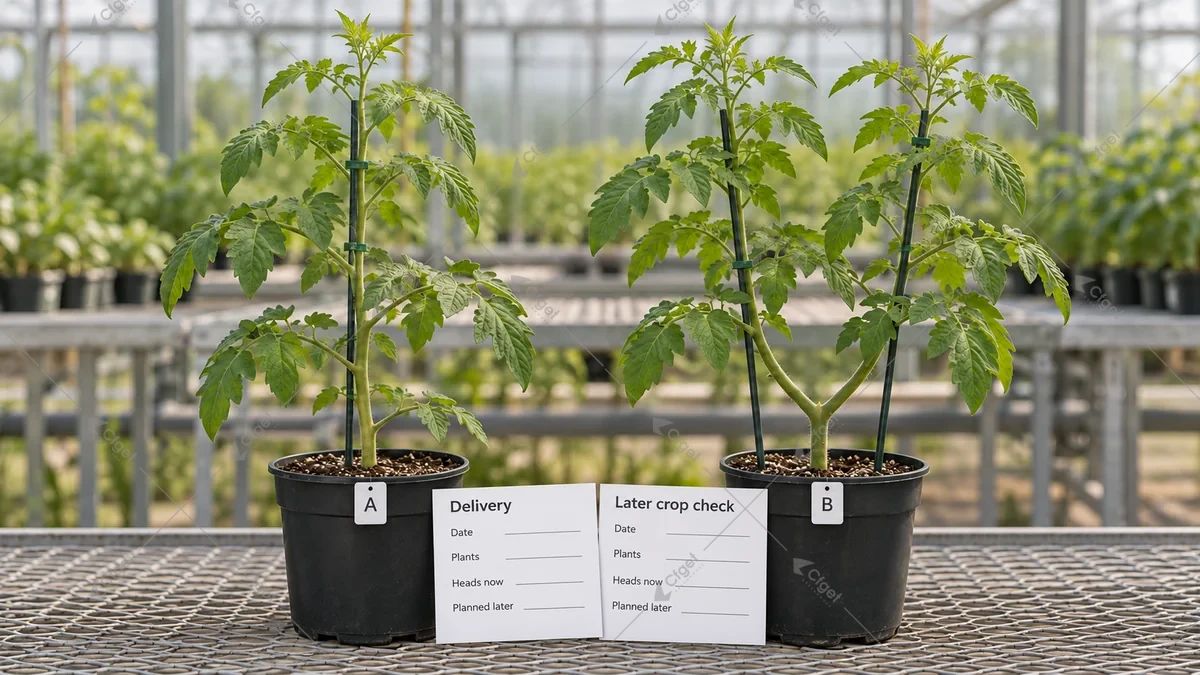
Identify the exact cultivar and whether the claim concerns a fruiting scion, a rootstock or another supplied plant component. Keep their records separate. A package of claims on the rootstock document should not be copied into the scion’s entry, or treated as a combined guarantee for the finished crop.
Read HR and IR with their limits attached
The International Seed Federation’s 2022 definitions describe high resistance, HR, and intermediate resistance, IR, as different degrees of restriction of the specified pest or its effects. HR plants can still show symptoms or damage under heavy pressure. Neither abbreviation promises that disease cannot occur.
The same document limits a resistance claim to its specified pest and, where applicable, its named subdivisions. It also explains that some pests have no accepted race or pathotype classification. A missing race number therefore needs interpretation; it is not permission to assume universal coverage or invent a race.
Do not use HR and IR as a complete ranking of two varieties from different suppliers. Bayer’s explanation of resistance terminology distinguishes the observed resistance designation from its genetic mechanism and discusses differences in company claims. The class alone does not identify the genes involved or predict which cultivar will perform best on your farm.
Match each named risk to one exact claim
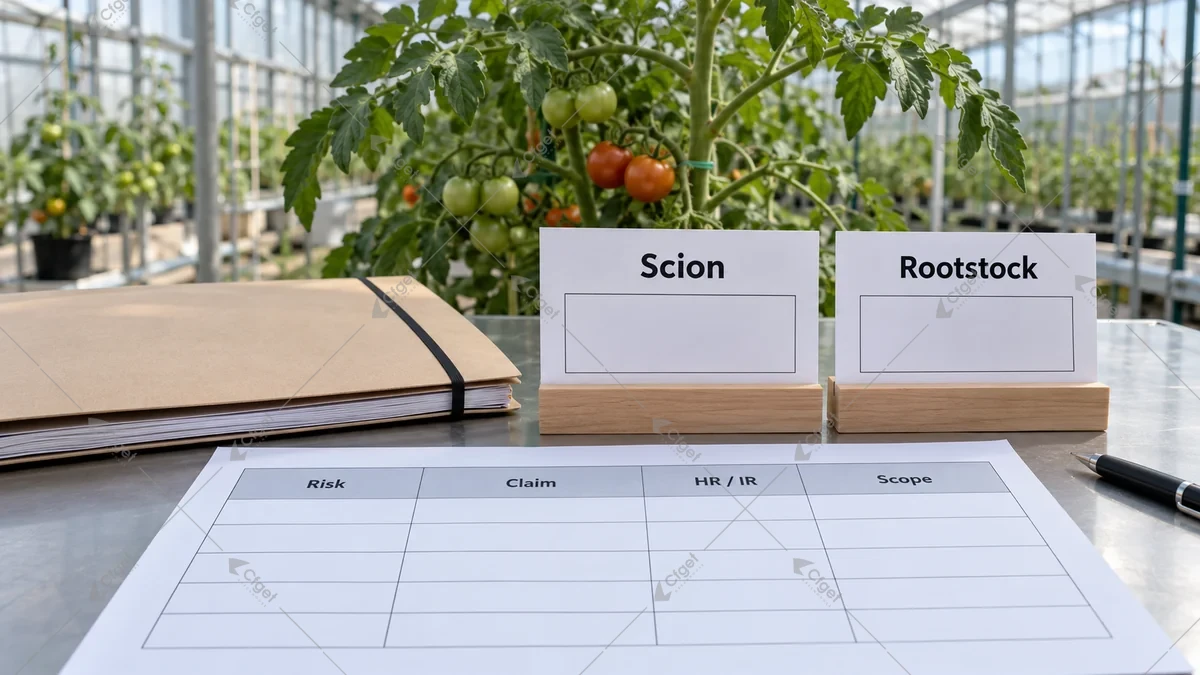
Use one row per identified risk and cultivar component in the risk-and-claim register, linked by its record identifier to the detailed claim card. When a cultivar has several relevant claims, compare each one separately rather than giving the whole package a single tick.
| Record | What the comparison needs |
|---|---|
| Risk evidence | Report or adviser reference, date, crop and the organism identification actually supported. |
| Cultivar identity | Exact name or code, supplier, scion or rootstock, and the document’s market and revision. |
| Claim wording | Organism name and code, HR or IR, specified race, strain or isolate scope, and relevant footnotes. |
| Code convention | The applicable regional convention and any interpretation confirmed by the supplier or adviser. |
| Conditions | Limits stated for the claim and whether the farm concern falls within them. |
| Result | Match, mismatch or unknown for this named concern, with the unresolved question and response. |
A match means the documented claim addresses the identified concern at the stated level and scope. It does not establish immunity, yield or a successful crop. A mismatch means the supplied claim does not cover the identified requirement. Unknown means the evidence cannot yet establish the comparison; it should not quietly become a match.
A catalogue example shows why the fields matter
On the Canadian De Ruiter Serenity page checked on 2 October 2026, the HR field includes Fol:1,2, while the separate IR field includes ToBRFV and TSWV:0. This is a short reading example from that market’s current page, not a cultivar recommendation.
Suppose a buyer’s verified concern were Fol race 3 under the same confirmed numbering convention. The displayed Fol:1,2 claim would not document that requirement. The immediate result is a mismatch between requirement and published claim, followed by a precise supplier question. It is not a diagnosis or proof of the plant’s response to every unlisted race.
If the farm report and catalogue use different conventions, the result stays unknown until those conventions are reconciled. Bayer’s terminology article gives a real example of differing European and US Verticillium designations. Copying the same-looking digit without checking its convention can therefore defeat the comparison.
The Serenity page also separates resistance information from agronomic and performance qualifications. Preserve the full relevant footnote with a saved claim. Do not extract a favorable abbreviation while discarding the conditions around it.
Keep seed-lot health and crop protection separate
A varietal resistance claim describes the variety’s response to a specified challenge. It is not a test result for the lot being purchased. Keep any seed-health or nursery-health evidence with its own lot identity, sampling basis and purpose. One record cannot stand in for the other.
Likewise, a matching resistance claim does not close the facility’s exclusion and hygiene decisions. The site guide to tomato production and virus-risk barriers in Souss-Massa addresses those wider system questions in a specific Moroccan context. Use the applicable local crop-protection plan for your operation.
Make the supplier question answerable
Send the exact cultivar identifier, market document and the named concern to the supplier through your normal procurement process. Ask what the claim covers, how any race convention is defined and which conditions or limitations apply. Avoid asking only whether a variety is “disease resistant.”
Have the crop adviser review unresolved diagnostic or nomenclature questions before the order is finalized. Keep the dated response in the card and recheck it if the cultivar, rootstock, market document or disease information changes. The result is a shortlist whose resistance claims answer the farm’s actual questions.