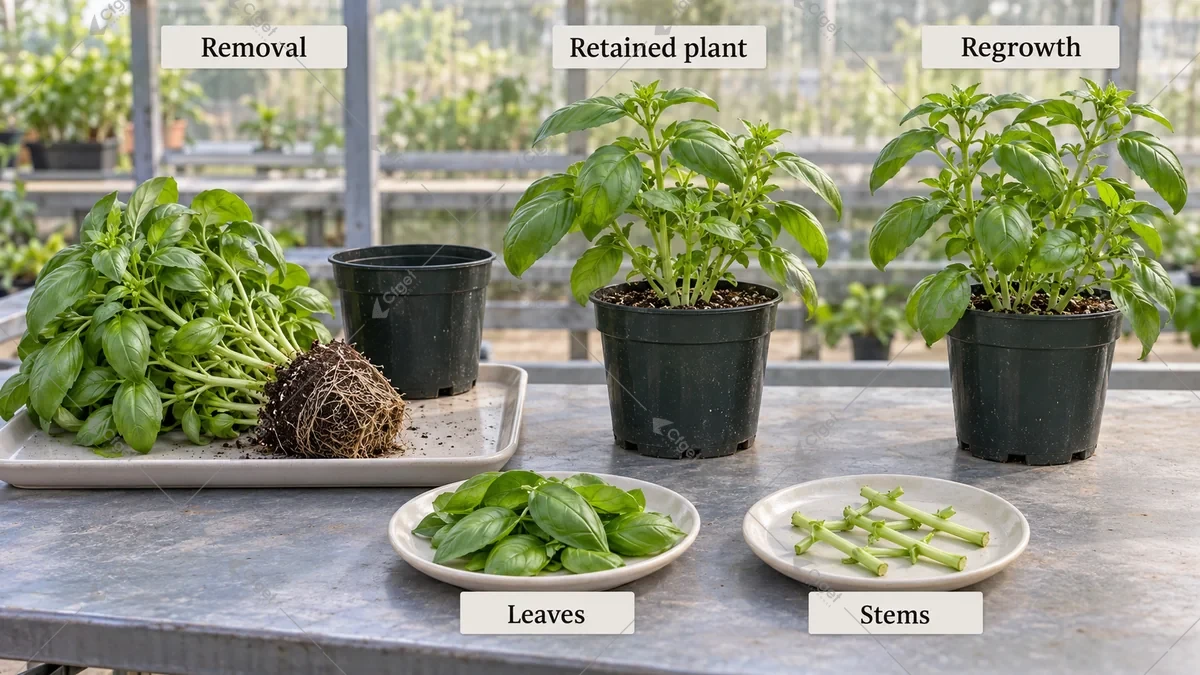
A later basil cut is regrowth from retained plants, not a second identical first crop. Keeping an established cohort changes the biological starting point, the occupied growing space and potentially the balance of leaves and stems in the harvest. A larger fresh-shoot total can still deliver less accepted product to a leaf-only buyer.
Compare the retained-plant route and the product it actually supplies at each cut. Before counting another harvest, distinguish gross shoots, leaf mass, stem material and buyer-accepted output. Keep the alternative whole-removal route visible.
Compare retained plants and saleable product separately
When plants remain after a cut, later shoots develop from the retained plant system. That is different from removing the crop and establishing a new cohort. The remaining roots, stems and developing buds are part of the later crop’s starting condition; they do not guarantee a repeat of its first leaf harvest.
A 2021 greenhouse study of three Genovese basil cultivars in a floating-raft system discusses established roots and changes in apical dominance as possible explanations for regrowth responses. Its spring experiment also shows why cultivar, system, density and cut context belong with a result. These mechanisms are not a promise that every later cut will increase production.
The product definition is a second decision. Rutgers’ basil fact sheet distinguishes individual leaves, stems with leaves and entire plants as possible harvested products. A buyer seeking leaf material is asking for something different from a buyer accepting whole bunches. Do not compare the masses as though they represent the same sale.
Keep gross shoots and accepted leaves on different lines
A 2020 Genovese-type glasshouse study separately measured fresh shoot material and detached fresh leaves over successive harvests. That distinction is useful for reading production claims: shoot biomass and leaf output are different quantities. Its reported cut-dependent response belongs to that experiment, not a universal forecast for another nursery.
| Quantity | What it includes | Question still needed |
|---|---|---|
| Gross fresh shoots | The defined harvested shoot material | How much belongs to the buyer’s product? |
| Separated fresh leaves | Leaf material on the stated separation basis | How much meets the buyer’s grade? |
| Stem or other separated fraction | The separately recorded non-leaf material | Is there any actual accepted use or buyer? |
| Buyer-accepted output | Accepted leaves or bunches under the named specification | Are its units and acceptance point comparable across cuts? |
Do not label all non-accepted material as stems. It may include rejected leaves or other recorded fractions. If separation was not measured, retain that uncertainty rather than inventing a complete mass breakdown.
A larger second harvest can fill less of a leaf order
Consider an invented example for one fixed basil cohort. Its first cut provides 100 kg of fresh shoots, of which 80 kg are accepted leaves. A later cut provides 120 kg of fresh shoots, but only 70 kg of accepted leaves for the same leaf-only specification.
The later cut has 20 kg more gross shoots and 10 kg less accepted leaf product. It therefore fills less of this order despite its larger shoot total. These values are teaching assumptions, not a farm trial, yield prediction or expected grade loss.
The two cuts together supply 150 kg of accepted leaves in this example. They do not supply 220 kg of accepted leaves, and multiplying the first cut’s accepted mass by two would also be wrong. The difference between gross shoots and accepted leaves needs its own measured categories before anyone assigns a secondary sale value.
Now change the buyer to one accepting a defined bunch product. The comparison must be made again on that buyer’s accepted bunch basis. The leaf-only result does not prove that the later cut is commercially worse for every market, just as a higher shoot mass does not prove it is better.
Use research to preserve the conditions, not invent a multiplier
The 2020 glasshouse paper and the 2021 floating-raft paper report different cut-related responses under their own conditions. Read cultivar, growing system, season and output definition with the conclusion. Averaging unlike study percentages would not create an expected regrowth factor for the proposed greenhouse.
Use existing records from the actual or a relevant comparable program where available. Was the later observation from the same cohort? What plant state remained after the previous harvest? Were the mass basis and buyer acceptance unchanged? A missing answer should stay visible.
This comparison does not prescribe a cut height, interval, number of cuts, density or nutrition adjustment. Those decisions require crop-specific advice. The purpose is to prevent an unverified biological repeat and an unlike product comparison from entering a commercial commitment.
Include the space retained plants still occupy
Retaining the cohort keeps growing area committed while it regrows. Whole removal ends that plant route but does not make the area instantly ready for the next crop. Keep the next-crop-ready boundary separate from the date of the first harvest or removal.
For the removal alternative, link the required turnover work to the crop-changeover guide. For the retained route, record the actual area still occupied and the condition of the retained plants. Neither route should receive an invented instant turnaround or guaranteed extra harvest in the comparison.
Use a cut-by-cut product ledger
Download the basil cut and product ledger. It is a manual record with no yield forecast or automatic cut-count multiplication. Open the file as UTF-8 comma-separated data. Identify one cohort and keep a separate column or record for each observed or provisional cut.
Record retained plant state, gross shoots, separated fractions where actually measured, accepted leaves or bunches, grade reasons and occupied area. Use explicit units and mark unknowns. The example totals are supplied as labeled teaching values, not formulas that recalculate. Compare the resulting accepted product with the whole-removal route before promising what a later cut must deliver.