A fertilizer can produce an acidic prepared solution while carrying a label that describes potential basicity. Those observations are not automatically contradictory. They answer different questions, and neither one predicts the final pH of the greenhouse substrate on its own.
Read the product’s potential reaction, prepared-feed pH, source-water alkalinity and substrate-pH trend as four separate pieces of evidence. Before selecting a replacement fertilizer, identify the complete formulation and ask what each observation actually establishes.
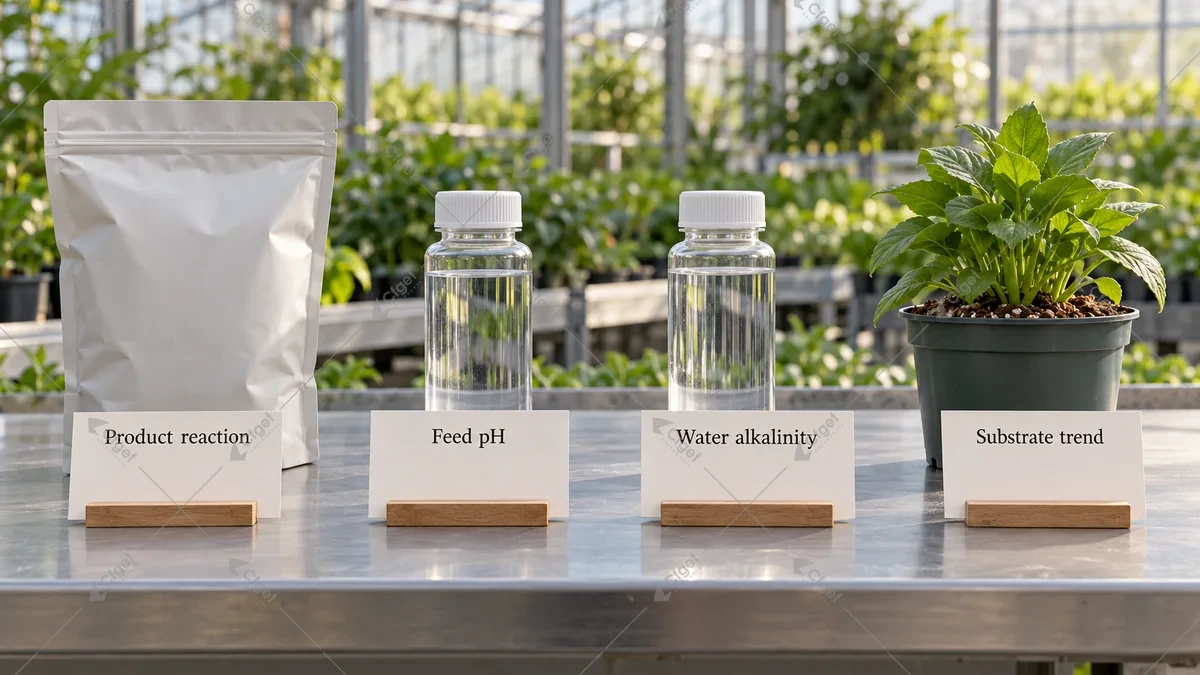
Give each of the four observations its own job
| Evidence | Useful question | Conclusion it cannot supply alone |
|---|---|---|
| Potential acidity or basicity on the product label | What reaction tendency is assigned to this formulation on its stated basis? | The final pH in a particular crop’s substrate |
| Prepared-feed pH | How acidic or basic is this solution at measurement? | The fertilizer’s complete longer-term effect in the root zone |
| Source-water alkalinity | What acid-neutralizing capacity enters with the water? | The combined outcome of water, fertilizer, substrate and crop |
| Matched-method substrate-pH trend | What is being observed in the sampled crop and medium over time? | Which single input caused the change |
UMass nutrient-management guidance describes potential acidity and basicity using a calcium-carbonate-equivalent basis per mass of fertilizer. Potential acidity expresses an acidifying effect on that basis; potential basicity expresses the equivalent basic reaction. These are not pH units.
Preserve the complete value and unit printed on the actual label. Do not drop “per ton,” silently change a ton basis or compare two unqualified numbers from different unit systems. The label value is also not a lime or acid application instruction. Water, substrate, amendments and crop processes affect the observed result.
Why an acidic solution can carry a basicity label
The University of Georgia’s pH-management publication gives a formulation-specific teaching example involving 15-5-15 Cal-Mag containing urea phosphate. In low-alkalinity water, that example can form a very acidic solution and reduce substrate pH despite the potential-basicity label. The surrounding water and formulation conditions are essential to the example.
This does not establish that every present-day product labeled 15-5-15 behaves identically. The three NPK numbers are not the entire formulation. The example shows why a low solution-pH result cannot be used to declare the potential-reaction label wrong or to predict the outcome in a different water and substrate system.
Keep both observations. Record the product identity and nitrogen forms, the prepared-solution context and the water analysis. The apparent mismatch is a reason to improve the interpretation, not a reason to discard one of the measurements.
Do not shop from NPK and one tank reading
Imagine a hypothetical purchasing note containing only “15-5-15” and “tank pH low.” A replacement offer lists another fertilizer’s NPK numbers and describes it as low acid. The team still lacks the exact original formulation, label reaction basis and evidence of what is happening in the crop.
The first question is whether “tank” means concentrated stock or the prepared feed delivered to the crop. Then establish the product and the source water used for that reading. A value without this context cannot be placed beside a substrate-pH trend as if both describe the same sample.
Next, obtain the actual potential-reaction entry from each current product label. JR Peters’ professional-product catalog, for example, describes 17-5-24 Low Acid Peat-Lite in terms of low potential acidity. That confirms a real commercial attribute to compare. It is not a recommendation for the hypothetical grower or proof that a marketing phrase predicts the root-zone result.
The purchasing decision remains open until the crop adviser can relate those product differences to the crop’s water and substrate evidence. A more complete label can narrow the question without becoming an automatic replacement instruction.
Use the trend to locate the next question
Suppose, in a fictional review, the prepared-feed pH is acidic but comparable substrate tests show an upward trend. Keep that observation rather than forcing it to match the sign implied by the tank reading. Ask the adviser to review water alkalinity, the formulation, the substrate and the relevant crop history together. The trend does not identify a cause by itself.
In a second fictional case, the product label is unchanged but the water source has changed. The old fertilizer assessment may no longer describe the combined conditions. The immediate task is to reconcile the new source-water information and actual delivered feed, rather than adjusting fertilizer from an assumed NPK-to-pH rule.
The water pH and alkalinity guide handles the source-water distinction in more detail. If the feed reaching the crop is uncertain, use the separate injector-verification guide. Product interpretation and delivery verification answer different parts of the investigation.
Build a four-evidence interpretation card
Download the fertilizer reaction and pH evidence card. It is a manual record with no dose or final-pH calculation. Open it as UTF-8 comma-separated data and keep the four evidence groups separate.
- Attach the complete current product label, formulation and potential-reaction units.
- Identify the prepared-feed sample and its water and solution context.
- Add source-water alkalinity and the crop’s matched-method substrate-pH trend.
- Record what the adviser can conclude and the specific uncertainty still to resolve.
A useful conclusion might be that the label is understood but the water basis is missing, or that a documented product comparison can now proceed. Neither a completed card nor one favorable pH reading supplies permission to improvise acid, alkali or fertilizer changes.