A tomato plant carrying only a few trusses can look easier to manage than a crop kept in production for many months. But replacing plants more often creates its own recurring work. Before choosing repeated short crops, decide whether your team can reliably establish, finish and renew them while the rest of the business continues.
This is a choice about the production system. A long crop keeps the same plants working through an extended harvest. A short, low-truss programme deliberately limits the crop on each plant, then relies on replacement groups. A shorter plant does not by itself tell you which programme will use less work or deliver the more useful product.
One commercial record shows why the whole sequence matters
Itoh and colleagues’ 2020 study followed Momotaro York tomatoes in one 1,730 m² commercial greenhouse in Miyagi, Japan, during 2014–2015. Plants were topped above the third inflorescence. The system included seedling growth followed by a separate greenhouse nursery stage before transplanting into production slabs.
Across six partly overlapping experimental periods, final transplanting to the end of observation ranged from 87 to 140 days. Those endpoints do not report when a cleared area was ready for replanting, and the six periods were not six successive whole-house crops. The study developed a crop-production model; it did not compare labour or profit against a long-crop system.
The practical point is that work began before final transplanting and the observed periods did not share one fixed length. A new programme needs its own evidence for the complete sequence.
Compare the work you keep with the work you repeat
Ask the crop team to describe the work that makes the existing long crop demanding. Is the concern continuing plant care, access to the crop, maintaining acceptable fruit, or keeping an ageing crop productive? Identify the actual problem before assuming shorter crops will solve it.
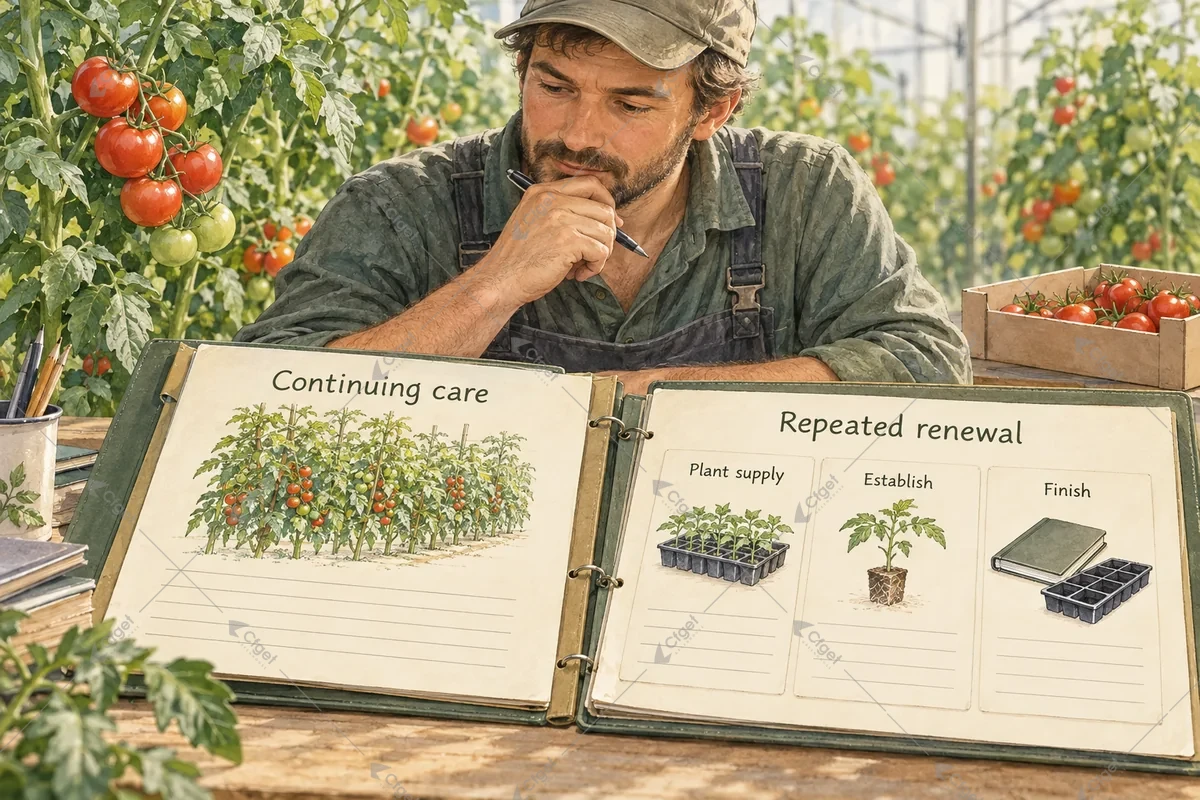
Then describe what renewal would repeat: receiving or raising replacement plants, preparing the production area, establishing them, finishing the previous crop and removing its material. Include supervision and the disruption to other jobs. These are operating questions for your farm, not a labour-saving result from the Japanese study.
If the team handles routine crop care well but already struggles whenever planting and removal coincide, repeated renewal may increase the pressure at its weakest point. If establishment and finishing are dependable, a limited short-crop evaluation may be worth considering. Either judgment needs actual task records rather than an impression based on plant height.
Make replacement plants a continuing commitment
Once renewal becomes part of normal production, plant supply must support it repeatedly. Establish who is responsible for making suitable plants available, where they will wait if the production area is delayed, and who decides what happens when a batch is unsuitable.
Keep this separate from the detailed calculation of buying versus raising transplants. The immediate question is whether the intended programme can be supported at all. One successful delivery does not settle the reliability of recurring requirements across the intended seasons.
Finishing one group while others remain in production also requires an orderly division of work and access. Retain the site’s required crop-removal and plant-health procedures. Choosing short crops does not resolve the separate question of whether new plants may overlap an old crop in the same area.
Judge the programme by usable output and manageable work
For a bounded evaluation, use comparable local records of buyer-accepted fruit, the work performed and the inputs consumed over the production period that matters to the business. Include establishment and finishing, rather than examining only the weeks when harvesting feels convenient.
Keep seasonal experience visible. A favourable group in one period cannot establish what the operation can repeat through every intended crop. Avoid multiplying a short observed period into an annual production promise.
Retain the long-crop approach if the reason to change remains unclear. Try a limited short-crop programme where plant supply, renewal work and the intended product can be supported. Expand only when the recurring obligations are demonstrated. Then use the tomato greenhouse project-planning guide to carry the chosen programme into the facility brief. The building should support the work the business is actually prepared to repeat.