Choose an iron chelate by matching its declared chemical form to assessed root-zone conditions. The printed iron percentage tells you how much iron the product declares on a particular analysis basis. It does not establish how well that iron remains in a useful soluble form in your crop system.
For a purchasing comparison, obtain the exact ligand, the chelated-iron declaration and the manufacturer’s conditions before ranking products. An elevated substrate pH is a reason to investigate that match, not an automatic instruction to add iron.
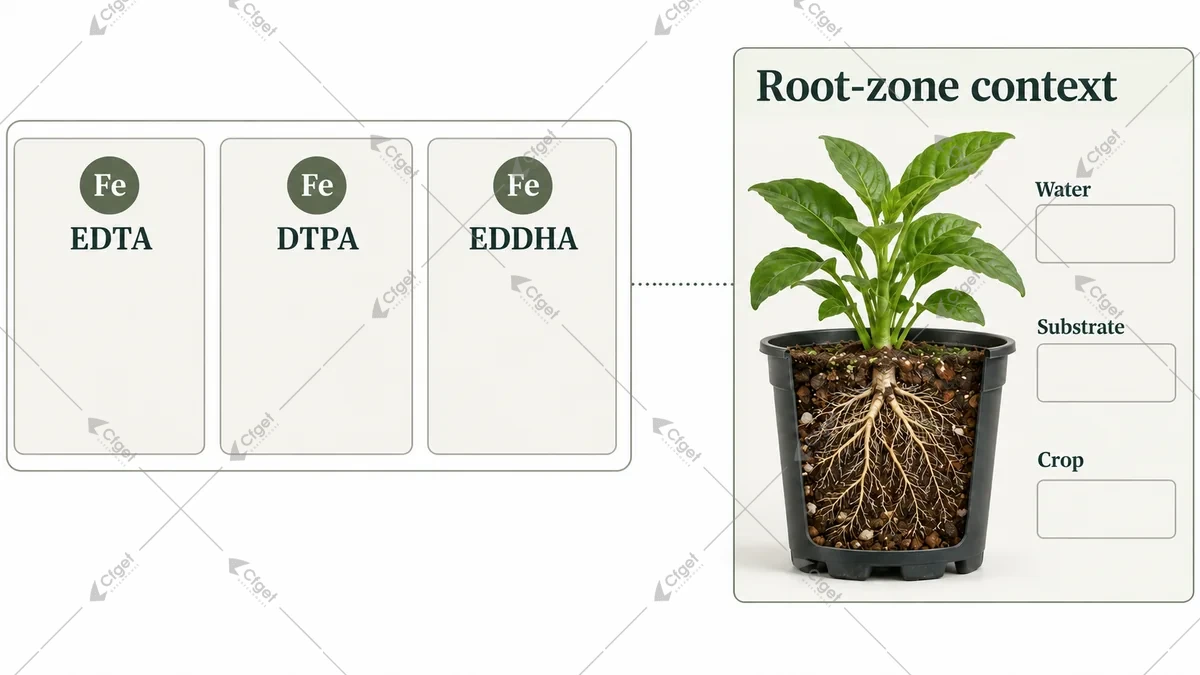
Separate iron content from ligand stability
A chelating ligand binds iron and helps keep it in solution. That bond’s behaviour depends on the ligand and its environment. EDTA, DTPA and EDDHA are different ligand names, not interchangeable abbreviations for an identical iron ingredient.
University of Arkansas greenhouse guidance explains that Fe-EDTA is less effective at retaining iron as substrate pH rises, while DTPA and EDDHA provide greater stability under higher-pH conditions. Its qualitative high-pH ordering is EDDHA, DTPA, then EDTA. Read that within the “Form of Element” discussion, rather than turning the order into a universal product ranking.
| Declaration or evidence | What it answers | What it does not answer alone |
|---|---|---|
| Total Fe and analysis basis | How much iron is declared per stated quantity of product | Which ligand holds it or how it behaves in the crop |
| Fe in a specified chelated form | Which portion is declared with the named ligand | Whether the offered form fits the assessed conditions |
| Root-zone and crop evidence | The context in which suitability must be evaluated | A deficiency diagnosis or application dose by itself |
Keep these three questions separate when reading a label. “More iron” can be a true composition statement and still be an incomplete suitability argument.
Use the high-pH comparison for the question it can answer
UMass also distinguishes soluble chelated forms and reports a high-pH effectiveness comparison in the specific context of corrective drenches. Its guidance warns that suspected iron deficiency needs confirmation because symptoms can be confused with other nutrient problems. The iron-nutrition fact sheet is evidence for checking form and diagnosis, not permission to transfer an application program to another crop.
For product selection, the useful inference is narrower: ask whether the supplier’s stability information covers the root-zone conditions actually being assessed. A broad statement about high-pH performance is not a recommendation to keep the crop at an unsuitable pH. Selecting a different ligand also does not explain why the pH changed.
Crop sensitivity belongs in the review. Avoid assuming that more soluble iron is harmless or that every crop showing pale growth requires supplementation. Have the crop adviser interpret the evidence and decide whether an iron-source change is relevant at all.
Compare two fictional offers without inventing a dose
Suppose Product A declares 10% total Fe with EDTA and Product B declares 6% total Fe with EDDHA, both hypothetically on a mass basis. These are invented label summaries, not verified commercial labels. A buyer initially favours A because its Fe percentage is higher.
The adviser has an elevated substrate-pH result, but no confirmed deficiency and no product-specific stability documentation. The comparison is not ready for a suitability conclusion. First clarify how much of each product’s total iron is declared chelated, obtain the exact ligand information, and compare the applicable conditions with the substrate evidence.
B’s lower percentage does not make it weaker for every purpose. Its ligand name does not make it the correct purchase either. The defensible outcome at this stage is a clarified technical question, with the diagnosis and product scope still unresolved. Do not calculate a price per “available iron” from these percentages.
Resolve label ambiguity before normalizing the analysis
Commercial pages show why the exact label matters. Yara’s UK REXOLIN Q40 page identifies an EDDHA iron product. For an actual offer, request the current regional label to establish the analysis basis and any declared chelated fractions. A short web listing is insufficient when the basis or fraction wording is unclear.
Attach the root-zone result with its sampling date, crop and extraction method. A source-water pH reading should not silently become a substrate result. Include other nutrient-program interactions that the supplier needs to assess, without attempting a new concentrate or mixing recipe from the comparison.
Download the iron-form interpretation card
Download the iron-form comparison card (CSV). It is a manual worksheet with no formulas. Import as UTF-8, comma-separated text and complete the Product A and Product B columns from current labels and evidence. Keep missing ligand information marked “unknown”; do not enter zero as a substitute. Retain the adviser-question column, adjust widths and wrapping, and save a native spreadsheet copy.
The finished card should explain which form is being offered, what conditions support its proposed use and what still prevents a purchase decision. For the separate causes of pH drift and stock-solution problems, see water pH versus alkalinity and fertilizer-stock precipitation.