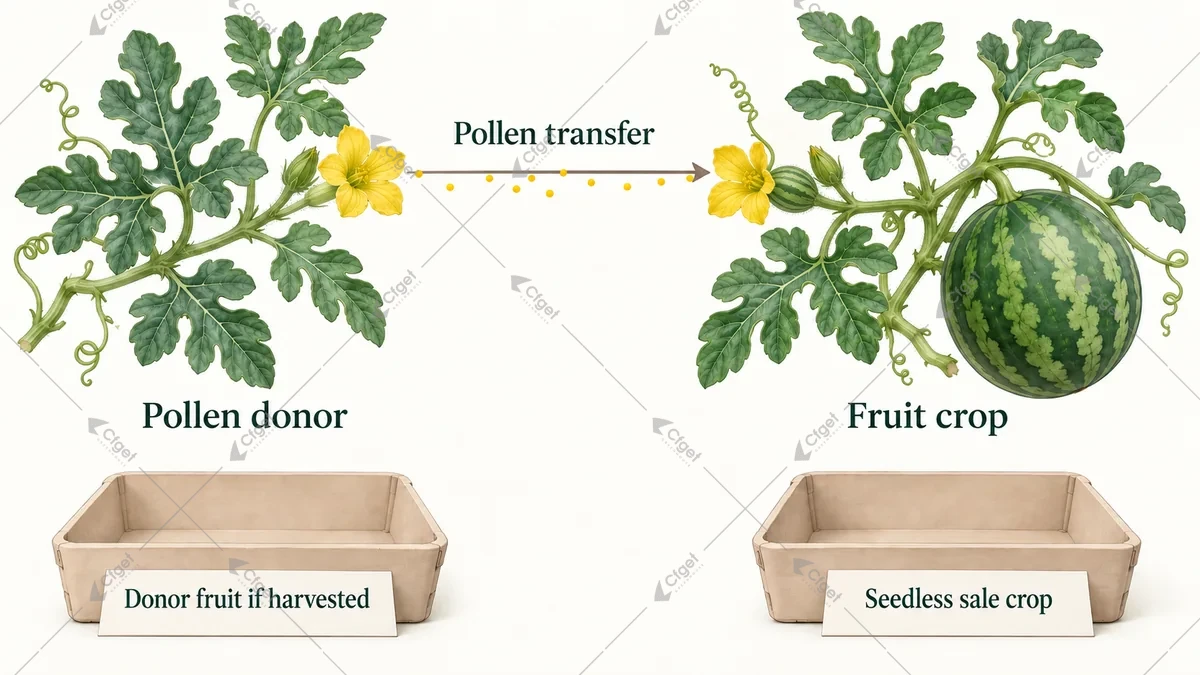
A commercial seedless-watermelon planting order needs more than the name of the triploid sale cultivar. It also needs a suitable pollen-donor plant program and a separate arrangement for transferring pollen. The donor plant and the pollinator are different parts of that system.
Reconcile three roles before treating the plant order as a seedless-fruit production plan: the triploid fruit crop, the diploid pollen donor and the pollen-transfer responsibility. Keep any harvested donor fruit separate from seedless sales assumptions.
Separate the fruit crop from the pollen-donor crop
Bayer’s 2026 seedless-watermelon overview explains the need for diploid pollenizer plants in commercial triploid fruit production. It distinguishes seeded donor varieties that may be harvested from dedicated donor types whose fruit are not harvested. It also emphasizes distinguishable fruit for separation at harvest.
The donor supplies suitable pollen. The pollinator transports pollen between flowers. Buying a donor cultivar does not establish a pollen-transfer arrangement, and arranging pollinators does not establish that the planting contains the required pollen source at the relevant time.
Do not simplify this to “triploid plants produce no pollen.” The purchasing issue is that their viable-pollen contribution is inadequate for the commercial program’s donor requirement. It is also a different biological case from parthenocarpic greenhouse cucumber, where fruit can develop without fertilization. The word seedless does not make those crop systems interchangeable.
Choose the donor’s commercial role explicitly
| Plant role | Order information needed | Sales assumption to keep separate |
|---|---|---|
| Triploid fruit crop | Exact cultivar/lot and buyer’s seedless product specification | Plant count is not a guaranteed accepted-fruit count |
| Harvestable diploid donor | Donor identity, suitability and intended harvest status | Seeded donor fruit need their own buyer and product identity |
| Dedicated non-harvested donor | Exact donor product and its role in the approved crop plan | Do not count it as a seedless-fruit sale plant |
Syngenta’s U.S. SP-7 product entry provides a commercial example of the dedicated pollinizer category and describes distinguishing fruit characteristics. The page demonstrates that the role exists as a purchasable product. It does not establish suitability, availability or flowering performance for an individual greenhouse.
For an actual offer, ask the breeder or supplier to confirm the donor role and its compatibility with the intended crop program. The crop adviser must establish the quantity and spatial basis. A dedicated donor is not simply a spare fruit-crop plant, and a harvestable donor is not automatically a second profitable product.
Reconcile an order before it enters the sales model
Imagine a hypothetical nursery order listing 1,000 plants under the heading watermelon. Its detailed lines include 200 dedicated pollinizer plants and 800 triploid fruit-crop plants. Entering all 1,000 as seedless-fruit plants would overstate the relevant plant count.
The correct role count for this invented order is 800 triploid fruit-crop plants and 200 dedicated donors. These numbers are label-reconciliation examples only. They are not a recommended donor ratio, planting layout or crop area allocation, and neither count predicts the number of accepted fruit.
Now suppose a different quotation supplies a harvestable seeded donor instead. A possible donor-fruit sale belongs on a separate line with its own buyer, grade and identity. It should not be added to the seedless total merely because both fruits came from the same greenhouse.
Keep nursery labels, lot identities and delivery records aligned with those roles. A substitution or delivery shortage can change the pollen-source plan without being obvious in an unchanged total plant count. Ask the crop adviser to review the actual change rather than filling a missing donor position with an unidentified watermelon plant.
Resolve flowering overlap and pollen transfer separately
A donor needs to provide its intended function when the fruit crop requires it. Request breeder or supplier evidence for flowering overlap in the proposed program, with the relevant local conditions and limitations. Do not infer overlap from a shared delivery date or create a sowing offset from a general article.
Protected watermelon is a real research context: a 2022 Almería greenhouse study included separate diploid and triploid cultivars while investigating pollen transfer. Its experimental plant arrangement and pollinator releases are not recommendations for another greenhouse. The useful distinction here is between plant roles and the transfer function.
Record who is responsible for the actual pollen-transfer plan. The greenhouse pollination-management guide addresses the wider flower-to-fruit-set investigation. This order review does not prescribe a hive count, insect release, hand-pollination method or fruit-set treatment.
Keep the buyer’s fruit definition intact
Seedless is a commercial description, not a guarantee that every fruit contains absolutely no seed structures. Bayer’s overview notes the possibility of pips and occasional hard seeds. Preserve the actual buyer specification and avoid converting a cultivar class into a quality guarantee.
Also establish how the donor fruit will remain distinguishable from the intended sale crop. The supplier’s product description can inform that question, but the project still needs its own identification and handling responsibilities. This matters whether donor fruit are harvested separately or excluded from sale.
Use a role-to-order reconciliation
Download the watermelon plant-role and order map. It is a manual worksheet with no donor-ratio, planting or yield formula. Open it using UTF-8 and comma separation. Enter counts only from the approved crop plan and keep the worked example separate from the project fields.
Match each plant line to its role, cultivar/lot, harvest status and flowering evidence. Then add the separate pollen-transfer responsibility. A complete order is one in which those roles can be traced and reconciled, with remaining evidence gaps clearly assigned before the grower relies on the seedless sales plan.