The useful comparison is the cost of a plant that meets your agreed specification and is available when the production block needs it. Comparing a nursery’s delivered price with the cost of seed alone will make in-house propagation look cheaper than the evidence supports.
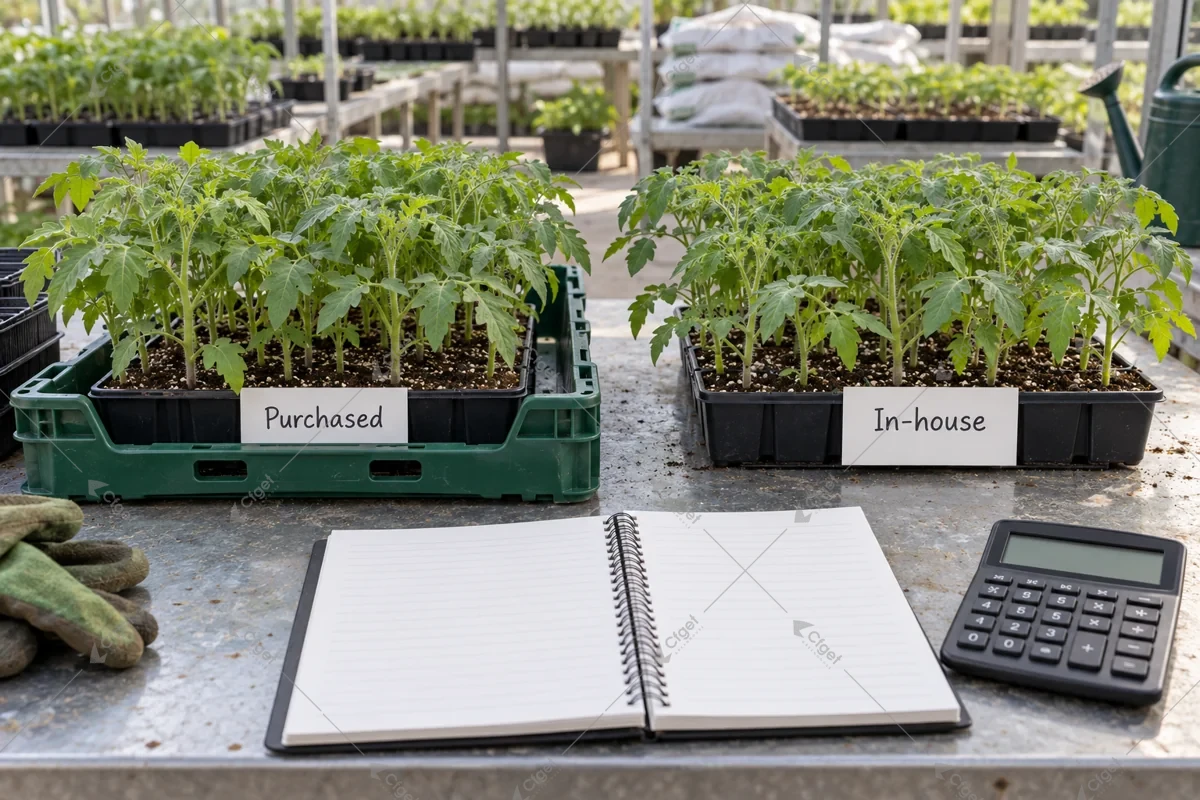
Put purchasing and propagation on the same cultivar, rootstock, quality, quantity and delivery-date basis. Then compare near-term cash commitments, full economic cost and the consequences of a shortfall. The best choice may differ by crop or planting window.
Define an accepted plant before calculating its cost
Write the production requirement first: crop and cultivar, grafting or rootstock where relevant, tray or plug specification, developmental stage, acceptance criteria, quantity and date at the agreed handoff point. Use the same requirement for both options.
Define “accepted” consistently. For this comparison, it means a plant meeting the agreed requirement at that handoff. It does not guarantee future crop performance or freedom from every pest. Count late, rejected and surplus plants separately so that they cannot quietly inflate the useful output.
If several delivery dates are required, make separate comparisons for those windows before calculating an annual total. Check the physical calendar separately with the nursery capacity and bench-space plan. An annual plant count can conceal a shortage at the one planting date that matters most. A low average unit cost does not show whether the business can meet its crop calendar.
What does the purchase option actually include?
Use a current written nursery offer. Record whether the price includes seed, grafting, trays, freight, handling, taxes that are a real business cost, and any returnable packaging charge. Keep refundable deposits separate from consumed costs and cash tied up.
List the business’s own costs after ordering: administration, transport where excluded, receiving labor, required inspection and holding before the defined handoff. Record agreed credits or replacements only when supported by the terms or actual correspondence.
Choose a clean accounting boundary. One workable option is the cost of meeting a named planting requirement, including any authorized replacement purchase needed to meet it. Divide by the plants accepted for that requirement. Keep an unmet quantity visible beside the cost; a smaller denominator alone does not explain the commercial effect of missing a planting window.
Do not assume that a nursery bears every consequence of a late or rejected delivery. Use the actual agreement. Record unresolved supply or claims terms as decision risks, without inventing a compensation value.
Count the work that in-house propagation adds
The University of Georgia’s commercial transplant production guide asks growers to consider business fit, management skill, resources and capital as well as economics. That is a useful starting point: owning a propagation area creates responsibilities as well as a possible supply option.
Build the estimate from your crop plan and available records. Include seed, rootstock and grafting inputs where applicable; trays and media; water and nutrients; heat and electricity; direct labor; supervision; sanitation; monitoring; and any agreed testing. Include preparation and cleanup rather than counting only the time spent sowing.
Record how usable output was estimated. Seeds purchased, cells sown, emerged seedlings and accepted plants are different counts. Use observed results from comparable batches where available. If they are unavailable, show the usable fraction as an assumption that needs a pilot, rather than inserting a convenient survival percentage.
The University of Kentucky transplant guide separates initial investment from variable production costs and stresses site-specific estimates. Its published money figures describe an earlier Kentucky budget; they are not current prices for your operation.
Keep a cash view and an economic view
The cash view shows payments that change with the choice and when those payments occur. It is useful for the coming production period. Include additional hires, inputs, energy, service contracts and the timing of a new equipment purchase.
The economic view also recognizes resources the business already owns or contributes. Examples include owner labor, use of an existing propagation space and an appropriate annual ownership cost for equipment. State how those costs were estimated and obtain accounting advice where needed.
Keep the two views separate. An allocation of existing rent or salaried labor does not automatically disappear from the bank account when propagation stops. Equally, an already-owned greenhouse is not necessarily free to use if propagation displaces another valuable activity. Record the alternative use and its evidence instead of assuming either conclusion.
Do not charge the full purchase price of a long-lived asset to one batch and also include its annual ownership charge in the same economic total. Choose a consistent treatment. Show capital cash spending separately from per-batch operating cost.
A blank comparison you can take to a planning meeting
Download the make-or-buy cost worksheet and the accepted-plant output record. These are manual worksheets; totals and unit costs are not calculated automatically. Amounts and usable fractions are deliberately blank. Use one currency and one requirement window throughout a comparison.
- Start in the accepted-plant output record. Define one requirement ID, specification, handoff date and required quantity, then record each option’s accepted-on-time count.
- Use that requirement ID in the cost worksheet. Calculate each line total and mark its inclusion as both, cash only or economic only. Paid operating inputs and labor normally enter both views; an additional owner-labor charge enters the economic view only. If one resource has different cash and economic amounts, use clearly linked separate rows and explain the difference.
- Sum the eligible cost rows for each view, counting every line once per included view. Transfer those totals to the output record and divide each by that option’s accepted-on-time count for the same requirement. Keep capital cash spending separate from the per-batch operating unit cost; include the supported annual ownership allocation in the economic view without also charging the full asset purchase there.
Illustrative numbers only: for a requirement of 9,500 accepted plants on the same date, assume buying costs $4,750 in both views. In-house propagation has $4,200 of operating cash costs, also counted in its economic view, and $900 of additional economic charges not already counted. If both options deliver all 9,500 plants, buying costs $0.50 per accepted plant; in-house costs about $0.44 on the cash view and $0.54 on the economic view. The ranking changes with the cost basis. These invented costs and plant counts are not a nursery quote or a production result.
If only 9,000 plants are ready for that requirement, record the 500-plant shortfall and assess a verified replacement plan before choosing. Recalculate with the accepted quantity and any supported replacement costs; do not keep 9,500 as the denominator simply because that was the target.
| Decision input | Purchase | In-house |
|---|---|---|
| Equivalent requirement | Cultivar, quality, quantity, handoff and date | Same requirement |
| Direct cash costs | Offer, freight, receiving and other included costs | Inputs, paid labor, utilities and other added costs |
| Economic costs | Additional resource use not already counted | Owner labor, space and asset ownership not already counted |
| Output | Accepted on time; rejected; late; replacement; unmet | Accepted on time; rejected; late; replacement; unmet |
| Uncertainty | Unconfirmed price or terms, delivery and backup availability | Unverified usable output, labor, skills and backup availability |
| Decision | Relevant total divided by accepted plants; shortfall shown separately | Same calculation and boundary |
For a unit figure, divide the defined option cost by the accepted-plant count within the same boundary. Label whether the numerator is incremental cash or full economic cost. If accepted output is zero, the unit cost is undefined; record a failed requirement rather than a zero cost.
Test the decision before committing the nursery
Identify which uncertain input could change the choice. Recalculate with documented alternatives for labor, usable output, energy or supplier terms. These are scenarios, not forecasts. Keep the baseline and the evidence for each changed assumption.
Consider a limited pilot or mixed approach when propagation skill and output are unproven. Purchasing a critical window while trialing internal production elsewhere may be worth evaluating, provided the comparison includes both sets of costs and responsibilities.
Ask who can supply replacement plants and by when if either route falls short. Verify availability before treating backup as part of the plan. Do not assign a speculative crop-loss or payback figure to make one option appear decisive.
The final record should state the preferred option for each planting window, the cost basis, remaining risks and what evidence would trigger a review. That gives the grower a decision to manage, rather than a universal answer that buying or growing is always cheaper.