Before buying or leasing a greenhouse site, check the applicable flood information, surveyed levels, routes by which water can reach the parcel and the reliability of the access road. Include utilities and service buildings in that review. A greenhouse floor that stays dry is not enough if workers, deliveries or essential services cannot reach it.
Flood screening helps decide whether to pursue a site and what further investigation it needs. It does not replace a local flood assessment, drainage design or approval.
Contents
Start with the current map, then locate the actual footprint
In the United States, the FEMA Flood Map Service Center is the official public source for flood hazard information supporting the National Flood Insurance Program. It provides effective maps and other flood-risk products. FEMA also notes that downloaded information may later be superseded.
Search the location, save the map reference and date, and identify the proposed greenhouse footprint rather than relying on a pin placed somewhere within a large parcel. Include the access road, transformer or connection point, water facilities and packing area. Ask the local floodplain authority or adviser which effective information and additional studies apply to the proposed development.
Outside the United States, use the responsible national or local flood authority. FEMA zone names and US approval requirements should not be applied to another country.
A seller’s statement that “the land has never flooded” is useful history to investigate, but it cannot establish the future risk. Ask for records and local evidence, including photographs or reports of past events, while keeping their location and date attached.
A “100-year flood” is a probability, not an appointment
USGS explains that a flood described by a 100-year recurrence interval has a 1% annual chance of being equalled or exceeded. It can occur in consecutive years. The estimate can also change as more observations become available or conditions in the drainage basin change. USGS: The 100-Year Flood
A simplified probability illustration helps put that annual figure beside an investment term. If the annual probability stays at 1% and years are treated as independent, the chance of at least one such event over 20 years is:
1 − (1 − 0.01)²⁰ ≈ 18.2%.
This is arithmetic under stated assumptions, not a forecast for a particular parcel. It does not predict water depth, damage, crop loss or insurance coverage. Those depend on the site, the event and the assets exposed.
Read the levels and access together
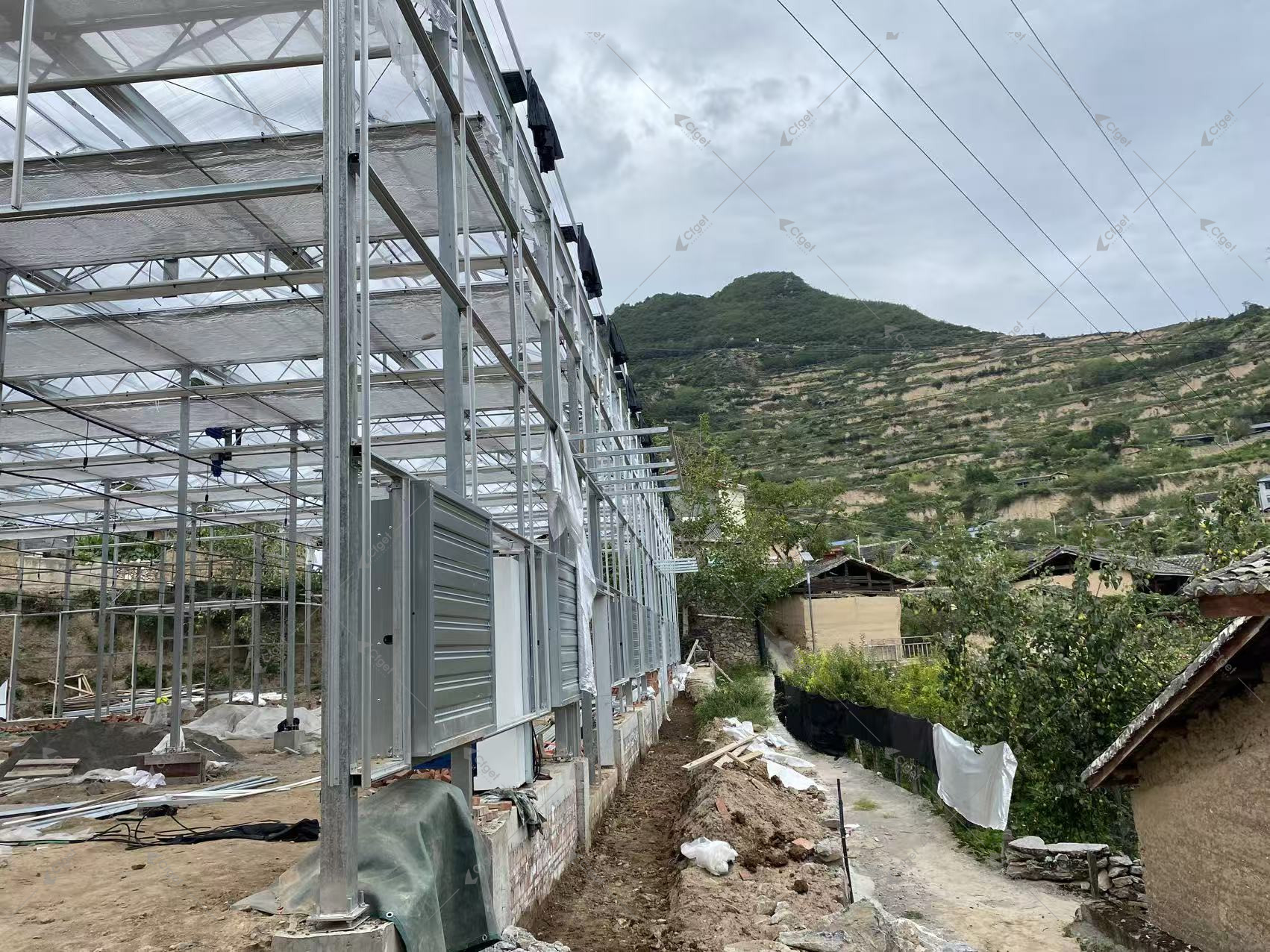
A topographic survey should show how the greenhouse, surrounding ground, road and nearby channels relate in elevation. Ask the local specialist to use a consistent survey datum when comparing the site with applicable flood elevations. A number on one drawing cannot be safely compared with a number on another if they use different references.
UMass greenhouse planning guidance calls for mapping land elevations, road access, utilities, streams, wetlands and runoff. It also considers access to buildings for emergencies. Those items give the flood review a practical frame: follow the routes people, supplies and water would use. Greenhouse Facilities Master Plan
Consider these two hypothetical site conditions, without treating either as an assessed property:
| Condition | Question that remains open |
|---|---|
| Greenhouse footprint lies on higher ground, but the only road crosses a low channel | Can staff and essential deliveries retain safe access, and what interruption would the business face? |
| Road remains usable, but the proposed electrical equipment and water-treatment area sit lower than the growing area | Which services could be lost before water reaches the crop, and can the design address that exposure? |
A useful site comparison records the investigation needed and its likely effect on layout, budget and operation. It should not reduce these different conditions to a single label such as “good drainage.”
Keep flood risk separate from roof-water disposal
Gutters and drains deal with defined flows under a design basis. The parcel also needs assessment of water arriving from outside its boundary and of what happens at the outlet during a flood. A larger drain is not proof that a location is acceptable, and proposed grading or fill may itself require review.
The greenhouse drainage design guide addresses the drainage system. Use it after the broader site constraints are understood, alongside the site due diligence workbook.
Before selecting the site, obtain a clear answer on what may be built, which elevations and access requirements govern, what further study is needed and which residual risks remain. Confirm insurance terms for the actual structure, equipment, crops and interruption exposures with the insurer; a map classification alone does not describe the policy.
If those answers require changing the footprint, services or access, carry the cost into the land comparison. The useful result of early flood screening is a decision made while choosing another parcel is still possible.