Select a sealed lettuce pack against the actual product form, fill quantity and temperature history. A bag evaluated for one lettuce product is not automatically suitable for another. “Breathable” is too incomplete a description to establish the atmosphere that will develop inside it.
The greenhouse origin of the crop does not remove the packaging question. Once lettuce is packed, living tissue and the package continue to interact. A useful purchasing brief must describe both.
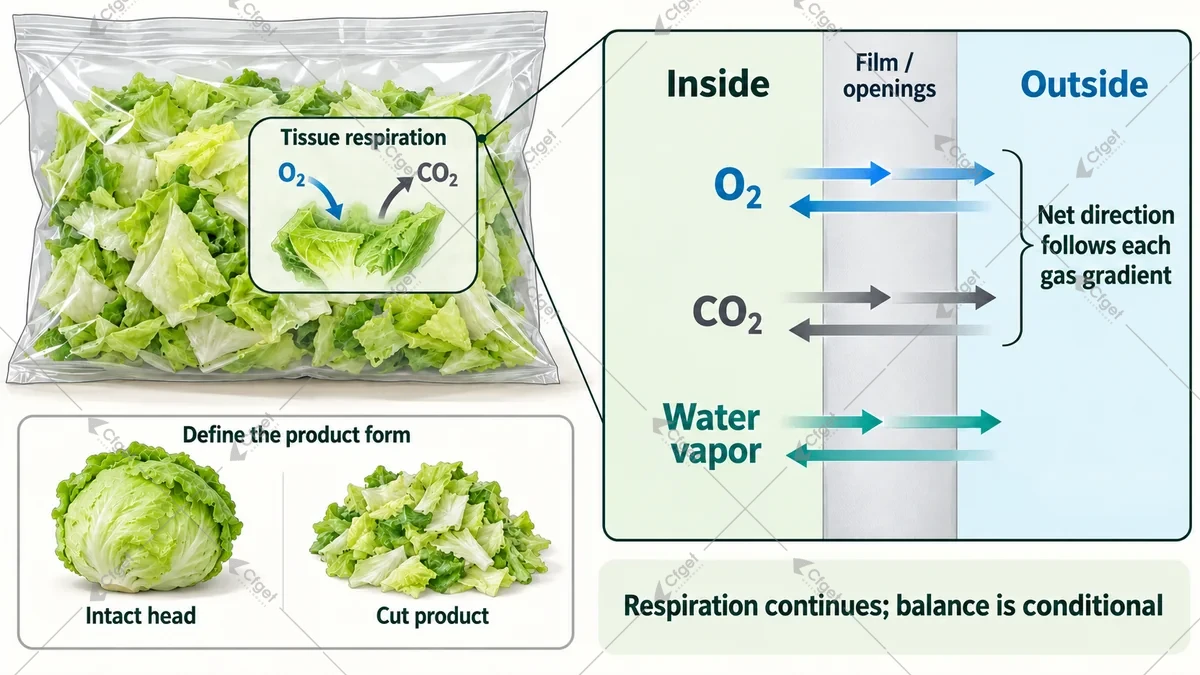
Follow respiration and gradient-dependent gas transfer
Lettuce tissue continues to respire, consuming oxygen and producing carbon dioxide. Gases also transfer through the film or its openings. Net transfer for each gas follows its concentration or partial-pressure gradient across the package boundary; direction can change when conditions inside or outside change.
A relatively stable atmosphere, if reached, is a dynamic balance between those processes. It does not mean respiration has stopped. Sealing a bag or setting its initial gas mixture does not freeze its later composition. The Australian Postharvest Management of Vegetables resource explains the dependence on respiration, film properties, film area, product mass and temperature.
Keep two kinds of arrows separate in a package sketch. Tissue respiration shows oxygen consumption and carbon-dioxide production. Boundary-transfer arrows must be paired or labeled as gradient-dependent. An arrow showing carbon dioxide permanently leaving every possible pack would misrepresent the mechanism.
The product form changes the quality question
UC Davis’s crisphead lettuce fact sheet distinguishes intact heads from lettuce cut for salad. Intact heads can suffer carbon-dioxide injury, while modified atmospheres used for cut salad pieces address rapid browning at cut surfaces. This commodity evidence explains why a result for fresh-cut lettuce should not be transferred unchanged to intact crisphead heads.
It does not supply a packaging recipe for every cultivar or delivery route. State whether the offer concerns intact crisphead heads, another lettuce type or cut pieces before interpreting a test result headed simply “lettuce.” Preserve maturity and handling context where they affect the supporting evidence.
Trace what a proposal changes
Consider a fictional supplier proposal. A bag and fill specification evaluated for cut lettuce is offered unchanged for intact greenhouse-grown crisphead heads. The product name matches, but the structure and atmospheric quality response have changed. Ask for evidence covering the proposed whole-head use before accepting the transfer.
In a separate fictional change, the buyer wants more product in the same bag and a warmer distribution route. More tissue changes the respiration demand relative to the available film area. Temperature can increase respiration faster than it increases gas transmission. Previous package-balance evidence therefore needs review for the changed conditions.
| Proposed change | What to take back to the specialist |
|---|---|
| Cut pieces become intact heads | The actual lettuce type and form, with product-specific quality-response evidence |
| Fill mass increases in the same pack | Measured fill and effective film area, linked to the evaluated specification |
| Material, thickness, openings or seals change | The exact package construction and its applicable transmission evidence |
| Route or opening stage changes | Product-temperature history and where the pack will be opened or displayed |
The decision is to reopen the affected validation, not to choose more holes or a new gas percentage from this worksheet. First isolate which assumption changed. That makes the conversation with the packaging supplier and postharvest specialist much more specific.
Keep cooling, moisture and safety evidence distinct
A moisture barrier does not establish oxygen or carbon-dioxide performance. Preserve the supplier’s separate gas- and water-vapor-transmission quantities, units and test conditions. Likewise, cooling air moving around a carton is a different path from gas transfer across a sealed inner pack. Modified-atmosphere packaging does not replace appropriate cooling.
Food safety requires its own assessment. The FDA’s August 2026 guidance for ready-to-eat fresh-cut produce discusses biological hazards associated with reduced-oxygen packaging. It contains nonbinding recommendations in a U.S. fresh-cut processing context, with applicability depending on the operation. Do not apply identical regulatory conclusions to every whole-head pack or greenhouse.
A pack that looks fresh has not thereby been microbiologically validated. Have the relevant food-safety specialist assess the proposed product and process alongside the packaging review. This article selects no gas mixture, film thickness, storage setpoint, shelf-life extension or real-lot release decision.
Download the lettuce package change-impact worksheet. This manual tool contains no formulas or film-design calculator. Import the UTF-8 comma-separated file, widen columns and wrap text, then save a working copy. Compare the supported baseline with the proposed change in separate columns. Identify which evidence no longer covers the proposal and who must resolve it. Keep respiration, gradient-dependent gas transfer, water-vapor transfer and safety review as separate entries.