Growing strawberries in a greenhouse can feel like you’re doing everything “right” and still getting disappointing results. One week the plants look perfect. The next week, flowering slows down, fruit sizes become uneven, and gray mold shows up overnight.
I’ve seen this pattern many times.
Strawberries are not like tomatoes. They prefer cooler air, tighter humidity control, and steadier conditions. If you treat a strawberry greenhouse like a tomato greenhouse, you usually pay the price in yield and quality.
Here’s the practical target that keeps most commercial strawberry greenhouses stable:
Recommended climate range
- Day temperature: 16–24°C
- Night temperature: 8–13°C
- Relative humidity (RH): 65–75%
- Light: at least 8–10 hours/day
- Irrigation: small pulses + moisture-based timing (avoid wet leaves and high RH)
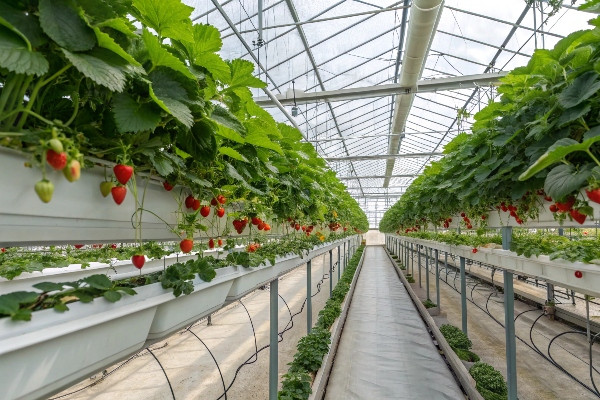
I’m Chen Tao from CFGET. Over the last 28+ years, my team has helped growers build strawberry-specific greenhouse systems across different climates. In this article, I’ll share what actually matters in real production—especially temperature, humidity, lighting, irrigation, and disease prevention.
Don’t Miss:
Mastering Greenhouse Tomato Cultivation: A Step-by-Step Guide?
You might like:
The Ultimate Guide to Commercial Strawberry Greenhouses: Boost Your Yield & Profits
Quick Answer: Ideal Temperature and Humidity for Strawberry Cultivation in Greenhouse
If you only want the short answer, start here.
| Growth Stage | Day Temp | Night Temp | Relative Humidity (RH) | What to Watch |
|---|---|---|---|---|
| Vegetative | 18–22°C | 10–13°C | 65–75% | Keep growth steady, avoid stress |
| Flowering | 16–20°C | 8–12°C | 60–70% | Lower RH helps pollination and reduces Botrytis |
| Fruiting | 16–22°C | 8–13°C | 60–70% | Focus on dry canopy and stable fruit quality |
One simple rule that saves a lot of trouble:
If RH sits above 80% for hours, especially at night, Botrytis risk climbs fast. It’s not just the number—it’s the time spent high and whether condensation forms on flowers and fruit.
What is the Ideal Climate Control Setup for Greenhouse Strawberries?
Temperature problems are usually the first thing growers notice—slow flowering, weak fruit development, and uneven harvests. But behind those symptoms, the real issue is often stability.
Optimal strawberry greenhouse climate control aims for:
- 16–24°C during the day
- 8–13°C at night
- 65–75% RH (and in many regions, 60–70% is safer during flowering/fruiting)
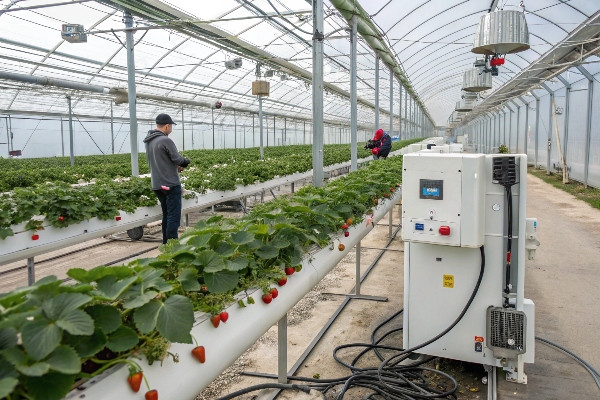
1) Temperature: keep it steady, not “as warm as possible”
Strawberries perform best when they get a clear day-night difference. That temperature drop at night helps flowering and fruit development.
Common problems I see:
- Nights too warm → soft growth, weaker flowering, poorer fruit firmness
- Hot spots and cold corners → uneven ripening and inconsistent fruit size
- Sudden swings → plants “pause” and yield becomes unstable
If you’re building a system, aim for even distribution across the whole growing area. A greenhouse that is 18°C in one corner and 24°C in another never performs like you want it to.
➡️ Related solution: Climate control
2) Humidity: 65–75% is the target, but avoid long periods above 80%
Humidity is where many strawberry greenhouses lose money quietly. Not always immediately—but over time.
- Too low RH → plants get stressed, fruits can be misshapen, and quality becomes inconsistent
- Too high RH → Botrytis and powdery mildew become regular “visitors”
The real danger is condensation. If you can see water on plant surfaces (or you get wet flowers in the morning), you’re already in the danger zone.
Good humidity control usually comes from a combination of:
- ventilation (roof + side)
- gentle heating when needed (to dry air and reduce condensation)
- circulation fans (to prevent “still air” around the canopy)
➡️ Related solution: Humidity control
3) Ventilation + airflow: don’t rely on vents alone
Natural ventilation does most of the cooling and moisture removal. But strawberries have a dense canopy, and humidity can get trapped right where it matters—around leaves, flowers, and fruit.
Practical airflow targets:
- Normal operation: 1–2 air changes/hour
- Hot periods: 3–4 air changes/hour
Fans help keep the canopy dry and reduce microclimates. You don’t need “wind.” You need consistent movement.
4) Heating: aim for uniformity, not brute force
Strawberry heating is about precision. Hot air systems can work, but they often create uneven zones. Distributed hot water systems tend to provide more stable temperatures.
The benefit shows up in fruit quality:
- fewer soft berries
- more uniform sizing
- fewer disease-friendly “cold damp corners”
5) CO₂ enrichment (optional, but useful in commercial systems)
CO₂ enrichment can improve yields when done properly, especially in winter or in tightly controlled houses.
A common commercial target is 800–1000 ppm during active photosynthesis.
The key is integration: CO₂ works best when the system manages temperature and ventilation together, otherwise you enrich and immediately ventilate it away.
➡️ Related solution: Gas enrichment / CO₂
How to Optimize Lighting and Irrigation for High-Yield Strawberry Greenhouses?
Poor lighting and poor irrigation usually show up as:
- weak plants
- low fruit set
- inconsistent size and sweetness
Minimum requirement:
8–10 hours of light/day (and enough intensity), plus precision irrigation that matches plant demand.
Lighting: “hours” is only half the story
Strawberries can flower under shorter day lengths, but fruit quality depends heavily on total light energy.
A useful planning metric is DLI (Daily Light Integral). Many commercial growers aim around:
- 12–16 mol/m²/day (typical target range)
In winter months or northern regions, supplemental lighting is often the difference between “surviving” and “profitable.”
LED systems have become the practical choice because they:
- use less energy than older systems
- add less unwanted heat
- allow better spectrum control
➡️ Related solution: Light management
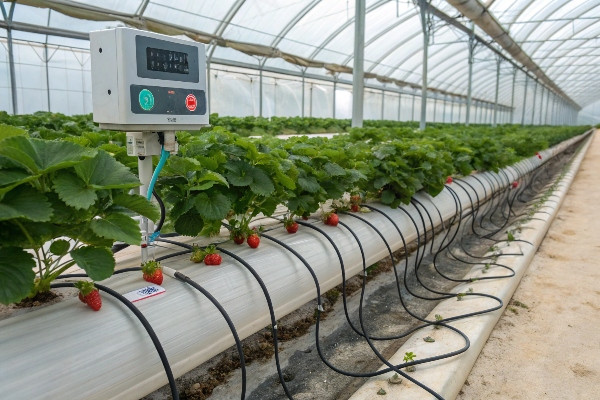
Irrigation: small pulses beat one big watering
One of the fastest ways to push RH too high is to irrigate heavily at the wrong time. The greenhouse becomes wet, the canopy stays damp, and disease pressure rises.
Your earlier baseline of 100–150 ml per plant per day can be a starting point, but the real need changes with:
- plant stage and size
- media type (coco/peat/perlite)
- sunlight, temperature, and ventilation
What works better in practice:
- drip irrigation with small pulses
- more events during active light periods
- adjust based on actual moisture, not just a timer
Many successful operations run 4–6 irrigation events/day during peak production, then reduce during cool or cloudy conditions.
➡️ Related solution: Irrigation management
Strawberries react quickly to water chemistry.
Common targets for source water:
- EC: below 0.7 mS/cm
- pH: 5.5–6.5
- sodium: below 50 ppm
If your local water is hard or has high bicarbonate, treatment may be needed. It’s not glamorous, but it prevents endless “mystery problems” later.
Managing Pests and Diseases in Your Strawberry Greenhouse Environment
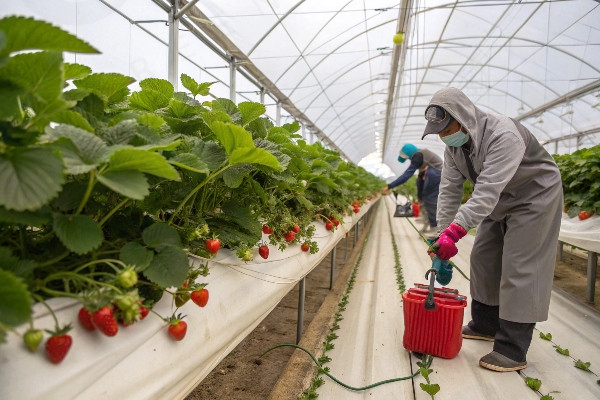
In greenhouse strawberries, pest and disease problems can spread fast. A reactive approach usually becomes expensive.
The best results come from prevention:
- stable climate
- biological controls
- consistent monitoring
Common pests in strawberry greenhouses
- two-spotted spider mites
- aphids
- thrips
- whiteflies
Climate is part of pest control. For example, spider mites reproduce faster in hot, dry conditions. Keeping RH in the recommended range often reduces pressure.
Botrytis (gray mold): the main enemy in most regions
Botrytis needs moisture on plant surfaces. That’s why condensation is so dangerous.
A practical prevention checklist:
- keep RH mostly 60–75%
- avoid long periods above 80%
- use drip irrigation (avoid wet leaves)
- remove infected material and old fruit quickly
- maintain airflow around flowers and fruit
If you implement only one improvement, start with night humidity management. Many growers focus on daytime temperature and ignore what happens after sunset.
Hydroponic vs. Soil-Based Systems: Which is Better for Greenhouse Strawberries?
This question comes up in almost every project. The honest answer is: it depends on your budget, your team, and your local constraints.
In many commercial operations, substrate beds or trough systems remain the most common choice because they’re simpler and lower cost. Hydroponics can be excellent, but the management must be tight.
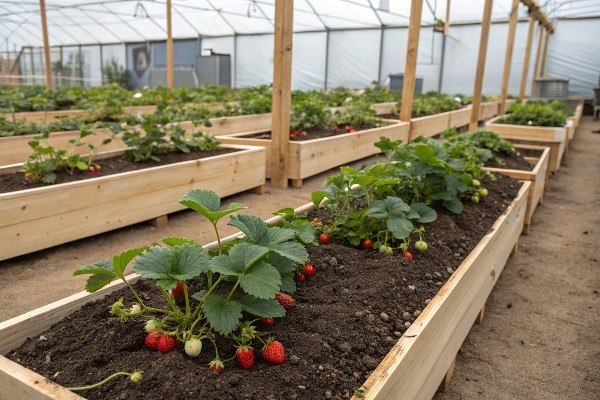
Soil/substrate systems (raised beds or troughs)
Why they’re popular:
- lower startup cost
- easier operation
- more forgiving if irrigation/fertigation isn’t perfect
- good fruit quality
The “trough” style systems are especially cost-effective in many markets.
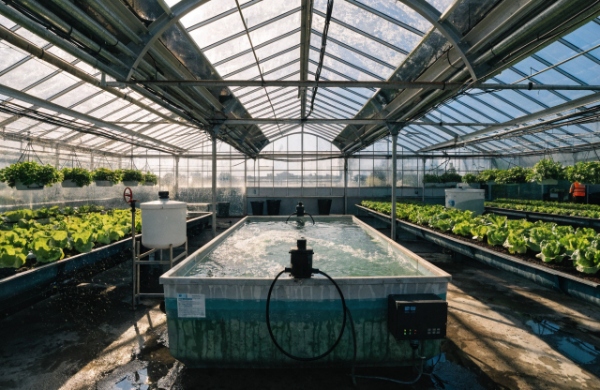
Hydroponic systems (NFT / DWC / substrate slabs)
Where hydroponics shines:
- water efficiency
- reduced soilborne disease
- precise nutrient control
But it requires consistent monitoring of:
- EC (often 1.2–1.8 mS/cm, stage dependent)
- pH (5.8–6.2)
- nutrient balance by growth stage
- solution temperature (commonly 18–22°C)
For many teams, a phased approach is safest: start with substrate systems, then trial hydroponics in a smaller section.
Helpful references:
- https://www.ishs.org/ishs-article/1227_81
- http://www.ars.usda.gov/SP2UserFiles/Place/19310000/FTakeda/1999Advances%20in%20Strawberry%20Res%20feature.pdf
FAQ: Ideal Temperature & Relative Humidity for Strawberries in Greenhouse
What is the ideal relative humidity for strawberries in greenhouse?
A practical target is 65–75% RH.
During flowering and fruiting, many growers aim 60–70% to reduce Botrytis risk, especially in dense canopies.
What is the ideal temperature for strawberry greenhouse cultivation?
Most operations run 16–24°C in the day and 8–13°C at night. The day-night difference supports flowering and fruit development.
What humidity causes Botrytis in greenhouse strawberries?
Botrytis risk increases when RH stays above 80% for long periods, especially if condensation forms on flowers or fruit.
Can I use tomato greenhouse settings for strawberries?
Usually not. Strawberries prefer cooler temperatures and stricter humidity/condensation control than tomatoes.
Conclusion
Strawberries reward growers who control the basics well: steady temperatures, controlled humidity, enough light energy, and precise irrigation. When those fundamentals are stable, pest and disease management becomes easier, fruit quality improves, and production becomes predictable.
If you’re planning a commercial strawberry greenhouse (film, glass, or PC) and want a system designed for your local climate and crop plan, my team at CFGET can help you build a reliable setup from 0 to 1.