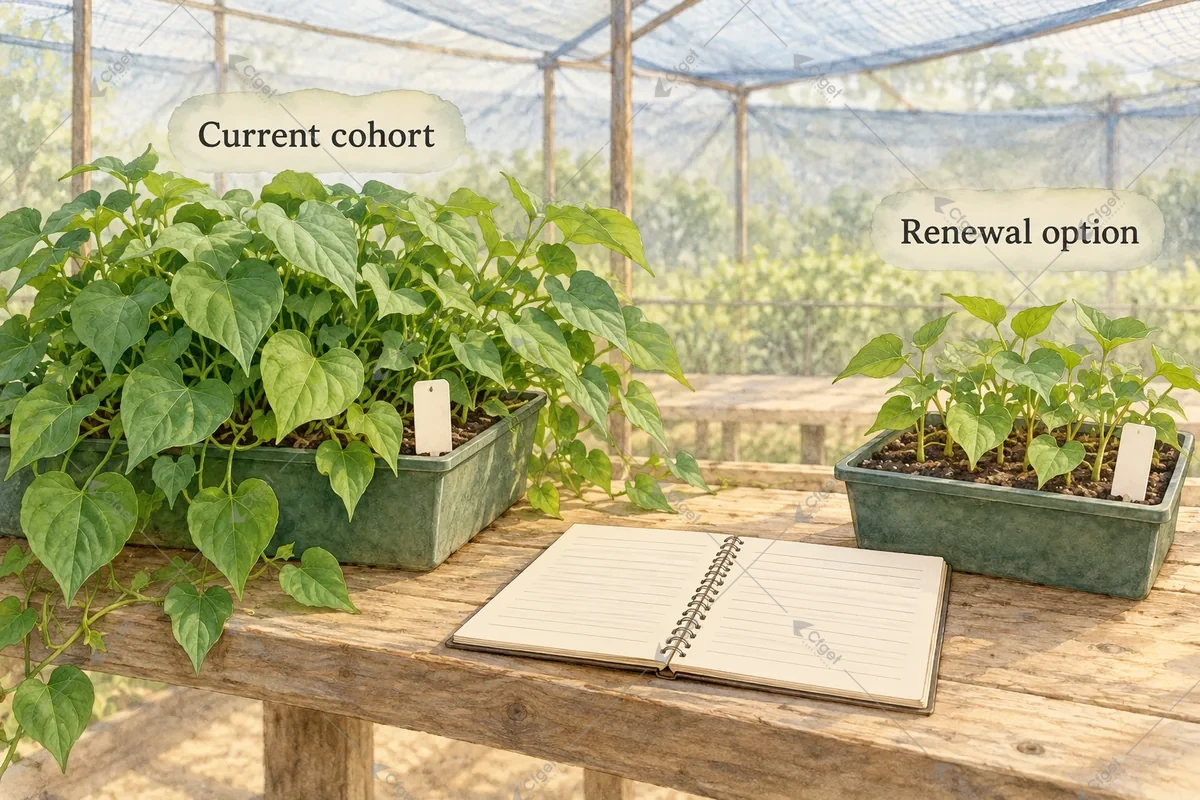
An established sweetpotato mother-stock block can look like the easiest way to supply the next series of vine orders. The plants are already growing, the team knows the block, and another harvest may produce plenty of planting material. Before extending its place in the production plan, ask what supports continued use of that particular group of plants.
The decision is about the whole delivery period. A strong early harvest does not answer whether the same stock should supply every later one. Keep a renewal route available while reviewing the cohort’s origin, exposure history and seed-health evidence.
More vines and a different later health record
Ogero and colleagues’ 2023 study followed sweetpotato seed-vine production at a TARI research farm in Mwanza, Tanzania, from September 2019 to November 2020. It compared Kabode and Mataya under net tunnels and in open fields, using either retained plants allowed to regrow, called ratooning, or replanting. The eight combinations had four replicates, with 40 plants per treatment unit.
The trial covered six harvest generations: the establishment harvest and five later regrowth or replanting comparisons. Retained plants produced more vines overall. However, retained open-field plants began showing visible virus symptoms at the fourth harvest generation, with symptoms increasing later. Neither net-tunnel technique nor the replanted open-field groups showed visible symptoms during the trial.
That contrast matters to a nursery manager: the option producing more vines can have a different health history as production continues. The study does not establish a universal number of safe harvests or a replacement age.
Understand what “replanting” changed
Every treatment began with clean, virus-tested cuttings from TARI–Ukiriguru. For later replanting, researchers used tip cuttings from the preceding crop. They did not buy a fresh batch of clean stock for every generation. Renewing the plant stand and obtaining new source material are therefore separate choices.
The researchers assessed virus symptoms by eye. They explicitly noted that molecular testing could have improved understanding of infection in symptomless plants. An observation of no visible symptoms cannot establish that a cohort is virus-free, and replanting its tips does not create a new verified health status.
Review the cohort before extending its job
Give each mother-stock cohort a clear identity and bring four pieces of information to the production meeting:
- Origin and continuity. Identify the cultivar, starting source, establishment date and which later plants came from that cohort. If tips were replanted, preserve the link to their parent stock.
- Protection and exposure. Record where the plants have been grown and any known periods of exposure or damage to protection. “Normally protected” is less useful than a dated history.
- Current health evidence. Keep visual observations separate from any actual diagnostic results, including their dates and the material examined. Ask a qualified seed-health adviser what that evidence supports for continued multiplication.
- The remaining assignment. List the future delivery windows the cohort is expected to cover and when a replacement route could realistically become available.
This is a review of a particular living crop. The Tanzanian experiment involved two cultivars at one location; its calendar cannot be pasted onto a different nursery as an expiry date.
Give renewal enough time to remain an option
Work backward from the first delivery that may need replacement stock. Establish the lead time for the intended source material, its health review, establishment and readiness for the nursery’s program. Use the actual source and local production advice rather than a harvest interval borrowed from the trial.
If replacement plants must be established while the present cohort is still producing, check that overlap with the nursery bench-space guide. Waiting until the old block is no longer supportable can leave the production plan without a ready alternative.
Retain a cohort provisionally where the available evidence supports its intended use, with a defined next review. If symptoms appear, exposure changes or important health evidence is missing, obtain a seed-health assessment and revisit the supply plan before relying on further multiplication from it. The useful outcome is a dated, evidence-backed decision about the next production window, with a workable renewal route behind it.