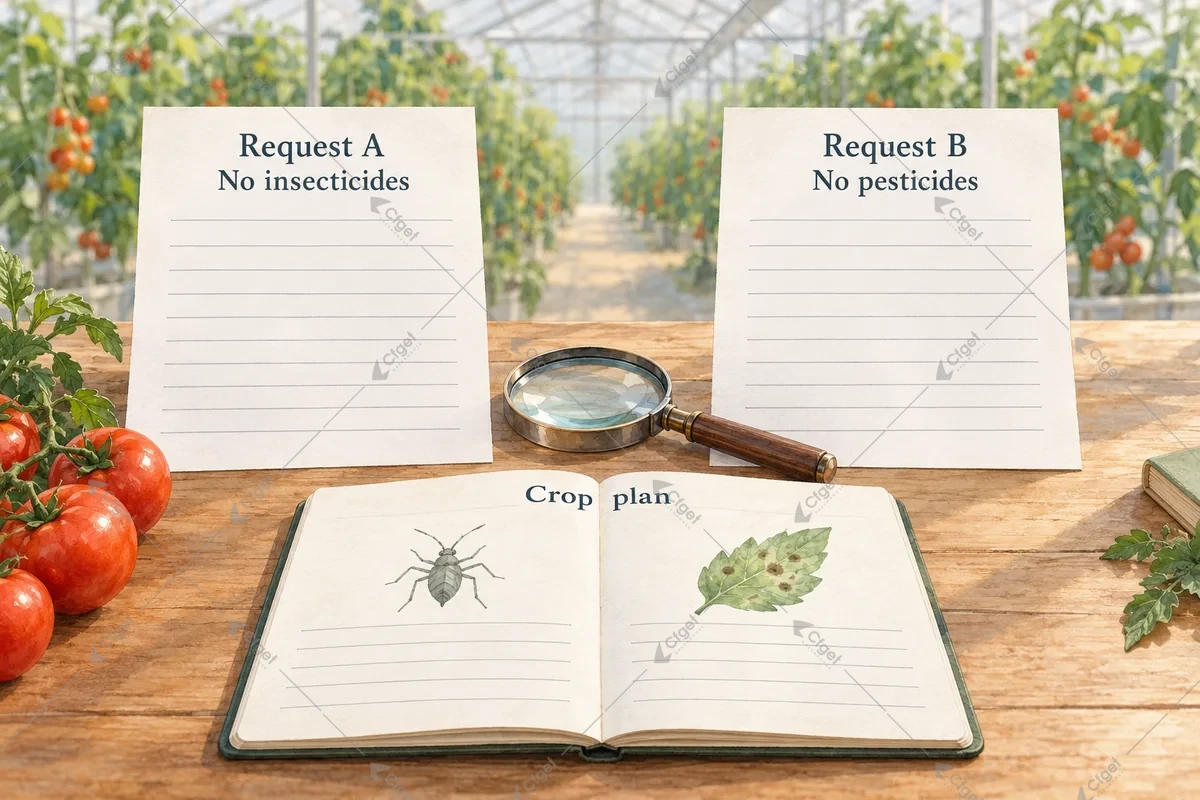
A tomato buyer’s request for “no insecticides” needs a different production review from a request for “no pesticides.” Before accepting either commitment, the sales team and crop adviser should agree what the words cover, which crop period they apply to and what happens if an excluded treatment becomes necessary.
Beneficial insects can be part of that discussion. Their presence does not, by itself, establish that the entire crop-protection program meets the buyer’s restriction.
What the Saudi trial actually recorded
Estidamah’s 2020 tomato project in Saudi Arabia compared management programs in two high-tech compartments. During the January–December crop, the biocontrol compartment had zero reported insecticide applications. The chemical-control compartment had seven chemical interventions specifically against Tuta absoluta.
Fungicides were still used in the biocontrol compartment. The zero therefore describes insecticide applications in that compartment, while the seven describes Tuta-specific interventions in the other. These are not counts of all pesticides, their mass or residues.
With one compartment per management program, the comparison does not isolate the effect of a particular beneficial organism or guarantee the result at another farm. Its useful commercial lesson is narrower: this reported no-insecticide crop was not a no-pesticide crop.
The terminology matters because pesticides include both insecticides and fungicides, as the US EPA’s pesticide-type explanation makes clear. That source supports the distinction; the buyer’s actual requirements still need to be established for the proposed sale.
Test two different orders against the same crop plan
Imagine a grower considering two hypothetical orders. One buyer restricts insecticide applications during a stated production period. The other excludes all pesticide applications during that period. Both orders may be described informally as a reduced-chemical offer, yet they create different feasibility questions.
If the planned crop program includes a fungicide response to a disease problem, the first restriction and the second cannot be treated as interchangeable. The adviser must examine the exact allowed and excluded inputs against the whole crop plan. The sales team must then confirm whether the proposed production history is acceptable to the buyer.
The Saudi finding does not tell the grower which treatment to use or whether a fungicide will be needed. It shows why the acceptance discussion has to include disease management as well as insect management.
Agree what happens if the plan must change
Before accepting the order, identify the person who can resolve a conflict between the crop’s needs and the buyer commitment. Make sure the production team knows when to alert that person, which affected crop or lots need review and how the relevant treatment history will remain traceable.
If an excluded intervention is being considered, the commercial response needs to be settled rather than assumed. Depending on the actual agreement and applicable requirements, the parties may need to review the commitment or identify another permitted selling arrangement. Do not continue presenting an affected lot as compliant merely because the original plan was compliant.
This is also why a production-method promise should remain separate from claims about residues, organic certification or food safety. The application history alone does not establish those conclusions, and this trial supplies no buyer approval or price premium.
Make a promise the operation can support
The useful decision is whether to accept the precise restriction, seek clarification or a revised scope, or choose another suitable outlet before committing the crop. Keep the discussion grounded in the actual production program and the buyer’s written requirements.
For broader prevention choices, see the greenhouse pest and disease overview. The order decision is more specific: can this crop meet this buyer’s exact production-method commitment throughout the stated period, including the agreed response if circumstances change?