A greenhouse, local or organic label can be part of a lettuce offer, but it needs buyer evidence before it becomes a price premium in an expansion forecast. Identify which attribute is expected to earn more, who will pay for it and whether that value reaches the grower.
Consumer research can help choose what to test. A farm’s base case needs evidence for its actual product, channel and selling period.
What a two-city auction tested
Krasovskaia and colleagues studied 289 adult primary shoppers in Ithaca, New York, in December 2022 and Madison, Wisconsin, in May 2023. Their in-person auction used approximately 200 g lettuce heads, with bids bounded at US$0–6. Four products over two rounds produced 2,312 repeated bids, not that many participants.
The paper appeared online in November 2025 and in a 2026 journal issue. “CEA” in this experiment meant greenhouse-grown versus field-grown; “local” meant in-state. Table 3, model 6, reports these latent willingness-to-pay coefficients before the information treatment:
| Attribute | Latent coefficient | Standard error | Reported significance |
|---|---|---|---|
| Greenhouse-grown | −0.076 | 0.07 | Not significant |
| Local | +0.256 | 0.05 | p < 0.01 |
| Organic | +0.716 | 0.05 | p < 0.01 |
The reference is conventional, field-grown, non-local lettuce. The college-town sample was not nationally representative; 57% held advanced degrees. Not every attribute combination was tested.
Use the model to choose a question, not a price
A latent coefficient is a parameter in the model’s underlying valuation equation. It is not the average extra amount actually paid for a head, a marginal effect, or a current farm-gate quotation. Multiplying it by five would not create an observed premium per kilogram.
The nonsignificant greenhouse coefficient also does not prove that greenhouse growing has exactly zero value to every buyer. The practical reading is more limited: do not assume a premium simply because the product comes from a greenhouse. Investigate the attributes your intended customer recognizes and values.
For an expansion project, separate three questions. Is the product legitimately eligible for the label? Does the target customer value that attribute in this offer? Does the selling arrangement pass enough of that value back to the farm? A positive answer to one does not resolve the others.
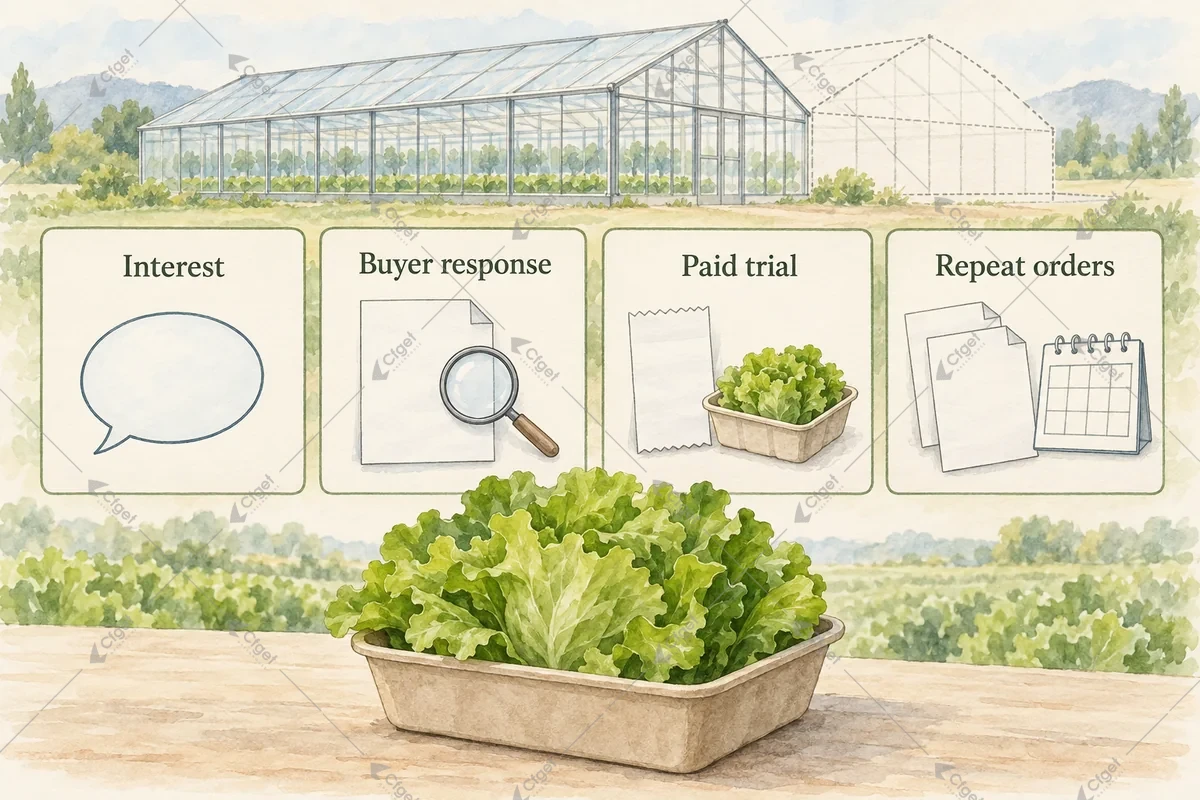
Keep a short record of the evidence and what it permits you to assume:
- General interest. Research papers, comments and survey answers can identify a promising proposition. Use them to choose a test, with no unverified premium in the base case.
- A specific buyer response. Obtain an indicative price for a defined grade, weight, pack, volume and delivery period. Record conditions and expiry. This is stronger than general interest, but it may still change before purchase.
- A paid trial. Record accepted quantity, actual price received, deductions and unsold or rejected product. Compare it with a genuinely comparable offer so that a pack-size or service difference is not mistaken for a label premium.
- Repeatable purchases or a bounded commitment. Look for repeat orders at the intended volume and terms, or a meaningful purchase commitment. Record remaining conditions before deciding how much of the premium belongs in the forecast.
This ladder does not guarantee demand. It makes the distance between a promising claim and a bankable assumption visible, so the next step can be proportionate to the uncertainty.
Use a supported reference price for the base case until the premium has suitable evidence. Keep an upside case separate and state which evidence would justify moving some of that value into the base case.
Then ask what happens if buyers accept the crop but pay no extra for the proposed attribute, or pay the extra price on only part of the volume. If either case undermines the expansion, resolving the premium is a priority before adding capacity.
The commercial greenhouse feasibility workbook can hold the product and buyer evidence. The greenhouse investment model should use only the supported assumptions. A useful outcome from the first market test may be a smaller premium, a different product or a decision to postpone expansion.