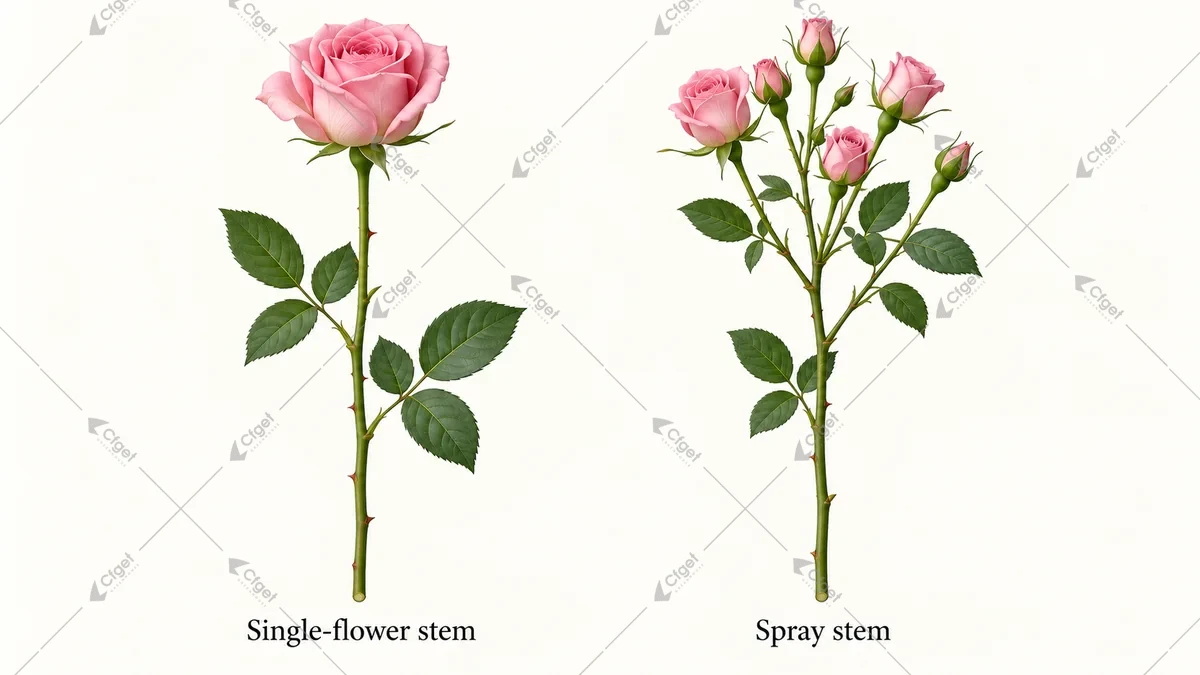
Order cut-rose plants against the harvested stem you intend to sell. A single-flower product presents one terminal flower on a cut stem. A spray presents several flower or bud units on branches of one main cut stem. Those units do not become several independent saleable stems.
Agree on that distinction with the buyer and nursery before treating cultivars as substitutes. In this article, “standard” refers to the commercial single-flower cut-rose category, not a tree-form garden rose.
Count the main stem and describe its flowers
Follow one cut stem upward. In the single-flower presentation, the terminal flower is the main floral unit the buyer assesses. In the spray presentation, lateral floral branching contributes several flowers or buds to the same harvested stem. The branching arrangement, distribution of those units and their opening states become part of the product description.
The stable morphological distinction appears in Robert W. McMahon’s 2000 An Introduction to Greenhouse Production, printed page 341, which contrasts terminal flowers with sprays retaining lateral flowers. Its historical horticultural classes should not be treated as exact definitions of every modern commercial cultivar.
| Buyer question | Single-flower cut stem | Spray cut stem |
|---|---|---|
| What is the counting unit? | One main cut stem | One main cut stem |
| Where are the floral units? | Terminal flower is the intended presentation | Several flower or bud units on the branched stem |
| What needs an agreed opening-state description? | The terminal floral unit | The useful distribution of flower and bud states across the spray |
| What must the nursery confirm? | Cultivar suitability for this intended product | Cultivar suitability for the required spray form |
“Several flowers” is still too vague for a purchase specification. Ask which units count toward buyer acceptance: visibly open flowers, usable buds, or a stated combination. A collection of very immature or damaged units does not answer that question merely because it raises the total count.
Match the cultivar to the intended architecture
United Selections currently presents separate standard and spray rose lines in its breeder catalog. Its breeder description connects the Blossoms line with spray roses. These are commercial category examples, not a recommendation of a cultivar or proof of its performance at your site.
For the actual order, obtain the exact cultivar name, breeder category and nursery description of the product it is expected to support. Do not assume a single-flower cultivar becomes an acceptable spray simply because lateral buds are retained. A buyer’s preferred branch distribution, floral presentation and handling envelope still have to be matched.
The reverse shortcut also fails: bundling several single-flower stems does not create one spray stem. It changes the number of stems in a bunch while leaving each stem’s flower-bearing architecture unchanged.
One hundred sprays still means one hundred stems
In a fictional order, 100 cut stems each carry four flower or bud units. The shipment contains 100 stems and 400 floral units. It does not contain 400 single-stem roses. Those figures are a counting example, not a yield expectation or a prescribed number of flowers per spray.
If the buyer’s order is expressed in stems, retain 100 as the stem count. If a separate floral-unit specification applies, assess it separately. If some of the 400 units are outside the agreed opening state, their presence does not automatically satisfy the specification.
The example also shows why a forecast needs a defined denominator. Floral units per stem, stems per bunch and saleable stems per growing area answer different questions. Do not multiply a stem forecast by bud count and call the result additional stems.
Make the buyer’s specification visible before ordering
Use an unscaled stem silhouette or a buyer-approved reference photograph to mark the main stem and relevant floral branches. Add the agreed descriptions of opening states, stem form and dimensions. The purpose is to remove ambiguity about the harvested unit, not to prescribe a pruning or disbudding method.
Discuss the handling envelope too. A spray’s lateral arrangement needs to arrive in the buyer’s intended presentation. Ask how the agreed stem form will be assessed after packing rather than assuming a package used for single-flower stems answers every spray requirement.
Keep the plant-supply discussion tied to this specification. Ask the nursery what cultivar-specific evidence supports the intended product and which assumptions require a local crop trial. Propagation permission and commercial product suitability are separate matters; one does not establish the other.
Download the harvested-stem specification
Download the cut-rose stem specification card (CSV). This is a manual worksheet with no formulas. Import as UTF-8, comma-separated text. Complete the single-flower and spray columns only for products you are actually comparing, retain one stem as the count unit, and reference your unscaled silhouette or buyer-approved image. The example count is illustrative and does not calculate your order. Adjust widths and wrapping, then save a native spreadsheet copy.
Before ordering plants, have the buyer confirm the harvested-unit description and the nursery confirm the cultivar-to-product match. Broader project questions belong in the greenhouse flower-production plan.