An aphid banker system is suitable for review only when its plant, alternative host, beneficial organism and target crop pest are identified and their relationships make sense for the actual crop mix. “Cereal aphids with beneficials” leaves too much unresolved to specify a purchase.
The central question is host compatibility. An aphid used to support a beneficial organism may be a non-pest in one crop program and a concern when another crop enters the greenhouse. Review current, adjacent and next-cycle plants before treating a banker system as transferable.
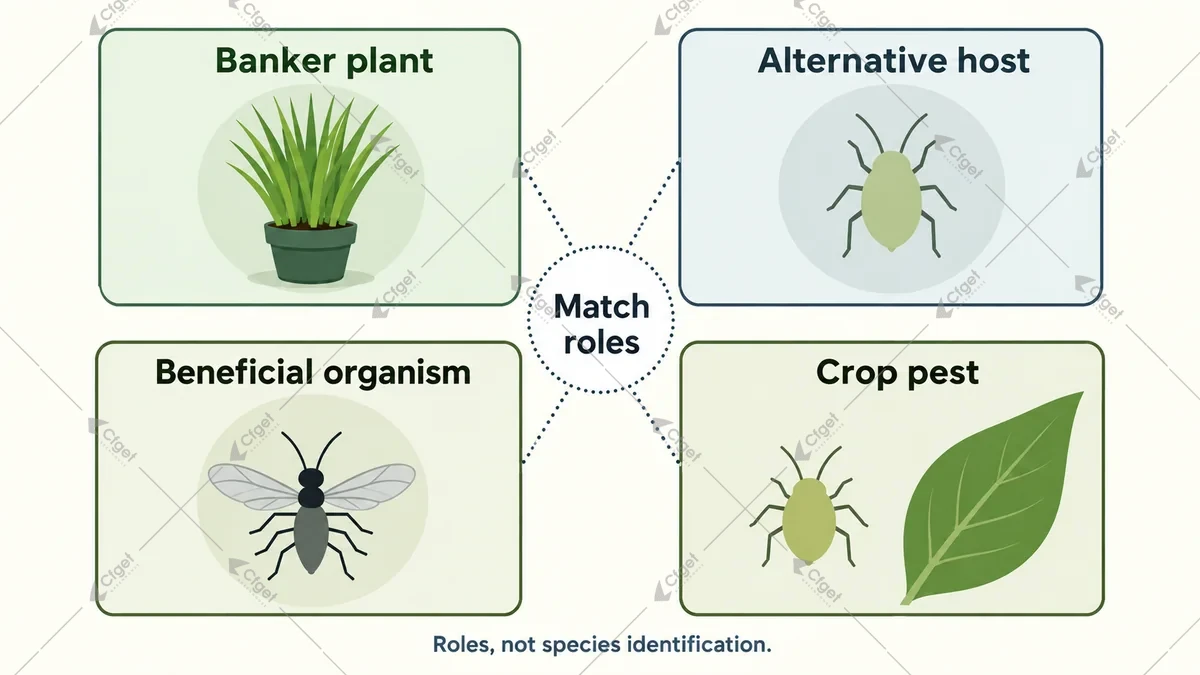
Name all four roles before reviewing the crop mix
In the aphid example, the banker plant supports an alternative aphid host. A parasitoid uses that host and can also attack suitable aphid pests in the cash crop. The alternative host and the pest being targeted are separate identities. The plant is part of the support system; it is not itself the organism that controls the aphid.
| Role | What must be identified | Compatibility question |
|---|---|---|
| Banker plant | The plant species used in the proposed system | Does it support the specified alternative host? |
| Alternative host | The aphid species maintained on that plant | Can it become a pest of plants in this operation? |
| Beneficial organism | The named parasitoid species | Does it use the alternative host and the intended crop pest? |
| Cash-crop pest | The confirmed target aphid | Is it within the beneficial’s relevant host range? |
This map follows the host-system explanation in UVM’s 2017 aphid banker publication. A generic insect drawing cannot confirm any of these scientific identities.
Keep the documented combinations intact
UVM describes cereal plants supporting bird cherry-oat aphid, Rhopalosiphum padi, in a system using Aphidius colemani. It discusses green peach aphid, Myzus persicae, and cotton or melon aphid, Aphis gossypii, among the crop-pest targets.
Koppert’s current Ervibank page describes a different combination: cereal plants carrying Sitobion avenae as alternative hosts for Aphidius ervi and Aphelinus abdominalis. The page also limits use to permitted countries, states and crops.
These examples show why names matter. They do not establish that either combination should be ordered for your crop, or that hosts and parasitoids can be swapped between them. Do not merge the two descriptions into a generic cereal-aphid system. Ask the supplier to document the complete proposed relationship and its relevant target pests.
Reopen the question when the crop mix changes
Consider a fictional tomato operation reviewing a cereal-aphid banker system. Before the next order, it adds ornamental grasses to the same production program. The original crop description no longer covers every plant that could encounter the alternative aphid.
The next action is a host-compatibility reassessment with the IPM specialist and supplier. Identify the added grasses, their location and the timing of the change. Do not assume that a small crop share makes an unresolved host relationship acceptable.
Oklahoma State’s banker-plant guidance explains that an alternative host can become a pest under a changed crop context, and that ongoing scouting remains necessary. Its broader discussion also includes systems using other plant resources. Here the decision remains the named aphid-host system, rather than every method described as a banker plant.
Separate the biological match from the delivery format
A trap crop draws pest attention to an alternative crop. The aphid banker system considered here supports a natural enemy through an alternative host. A predatory-mite breeding sachet is another delivery and support arrangement. Neither name answers the four-role compatibility questions for the proposed aphid system.
For the purchasing review, write down what each organism uses, not just what the product box contains. If the supplier identifies the alternative host but the target aphid in the cash crop remains unconfirmed, that missing identification still blocks a complete biological comparison.
Also assign observation and renewal responsibilities. Banker systems are living relationships, so an agreed program needs specialist reassessment when identities, crop mix or observed performance no longer match the original assumptions. This article does not supply a rearing method, inoculation schedule, release rate or placement plan.
Download the four-role planning map
Download the aphid banker role and crop-compatibility map (CSV). The file is a manual worksheet with no formulas. Import it as UTF-8, comma-separated text, complete “Your proposed system,” and attach the supplier or adviser evidence for each identity. Keep each role on its own row. Record current, adjacent and next-cycle crops separately, including unresolved identities. Adjust widths and wrapping and save a native spreadsheet copy.
Take the map to the IPM specialist before committing to a host system. A completed set of names supports the review; local permission and crop compatibility must still be resolved for the actual proposal.
For complementary observation and receiving practices, see useful sticky-card monitoring records and incoming-transplant inspection.