Before paying for mycorrhizal growing media, establish whether the fungus in the offered product forms the intended association with your crop. A broad greenhouse-use description does not cover every plant family. A confirmed host match makes a relevant evaluation possible; it does not establish colonization, crop improvement or a financial return.
Start with the crop’s identity and the product’s biological identity. “Beneficial fungi” is too broad to connect the two.
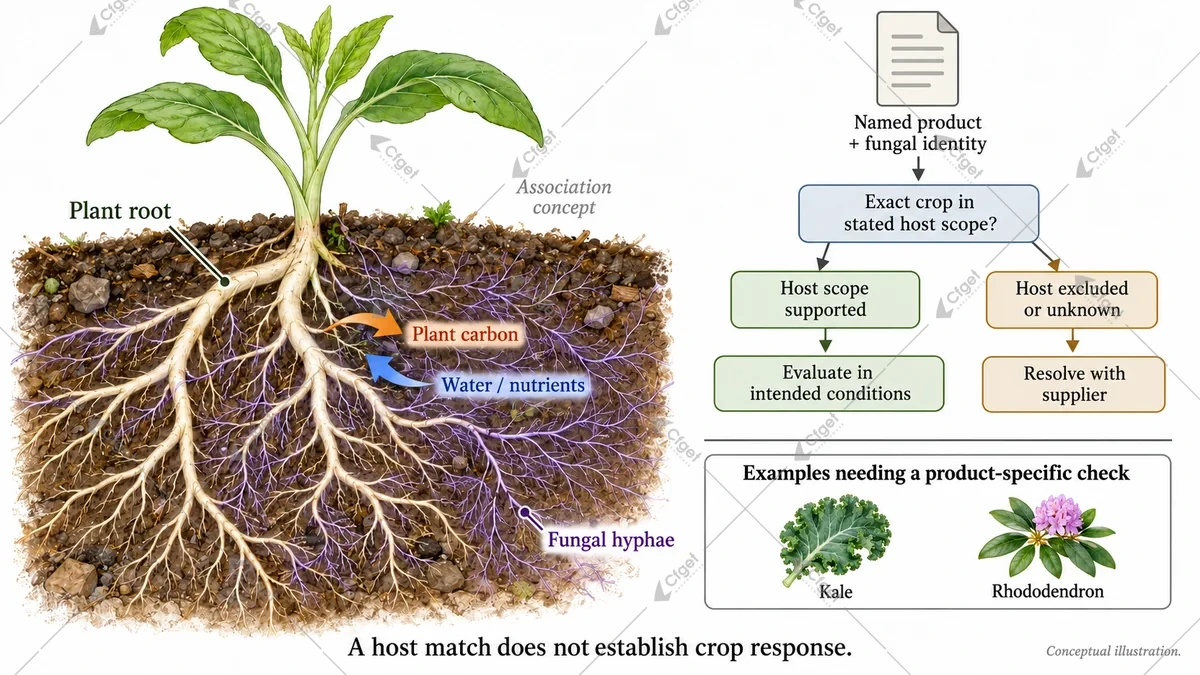
Trace the association from crop to fungus
Mycorrhiza describes an association between a plant root and a fungus. The plant supplies carbon, while the fungal partnership can help the plant access water and nutrients. The fungus is a separate living partner with fine hyphae extending beyond the root, rather than a replacement root or a bag of mineral fertilizer. Premier Tech’s explanation of the association also stresses host specificity.
There are different association types. Arbuscular mycorrhizal products are relevant to many herbaceous crops; ectomycorrhizal associations are a different group, common among many trees. Ericaceous plants and orchids have specialised associations. The Oklahoma State overview identifies these broad distinctions. They are a reason to check the particular fungus and host, not a complete compatibility table for purchasing.
In practical terms, follow this chain: exact crop, identified fungus or product, stated host scope, then evidence under the intended production conditions. An unresolved link should remain visible. A picture of white roots cannot fill it.
A real product note can change a fictional order
The current Canadian AGTIV REACH P product page identifies Rhizophagus irregularis and states that the fungi it contains cannot colonize listed families including Brassicaceae and Ericaceae.
Imagine a fictional order covering kale and rhododendron. Kale belongs to Brassicaceae; rhododendron belongs to Ericaceae. For this named product, copying a general greenhouse-use headline into the order does not overcome those exclusions. The buyer should ask the supplier to resolve the crop–product mismatch before assigning a mycorrhizal benefit to either line.
Keep that conclusion narrow. The restriction concerns the fungi in this product. It does not mean that rhododendron or blueberry can never form a mycorrhizal association, or that a plant outside this product’s host scope has no beneficial microorganisms.
Separate a host match from a production result
Now consider a second, entirely fictional comparison: a supplier documents that a different proposed crop is within the exact product’s host scope. That answers the first biological question. The buyer still needs evidence for what happens in the intended medium and crop program.
| Evidence in hand | What it supports | What remains open |
|---|---|---|
| Exact crop excluded by the named product | The proposed association is unsupported for that purchase | How the supplier will resolve the mismatch |
| Host scope confirmed | A biologically relevant candidate for evaluation | Whether the association establishes under the intended conditions |
| Relevant colonization evidence | Evidence of the association in the tested setting | Crop response and commercial value |
| Relevant crop-response evidence | A basis for discussing the observed outcome | Transferability and the cost of the proposed offer |
These steps prevent two opposite mistakes: paying a performance premium for an excluded host, or treating every host-compatible product as guaranteed to pay for itself. Media composition, nutrition and handling belong in the interpretation of evidence. They should not disappear behind the word “natural.”
Write a purchase question that can be answered
For each crop line, ask the supplier to connect the named organism and product version to the crop’s stated host scope. Then request the relevant evidence and its production conditions. A trial on another crop can be useful background, but it should not be relabeled as a result for your order.
Keep the wider physical and chemical medium choice in the greenhouse substrate-selection review. Biological compatibility adds a question to that review; it does not replace water, air or nutrient management.
Download the host-compatibility chain
Download the mycorrhizal host-compatibility CSV. This manual worksheet contains the bounded kale/rhododendron example and separate blank fields for your crop and product evidence. There are no formulas, benefit scores or inoculation instructions. Open as UTF-8, comma-separated text, widen and wrap the columns, and save a spreadsheet copy. Complete the host-scope conclusion before using the later fields for establishment, response and commercial evidence.