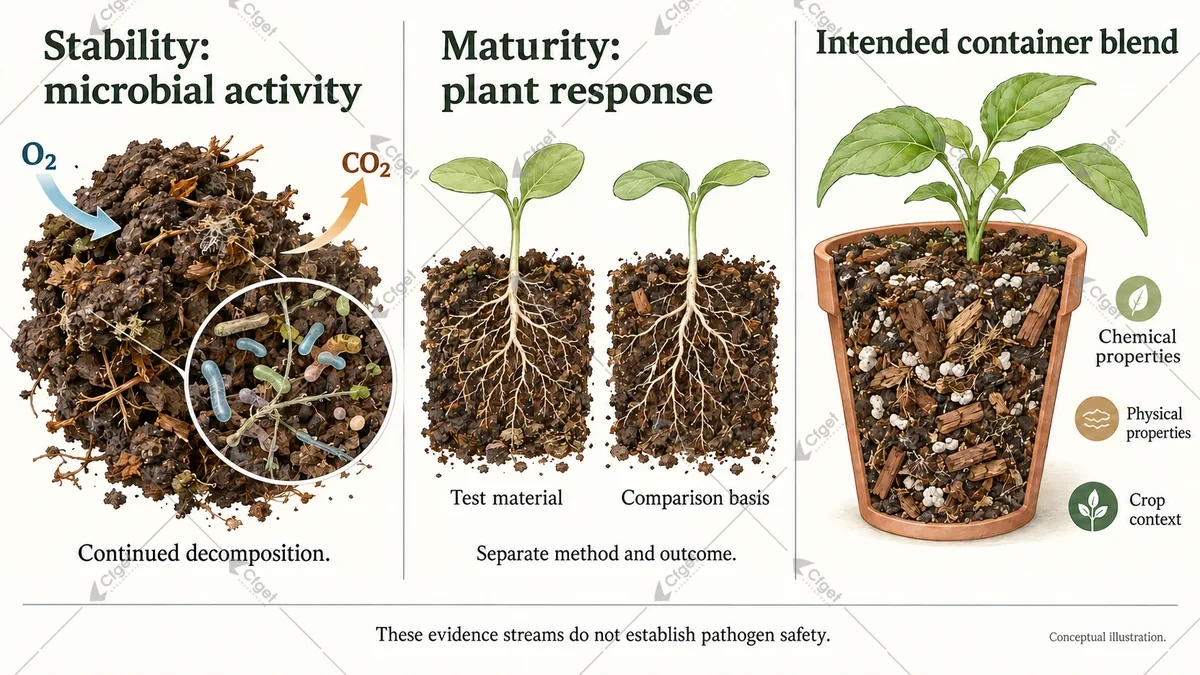
For a greenhouse growing-medium component, compost stability and maturity evidence answer different questions. A stability result concerns remaining biological activity under the test conditions. A maturity assessment can examine plant response and other completion indicators. Neither label, on its own, establishes that a material fits the intended container blend.
Read the method behind the claim before accepting “finished compost” as a complete specification. The useful decision is whether the report covers the questions relevant to your proposed use, and which questions still need evidence.
Separate decomposition activity from plant response
Microorganisms continue breaking down available material during composting. Their activity can consume oxygen and affect nutrients. A laboratory respiration result describes an aspect of that activity. A seedling-response assessment asks a different question: how the test plants performed under its defined conditions and comparison basis.
In Rob Ferris’s Midwest Laboratories teaching deck, hosted by the Compost Research and Education Foundation, stability is assessed through microbial activity, while maturity includes plant-response and other indicators. The deck also identifies interferences: excessive salts or ammonia can inhibit microbial activity and produce a low respiration reading. Low activity therefore needs method-aware interpretation rather than an automatic “ready for plants” conclusion.
These terms are not used identically by every supplier. Preserve the test name, units and laboratory interpretation instead of translating every occurrence of “mature” into the same result. A value reported relative to total solids is also not automatically comparable with one reported relative to organic matter.
Keep three evidence streams visible
| Question | Evidence to read | What remains separate |
|---|---|---|
| How much biological activity remains? | Method-defined stability result, reporting basis and laboratory comments | Whether a low result reflects completion or an interfering condition |
| What plant response was observed? | Maturity or bioassay method, test material, control and reported outcome | Performance of your crop in the complete proposed medium |
| Does the intended container blend fit the crop system? | Relevant chemical and physical properties of the proposed blend | Nutrition planning, biological safety and any certification requirements |
UMass greenhouse-media guidance discusses several compost completion indicators and the special demands of potting use. It also distinguishes compost as a field amendment from its role within container media. Color, age, a cool pile or C:N alone cannot settle every question about the finished material.
Even favorable completion evidence leaves the actual blend to evaluate. For example, a chemical result on the compost component is not a measurement of the complete mix after other ingredients have been added. Nor does a stable component automatically provide the entire fertilizer program. Carry the material into the container and irrigation-system comparison with its identity and evidence intact.
Compare two fictional supplier reports
Report A includes a low respiration result, but no plant-response assessment and no physical data for the proposed final blend. Report B includes a method-defined stability result and a separate seedling-response result with its control basis. B answers more of the completion questions. That is an evidence-coverage advantage, not yet a crop-suitability verdict.
For A, ask the laboratory what the result can establish under its method and whether the accompanying information leaves inhibition unresolved. Ask the supplier for the missing plant-response evidence relevant to the material. Do not fill the gap with the material’s dark appearance or the number of months since production.
For B, read what was actually tested. Was the assay performed on the delivered material or another sample? What was the comparison, and does the report identify the batch? Then resolve the proposed blend’s properties and intended crop use. Do not turn a favorable response by the assay plant into a universal pass for greenhouse seedlings.
This approach can change the purchasing conversation from “Which compost is most mature?” to “Which evidence supports this material in this intended role?” It avoids committing the whole crop plan on one reassuring adjective.
Download the compost-evidence comparison
Download the compost-evidence comparison CSV. This is a manual worksheet with no formulas or combined pass score. Import as UTF-8 with comma separators, widen the columns and wrap text, then save an editable spreadsheet copy.
Enter each supplied report in its own column. Keep stability, maturity, EC/pH and physical evidence on separate rows. Write “not supplied” where necessary, and use the conclusion to name the unanswered use-specific question. The worksheet interprets existing laboratory evidence; it supplies no home assay, composting recipe, blend percentage or release decision for a real batch.