A harvested snapdragon spike can develop an upward curve while remaining firm. For Antirrhinum majus, gravity-responsive growth can continue after cutting. A curved tip therefore deserves a review of orientation and temperature history as well as hydration and mechanical handling.
The first useful step is to describe the change precisely. A smooth upper-stem curve, a sharp local kink and general loss of firmness are different observations. Calling every bent shipment “wilted” can send the investigation toward the wrong part of the handling chain.
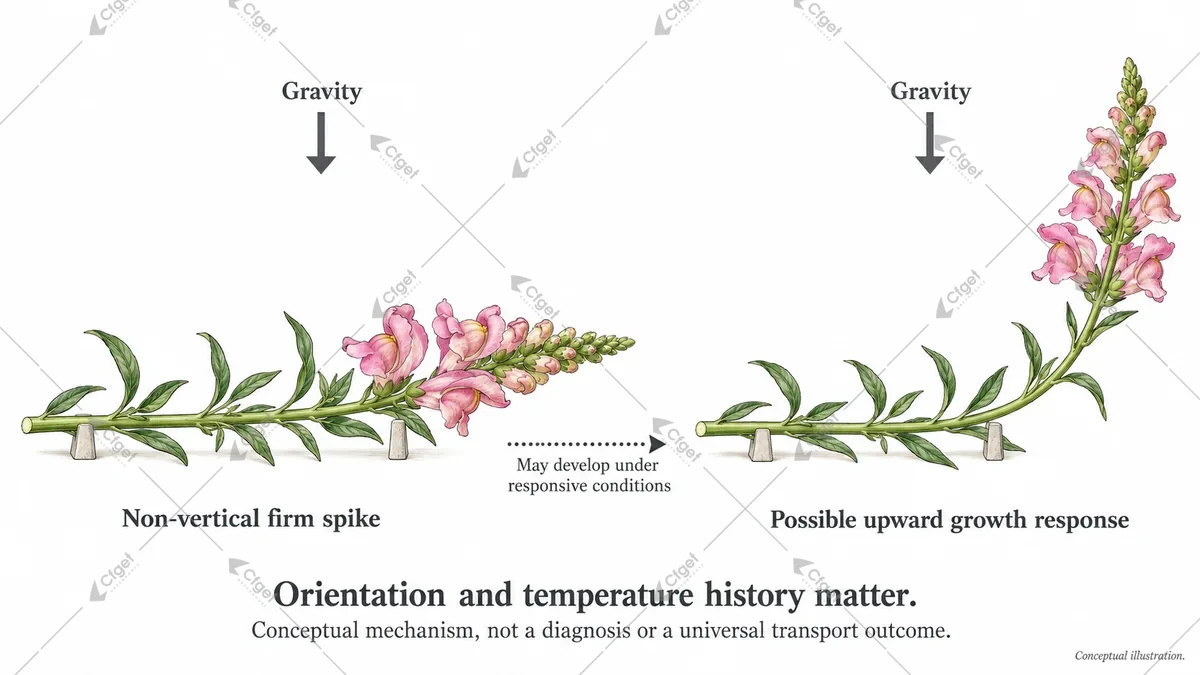
Follow orientation through the handling chain
Negative gravitropism describes growth directed against gravity. When a responsive cut spike is held non-vertically, differential growth can produce an upward-curving tip. The author abstract of Philosoph-Hadas and colleagues’ 2001 snapdragon research identifies differential growth as part of this curvature mechanism. It does not make a photograph sufficient to identify the cause of a particular commercial defect.
Cornell’s high-tunnel snapdragon guidance explicitly notes upward tip curvature in horizontally stored, turgid flowers. Firmness and straightness must therefore be observed separately. A stem can retain water-related firmness while its growing region changes direction.
For a handling review, follow the spike from its recorded form at harvest through packing, waiting, loading and receipt. Note orientation during each interval, not simply the position of the final box. A carton photographed upright at dispatch cannot explain an undocumented earlier waiting period.
Do not make every horizontal route the same
Temperature and handling history matter. UC Davis’s October 2004 snapdragon fact sheet discusses non-vertical holding and upward bending, but its packing section also recognizes properly precooled, controlled cold horizontal transport. That qualification prevents a blanket claim that every horizontal flower box is unsuitable.
For your route, ask the postharvest specialist which orientation and temperature conditions the crop-specific plan covers. An established cold transport arrangement and an unplanned non-vertical wait should not inherit each other’s evidence. A vehicle-air setting also does not, by itself, provide a complete record of product temperature through the chain.
| Observed condition | Useful history to examine | Conclusion to avoid |
|---|---|---|
| Smooth upward tip, stem still firm | Earlier form, orientation intervals and available product-temperature records | “Firm means gravity response is impossible” |
| Local kink or visibly compressed area | Contact, restraint and handling at that location | “Every bend is new growth” |
| General loss of firmness | Hydration and handling history alongside the shape record | “All shape changes have one cause” |
The table organizes questions rather than diagnosing stems. Several influences may coexist. Preharvest shape also matters: without an earlier observation, a curve seen at receipt may not be a newly developed change.
Work through a fictional delivery incident
A spike is documented as straight and firm at packing. At receipt, it remains firm but has a smooth upward tip. The chain record identifies an intervening non-vertical waiting interval. Product-temperature records for that interval are incomplete.
Gravity response is a plausible issue to investigate. The record does not prove it caused the defect, because the conditions and alternative explanations remain incomplete. The useful next action is to reconcile that waiting interval with the grower and handling team, including the missing temperature evidence and the original stem observations.
Keep the two statements separate in the incident note: “smooth upward curvature observed” and “orientation-related growth proposed for review.” That wording preserves what the buyer actually received without turning an interpretation into a fact. It also avoids assuming that rewatering or forcing a stem straight will resolve a growth-related change.
Download the orientation-through-the-chain log
Download the snapdragon orientation log CSV. This manual worksheet has no formulas, treatment recommendations or shelf-life calculation. Import as UTF-8 with comma separators, widen the columns and wrap text, then save an editable spreadsheet copy.
Use the harvest, packing, waiting, loading and receipt rows for timestamps, orientation, shape and firmness observations, and available product-temperature evidence. Mark missing records explicitly. The final section keeps the observed defect, possible explanation and follow-up question separate. Review an actual incident using existing records rather than deliberately stressing saleable flowers to reproduce a curve.