“Precooled” does not universally mean that tulip bulbs are ready to enter a warm forcing greenhouse. Establish the internal flower-development stage, the treatment already completed and the remaining root-development route. A dry bulb can have received cold treatment while still needing roots after planting.
For facility planning, the important question is which documented intervals remain and where they occur. Planted cooling and rooting may overlap. Adding them as two complete consecutive periods can misstate both timing and room occupancy.
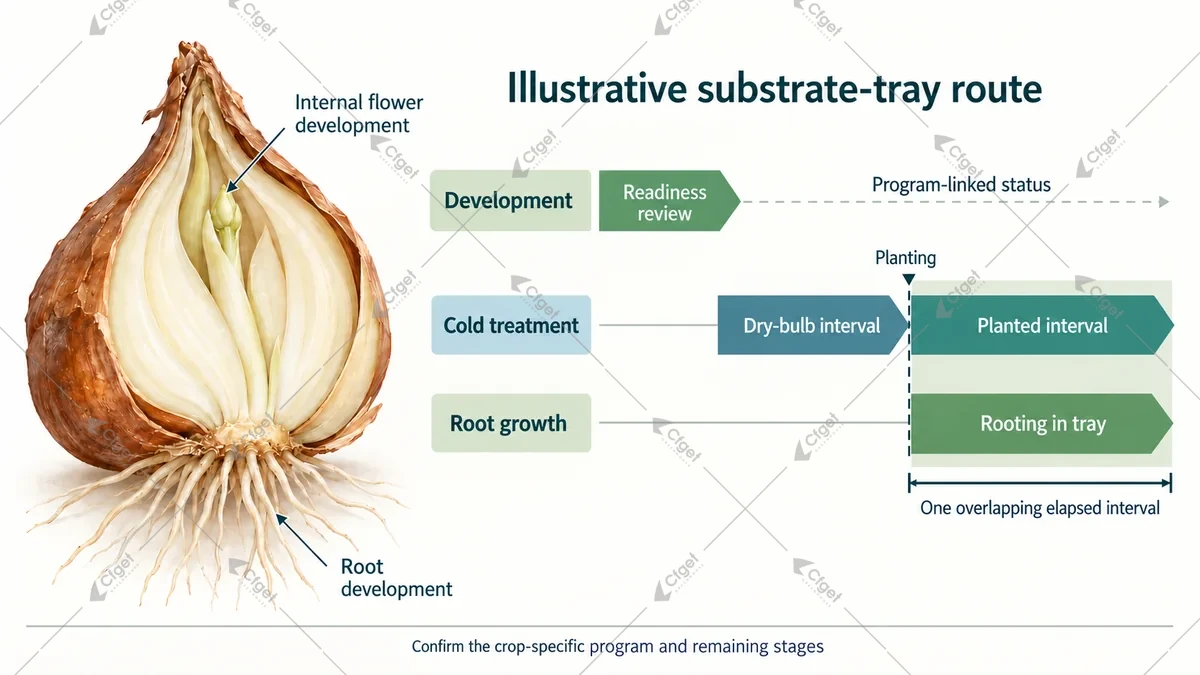
Align flower development, cold treatment and root growth
Tulip flower formation begins inside the bulb before the subsequent programmed cold treatment. Cold supports later stem development and flowering; it should not be described as simply initiating a new flower in an otherwise undeveloped bulb. De Ruyter’s treatment explanation distinguishes developmental assessment from the later cold period.
The International Flower Bulb Centre forcing guide hosted by Ruigrok describes internal flower development, Stage G, applicable intermediate treatment and the subsequent cold sequence. Its technical context is cool and temperate climates. The qualitative distinctions are useful here; its temperatures and durations are not a universal program for another site.
Stage G is a developmental assessment of the internal flower, not a statement that external roots are ready. Ruigrok’s commercial preparation page describes lot-stage assessment connected with its precooling service. Obtain the actual lot’s documented assessment and agreed program from the supplier. A shipping label or a conceptual bulb drawing cannot certify that stage.
Show simultaneous processes on the same timeline
For an illustrative substrate-tray route, draw three aligned tracks. The columns below are symbolic intervals, not equal durations or an executable schedule.
| Track | Before planting | Supported planted cold interval | Transition to forcing |
|---|---|---|---|
| Internal development | Supplier assesses flower development and the applicable intermediate treatment | Developmental status remains linked to the agreed program | Confirm the program’s transition basis |
| Temperature treatment | Documented dry-bulb portion of the cold program, if assigned | Remaining assigned cold treatment | Cold-program completion is checked |
| Roots | Record the actual unplanted starting condition | Roots develop after planting during this same supported interval | Root readiness is checked separately |
The middle column is one elapsed interval serving two functions: planted cold treatment and rooting. It is not a full cooling period followed automatically by another full rooting period. The industry guide describes cold treatment divided between dry bulbs and planted trays, with the remaining portion taking place in the rooting environment.
Keep the production routes distinct
University of Maryland Extension’s cut-tulip guide distinguishes purchased precooling, hydroponic trays and substrate-crate production. In its hydroponic description, rooting follows placement into water trays; its substrate route has its own treatment and planting context.
These routes cannot be combined by borrowing the shortest interval from each. Keep substrate crates, hydroponic trays and greenhouse border-soil programs separate. A completed dry-cooling program still does not describe actual roots, while an interval in a rooting room must be interpreted against the specific treatment program rather than treated as generic cold storage.
Compare two fictional offers by remaining facility work
Offer A supplies dry bulbs with part of an identified substrate-tray program completed. In the fictional agreement, the remaining planted cold interval is also the planned rooting interval. The buyer needs the designated rooting/cooling facility for that shared period. It should not add a complete new cold program merely because roots have yet to develop.
Offer B supplies bulbs under a different, fully documented dry-cooling program intended for another forcing route. The buyer must confirm where rooting and the next production stage occur in that route. It cannot assume that A and B enter the same room on arrival, or that either offer guarantees the requested flowering date.
For each offer, draw the confirmed dry and planted intervals once, then mark which facility and operator are responsible. Leave unconfirmed transitions open. After the crop specialist has confirmed the actual intervals, use nursery occupancy planning to examine overlap among batches. That capacity method does not determine the tulip’s biological treatment requirement.
Download the tulip three-track phase worksheet. This manual tool contains no formulas, chill-hour total or default treatment duration. Import the UTF-8 comma-separated file, widen columns and wrap text, then save a working copy. Align development, treatment and roots across the same interval columns for one named route. Record the evidence and remaining facility responsibility. Where planted cooling and rooting overlap, record one shared elapsed interval rather than adding it twice.