Broccoli transplants can survive cool weather and still form a small head too early for the intended market. Survival and head development answer different questions. For head-forming broccoli, review the leafy framework and the developing floral head together before treating a live cohort as evidence that a large-head sales plan remains on course.
The relevant problem is buttoning: premature small-head formation on a plant that has not developed enough vegetative growth for the intended product. A small head also needs to be distinguished from later open flowers and from a crop deliberately grown for a different small-stem product.
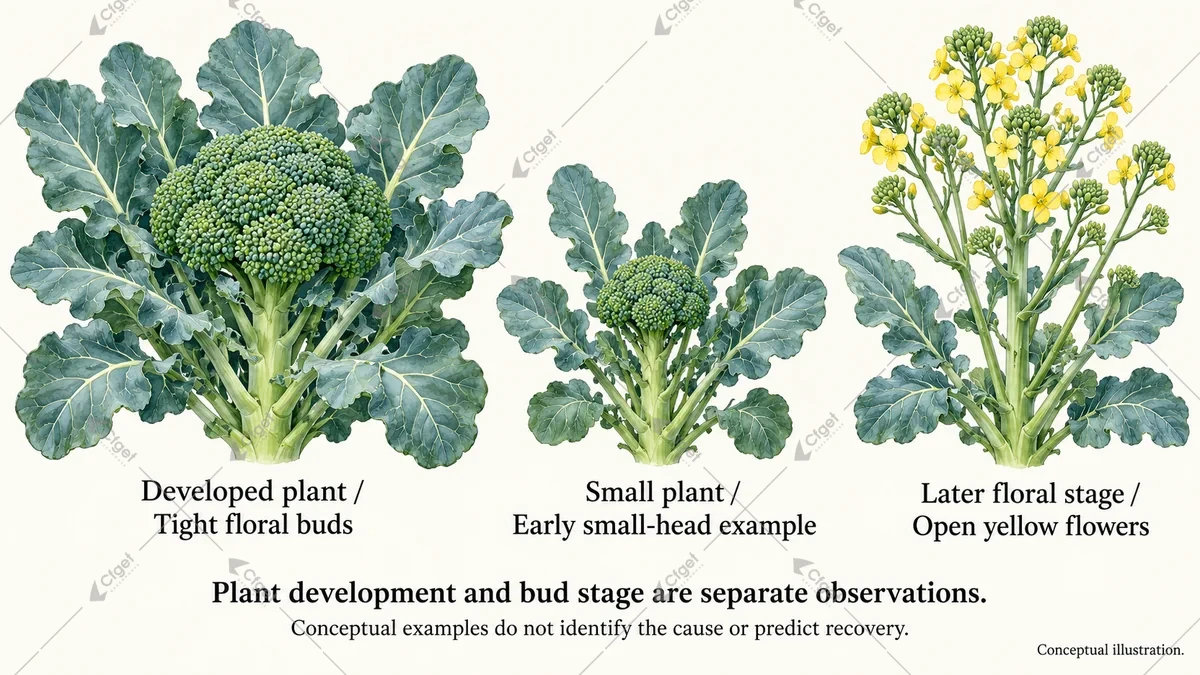
Follow vegetative growth and head development separately
The broccoli head consists of developing floral buds. Leaf and plant development support the crop, while the timing of reproductive development determines when that head begins and progresses. In its Minnesota high-tunnel discussion, University of Minnesota Extension’s “Gearing up to Grow: Brassicas,” updated April 2, 2026, warns that excessive early cold can trigger premature head formation and distinguishes the later risk of bolting.
That source supplies a regional commercial context, not a fixed cold-dose rule for every broccoli cultivar. Cultivar, plant age and condition, nursery history and other growth-limiting stresses belong in the assessment. An image of a small plant cannot identify one cause.
| Developmental observation | Why it matters to the product | Question to resolve |
|---|---|---|
| Developed leafy framework, head at the appropriate stage | Vegetative and head development may fit the intended tight-head product | Does this cultivar and cohort match the actual buyer specification? |
| Small tight head on an undersized plant | Premature head formation may constrain the original plan | What does the developmental history show? |
| Opening yellow flowers | This is a later reproductive endpoint | Does that stage still fit the intended market? |
The distinctions are useful even before the cause is settled. They stop a survival report, a head-size observation and a flower-stage observation being treated as interchangeable.
Compare two fictional lots that survived the same event
Assume two head-broccoli lots passed through the same cold event without obvious leaf death. Lot A has ample vegetative development and no prematurely visible small head. Lot B already has small tight heads on undersized plants. This is an invented comparison, not a trial result or a photograph-based diagnosis.
“Both survived” is true within the example, but insufficient for promising equal future head size. Lot B requires a developmental review before its original production commitment is reaffirmed. Lot A still needs normal cohort assessment; the absence of the pictured problem is not a yield guarantee.
Ask the nursery to connect sowing and transplant history, cultivar identity, temperature exposure and observations before and after the event. Then ask the crop adviser what the current bud stage and leafy framework imply for the specified product. This is more informative than asking whether broccoli is generally cold tolerant.
Keep the intended product visible
A buyer wanting a conventional tight head and a buyer wanting a deliberately small-stem broccoli product may be purchasing different things. Write the agreed product beside the observation. Do not relabel a prematurely small head as broccolini to make a forecast appear fulfilled.
Likewise, separate a small tight head from a head whose flowers are opening. A generic entry such as “small/bolted” removes information needed for a useful discussion. Describe the actual bud or flower condition and keep the lot identity attached.
The next commercial action is to revisit the cohort’s market fit with the nursery and adviser, using its development history. Do not infer a warming rescue schedule or discard the whole lot from the conceptual diagram. If a delivery issue also needs documentation, use the separate vegetable-transplant receiving guide.
Download the cohort-development record
Download the broccoli cohort-development CSV. This manual tool keeps intended product, vegetative development, tight-head observations and open-flower observations in separate fields. It includes the fictional A/B comparison and a blank column for an actual cohort. There are no formulas, cold-hour thresholds or automatic rejection rules. Open as UTF-8, comma-separated text, widen and wrap the columns, and save a spreadsheet copy. Complete the developmental question for the adviser before updating the sales expectation.