Before assigning Kenyan rose production to a sea-freight sales program, check how far ahead the buyer can plan and how much of that plan can remain stable. A lower freight quotation is of limited use if the buyer continues changing varieties, stem grades and quantities close to delivery.
Start with a defined part of the buyer’s assortment, a clear transition from forecast to firm order and an agreed response when the planned arrival or accepted quality is at risk.
Longer planning starts with the customer
Wageningen’s 2023 bottleneck analysis of Kenyan roses shipped to the Netherlands described roughly two months of retailer forecasting for direct-sale sea programs, rather than two weeks. This was an interview finding. Six participating organizations were named, while the number of individual respondents was not reported.
Those approximate horizons are historical context, not a current transport schedule or a compulsory order-lock deadline. Their practical message is that the buyer’s planning behavior is part of the transport decision.
Consider two hypothetical customers. One repeatedly buys a fairly stable assortment and can discuss likely demand well ahead. The other chooses much of its assortment shortly before delivery and regularly changes color or stem grade. The first offers a clearer starting point for evaluating a limited sea program. The second would need a different planning arrangement before the grower could rely on those volumes.
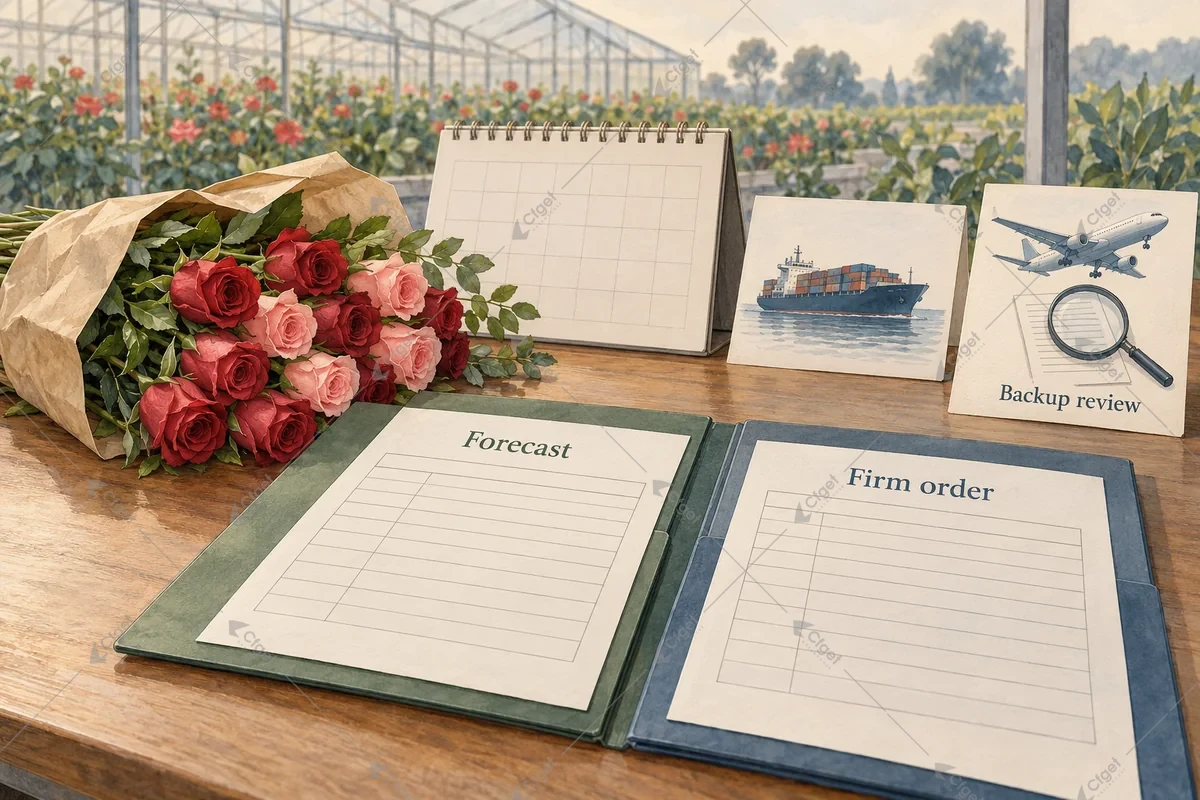
A forecast and a firm order do different jobs
A forecast helps the grower and logistics partners plan likely demand. It should not silently become a promise that the buyer will accept every stem in it. A firm order has a different commercial role, with the applicable obligations determined by the parties’ actual agreement.
Before allocating the crop, settle these practical questions with the buyer:
- Which varieties, grades, quantities and selling windows can be forecast far enough ahead for the proposed route?
- When does each forecast need to become a confirmed order for planning purposes?
- What changes remain possible after that point, and who must approve them?
- Which substitutions, if any, does the buyer accept?
- Who makes the decision if the expected delivery no longer fits the buyer’s selling window?
The answers should fit the actual route and booking arrangements confirmed with the logistics provider. Do not turn the historical two-month example into a universal cutoff. A rolling forecast may be useful, but the team still needs to know which part remains flexible and which part production is relying on.
Limit the assortment to roses with relevant quality evidence
A stable order alone does not make every cultivar–farm combination suitable for the journey. A Wageningen project summary published in July 2025 covered 2022–2024 work with three cultivars from five Kenyan growing locations. Its six experiments included three actual sea shipments and three simulated shipments; the cultivar–location combinations were incomplete.
The researchers assessed at least six bunches of ten flowers per stated cultivar/location combination in test and control groups. Quality after long transport varied substantially, with cultivar and location both relevant. The bunches were assessment samples, not independent sea voyages.
For a commercial decision, seek quality evidence that matches the proposed cultivar, farm and handling route. Keep a combination without adequate evidence outside the committed assortment until that gap is resolved. This protects the buyer discussion from resting on the broad claim that roses have successfully traveled by sea somewhere else.
Discuss the fallback before the shipment becomes urgent. The grower, buyer and logistics provider need to know what triggers a review, who can approve an alternative shipment and who accepts the associated cost under the agreed arrangements. An available flight is not automatically an approved or affordable substitute.
Also clarify what happens to the original sea-shipped product if replacement flowers are sent. Otherwise, a hurried fallback can create duplicated volume, an unplanned selling obligation or a disagreement over which flowers the buyer is expected to take.
The next step is a bounded program: a specific assortment, supported quality evidence, a buyer planning process and named decision owners for changes. Expand it only when the actual operating record supports doing so.
For the separate production-facility questions, see the Kenya rose greenhouse planning guide. The decision here begins earlier in the commercial conversation: whether the buyer’s requirements can support the proposed sea-freight program.