An unheated tunnel can offer an autumn spinach market or a valuable spring harvest, but those goals need different crop-exit decisions. Before removing a productive summer crop early, compare the contribution it still earns with the additional spinach sales an earlier changeover can realistically support.
The largest cumulative spinach harvest is not automatically the most valuable use of the tunnel. Harvest timing, accepted leaf quality, labor and the crop being displaced all affect the choice.
What two New Hampshire winters showed
UNH’s June 2016 winter-spinach report describes trials at Durham, New Hampshire, in 2014–15 and 2015–16. Three cultivars and six transplant dates were compared with four randomized-block replicates of 24 plants per cultivar/date combination. Marketable leaves were harvested repeatedly.
| Transplant date | 2014–15, lb/ft² | 2015–16, lb/ft² |
|---|---|---|
| September 20 | 0.66 | 1.31 |
| November 9 | 0.29 | 0.54 |
The earliest date produced more cumulative yield, while the first four dates through October 19 had statistically similar spring yields. November 9 transplants took 130 days to first harvest in one winter and 39 in the other. Tunnel covers and management also differed between years, so temperature alone cannot explain that contrast.
The table retains the report’s trial-area units. It is not an annual whole-tunnel-floor yield forecast. Nor did this experiment measure the profit forgone by ending a summer crop earlier.
Choose the sales window before the changeover date
If autumn or holiday sales are the goal, the growing period before winter slowdown has commercial value. An earlier crop may be worth making room for when buyers want that product, will accept its specification and can absorb the volume. Establish those conditions before assigning a holiday premium.
If spring sales are the priority, the trial gives a reason to investigate a later changeover. That may leave more time to harvest the summer crop without sacrificing the entire spring opportunity. It does not establish a universally safe planting date: local light, tunnel conditions and crop performance still determine what a later planting can deliver.
Keep the selling plan explicit. “Winter spinach” can mean selling leaves before the holidays, holding plants through winter for spring harvest, or both. Those are different uses of the same space and cash.
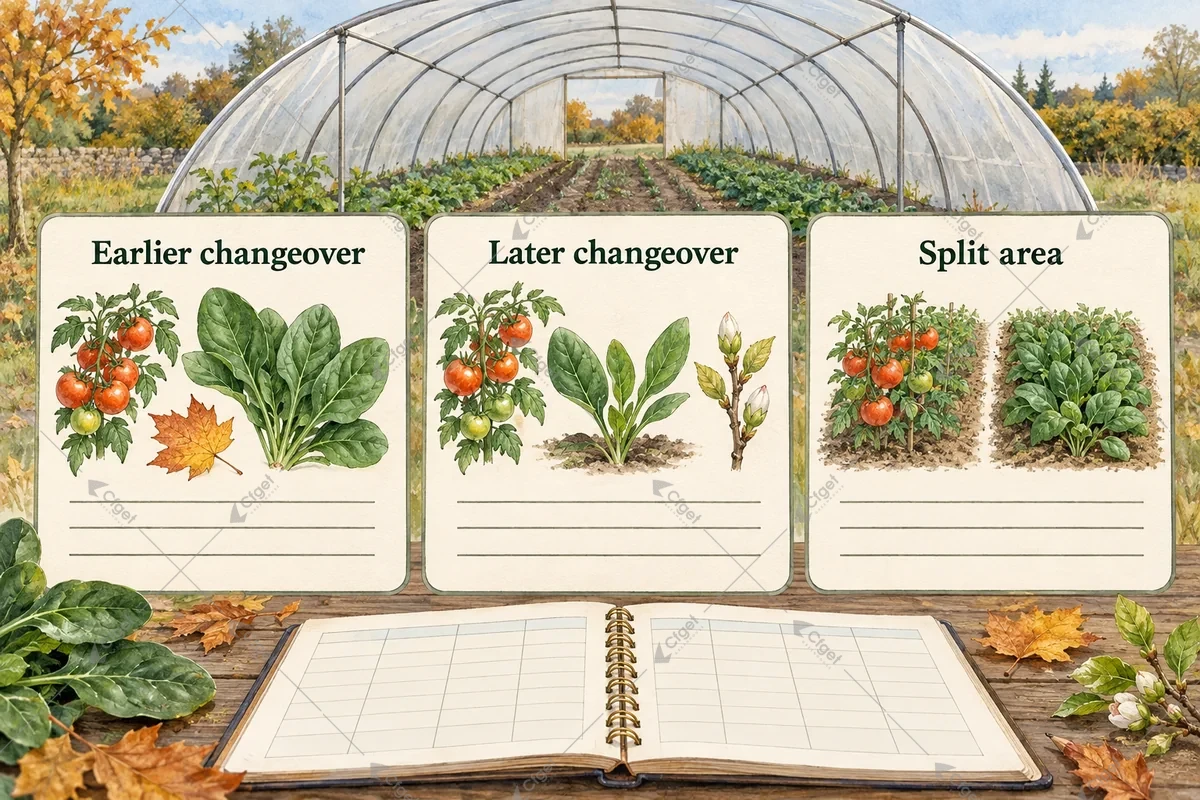
Compare three choices using contribution
Write a short comparison of these practical options:
- End the summer crop early. Estimate the late summer-crop sales and avoidable costs that disappear. Compare the lost contribution with the additional accepted autumn spinach sales, less the costs needed to produce, harvest and deliver them.
- Convert later for spring. Keep the supported remaining summer-crop contribution. Assess the later spinach crop mainly against the spring market, with limited early sales unless local records support them.
- Divide the changeover, where practical. Compare a smaller early spinach area with a later-converted area, accounting for extra coordination and separate crop handling. This is a way to limit an uncertain commitment, not a promise of the highest return.
Contribution means sales less the costs that change with that choice. It prevents a comparison of gross spinach revenue against the entire historical cost of the summer crop. Costs already incurred do not disappear when a crop is removed; the decision concerns the future cash and work that each option creates or avoids.
Check the bottleneck that can overturn the result
Review harvest and packing labor by selling window. More leaves have little commercial value if they cannot be harvested to specification or reach a buyer while saleable. Include the cleanup and preparation time between crops, and the nursery space needed to have usable transplants ready.
Use your own previous tunnel records to test a slower-harvest case. The wide first-harvest difference in the UNH experiment is a reason to leave room for uncertainty before making delivery promises. Do not multiply its cumulative leaf yield by imagined extra annual crop turns.
The next decision can be modest: identify the contribution from keeping the summer crop for one more interval, confirm the spinach selling window and determine whether the early changeover still wins. Check the nursery bench-space guide for transplant capacity and the commercial feasibility workbook for the wider production and market assumptions.