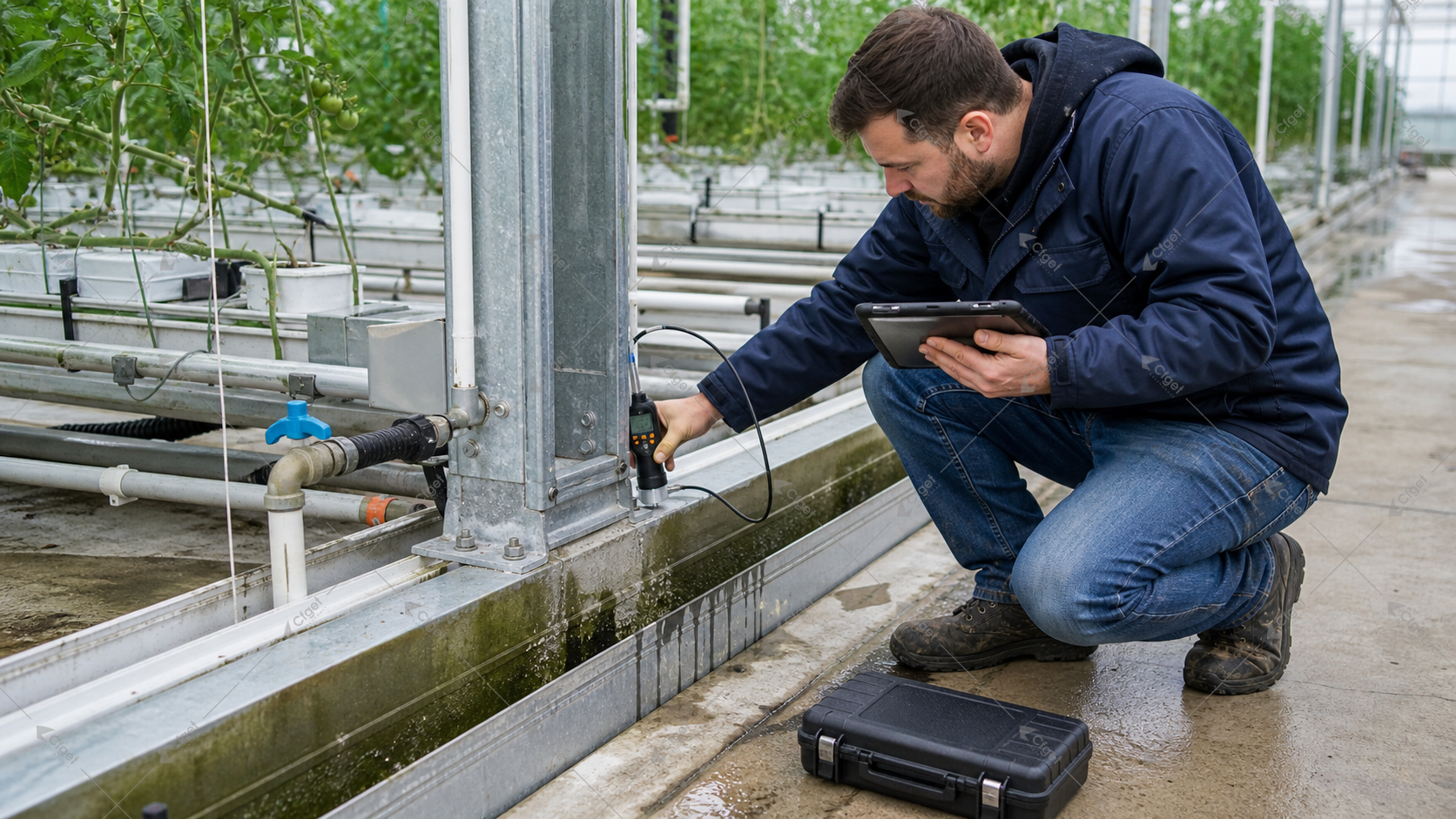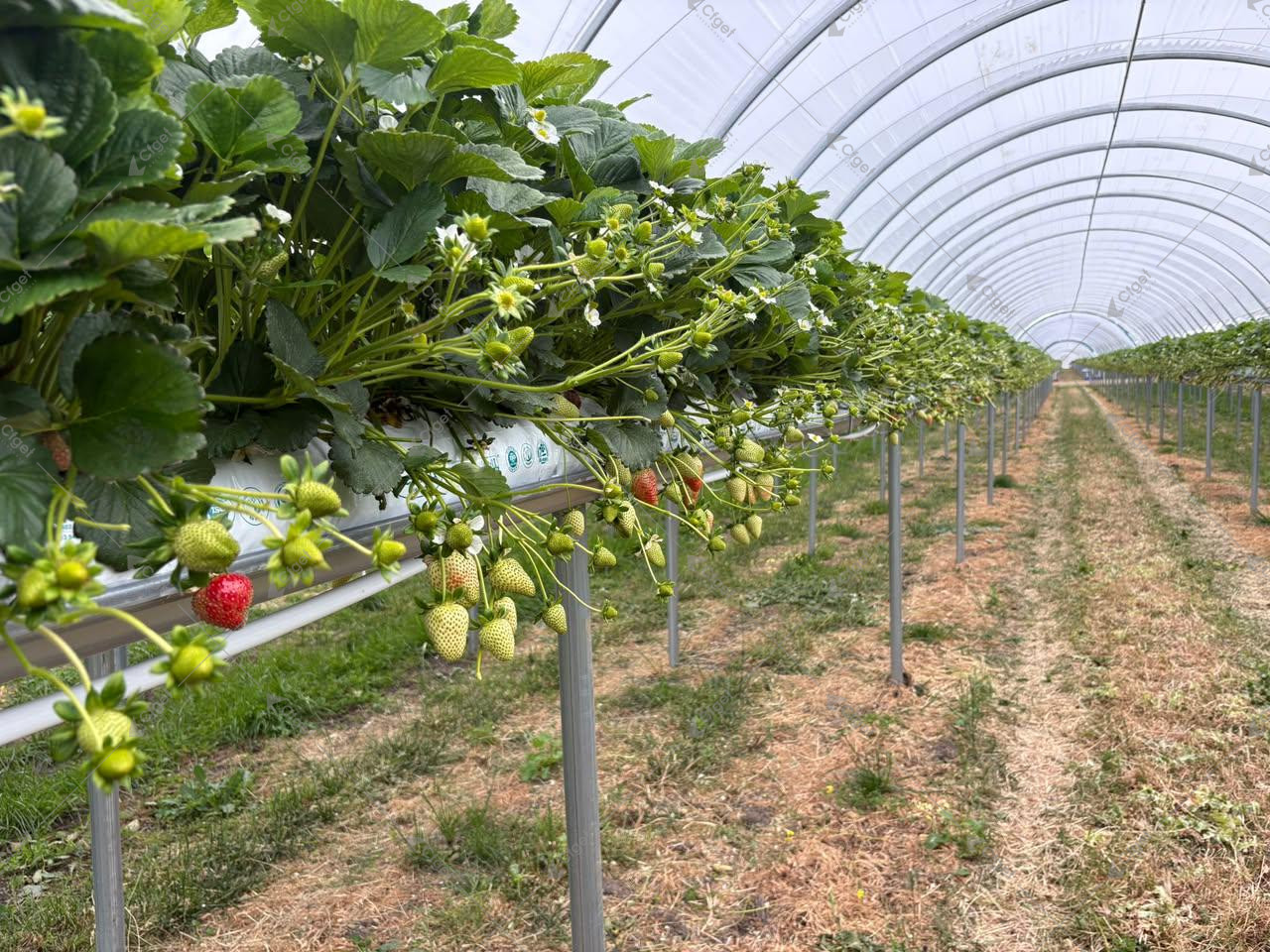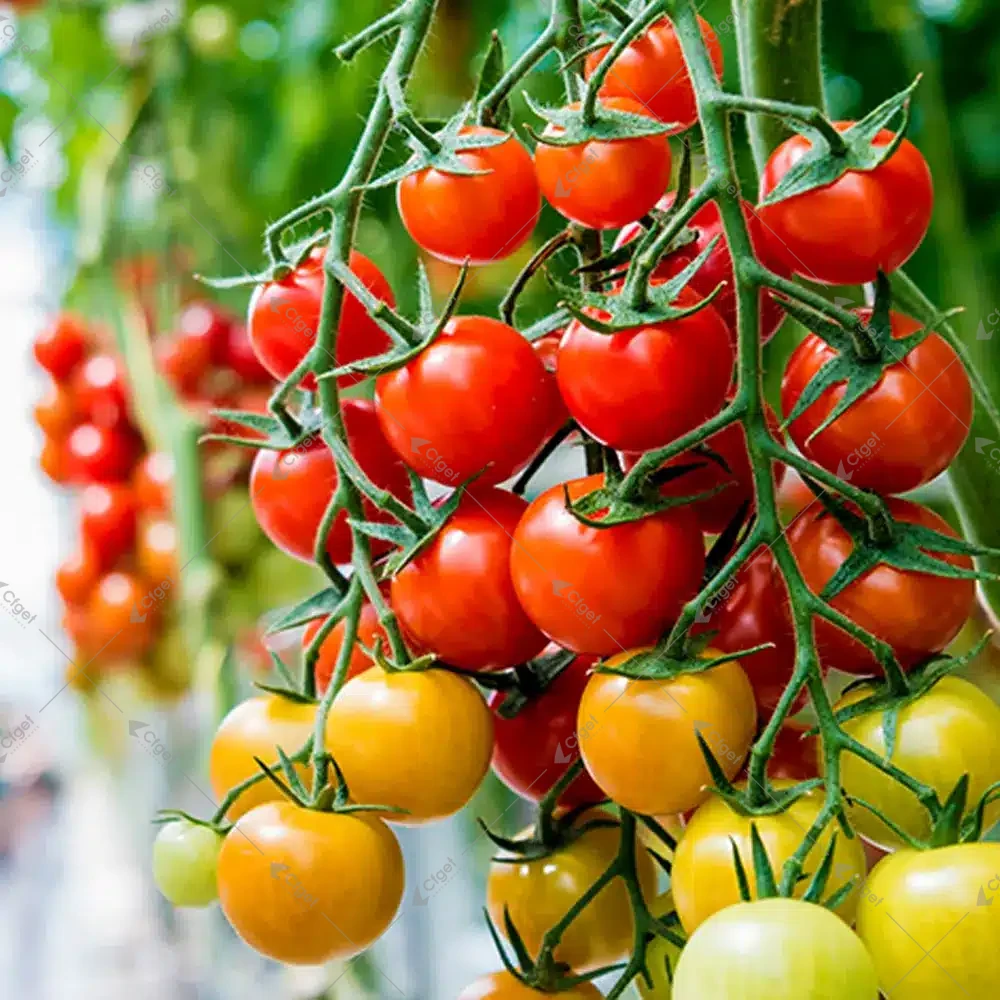
A watering system can keep the plants near the inlet wet while leaving the far end short of water. Choosing drip, a boom or flood benches will not by itself prevent that problem: match the method to the crop and layout, then verify delivery under the conditions in which it will operate. Drip irrigation may suit substrate-grown tomatoes, while a propagation zone may require fine mist and a container area may be better served by overhead irrigation or subirrigation. Many commercial projects use two or more methods because the root zones and operating requirements are different.
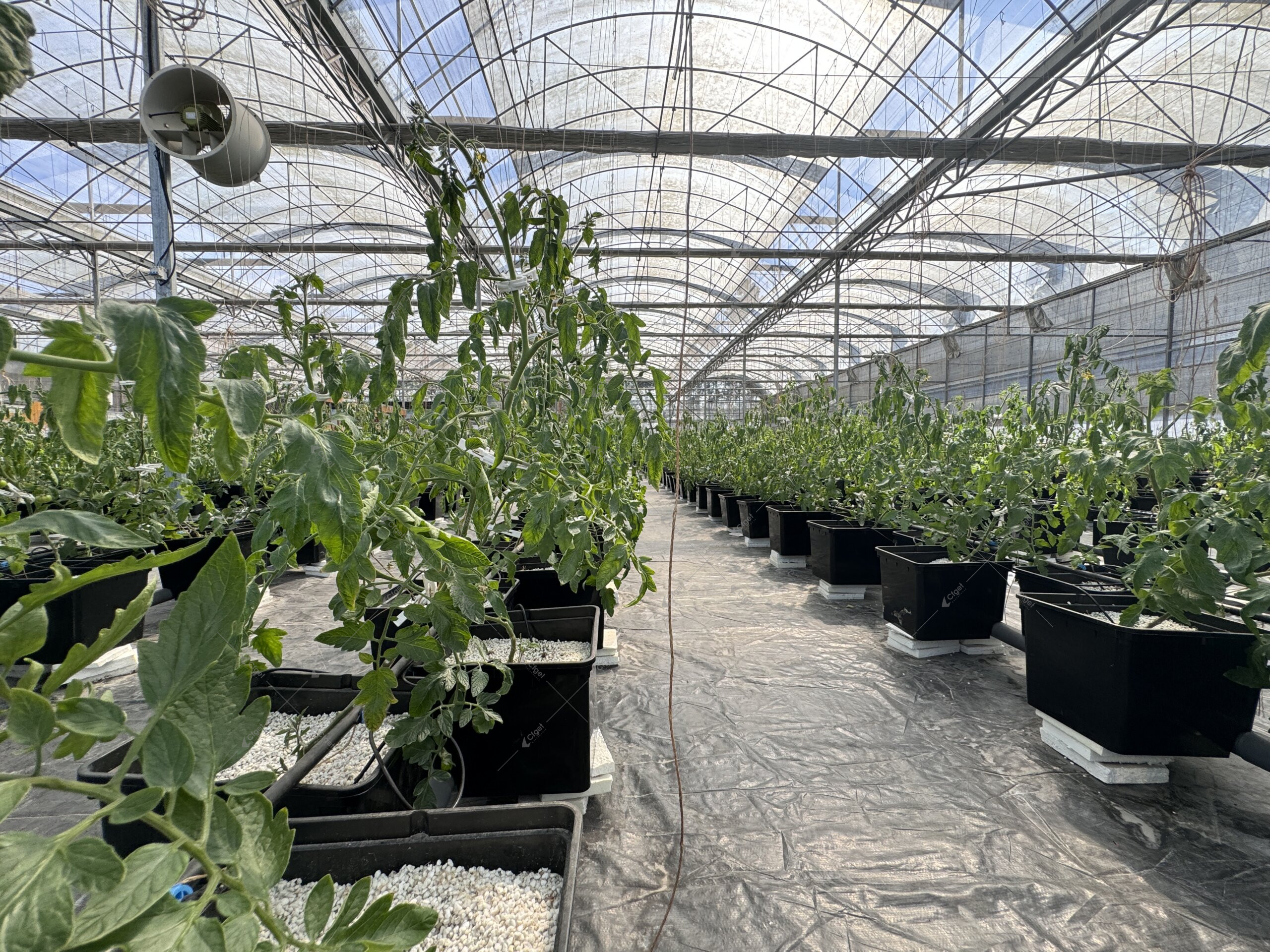
For a useful supplier proposal, start with project data rather than an equipment list. Define the crop plan, greenhouse area, growing method, water source, water-quality results, drainage route, available power, labor model and automation requirements. These inputs determine the pump, zones, pipework, filters, fertigation equipment, sensors and controls.
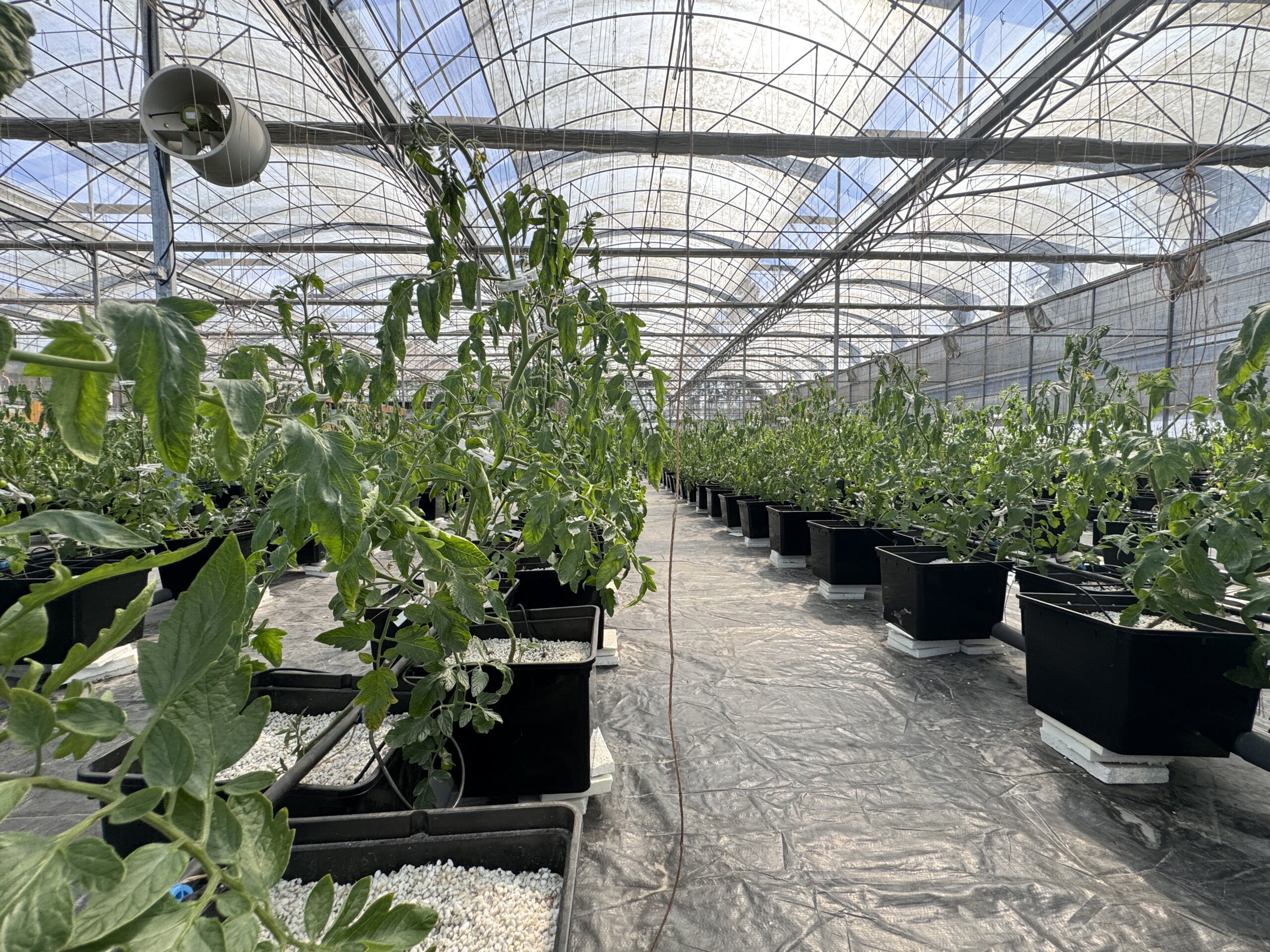
Commercial irrigation system comparison
| System | Typical commercial fit | Main strength | Main design check |
|---|---|---|---|
| Drip irrigation | Vine crops, substrate bags, rows and individual containers | Direct delivery to each root zone | Filtration, pressure regulation, emitter flow and flushing |
| Micro-sprinkler or overhead irrigation | Beds, pots, nurseries and selected leafy crops | Broad coverage with fewer delivery points | Foliage wetting, evaporation, spacing and measured uniformity |
| Irrigation boom | Regular benches and container production | Repeatable moving application | Rail layout, travel speed, clearance and maintenance access |
| Ebb-and-flow | Benches, trays, pots and some propagation systems | Root-zone watering with potential recovery | Fill and drain time, sanitation, storage and reuse |
| Fog or mist | Propagation and climate support | Fine droplets for cuttings or humidity management | Water quality, nozzle performance, pressure and disease risk |
| Recirculating hydroponics | Nutrient film technique (NFT), deep-water culture (DWC) and other soilless systems | Integrated water and nutrient delivery | Solution monitoring, oxygenation, hygiene and backup operation |
Choose by the operating constraint: start with individual root-zone delivery where fixed bags or pots need separate outlets. For frequently rearranged containers, compare the labor of moving drip lines with the coverage and foliage-wetting implications of overhead irrigation. For regular bench layouts, check boom clearance or the fill, drain and hygiene requirements of flood benches before choosing either. Keep propagation mist on a control strategy suited to cuttings rather than treating it as irrigation for mature plants.
Start with project inputs, not equipment names
Two greenhouses growing the same crop can require different watering systems. Their source water, elevation, bay layout, substrate, drainage policy, labor availability and production schedule may not be the same. Before a supplier selects pumps or emitters, prepare the following information:
- Project country, site and climate conditions
- Total greenhouse area and net irrigated area
- Crop, crop stage and expected planting density
- Soil, substrate, pot, bench or hydroponic growing method
- Water source, seasonal capacity and laboratory report
- Site elevation changes and approximate pipe routes
- Drainage, discharge or nutrient-solution recovery plan
- Available electrical supply and backup-power requirements
- Desired automation, data logging and remote-control functions
- Local installation scope and required supplier support
This information also prevents quotations from being compared on different bases. A low equipment total may exclude treatment, valves, electrical work, drainage, installation or commissioning that another proposal includes.
Test the water source before specifying the system
Water quality affects emitter blockage, nutrient availability, corrosion, sanitation and crop response. A representative laboratory test should be taken from the source that will actually supply the greenhouse. Seasonal sources may need more than one sample.
The review normally includes pH (how acidic or alkaline the water is), electrical conductivity or EC (an indicator of dissolved salts), alkalinity (resistance to acidification), hardness, suspended solids and relevant dissolved ions. Surface water, stored water and recovered nutrient solution may also require a biological-risk assessment. Agree the test panel with the grower, crop adviser and water-treatment supplier.
University of Arkansas guidance on greenhouse irrigation water stresses that pH and alkalinity are different measurements. EC also does not identify which ions are present. A reading alone cannot establish a fertilizer recipe or treatment dose; interpret it with the laboratory analysis, crop and substrate.
The result determines whether the project needs screen, disc or media filtration, chemical adjustment, disinfection, reverse osmosis or another treatment stage. Filter grade should be selected for the smallest emitter or nozzle passage and the actual contaminant load. Selecting a filter from pipe diameter alone is not enough.
Water availability matters as much as chemistry. Confirm the reliable flow and storage available during the hottest or highest-demand production period. Size any intermediate storage against the source’s reliable supply and the demand during the operating window. UMass Extension describes storage as a way to bridge a supply shortfall during peak irrigation. A tank does not solve an insufficient total daily water supply.
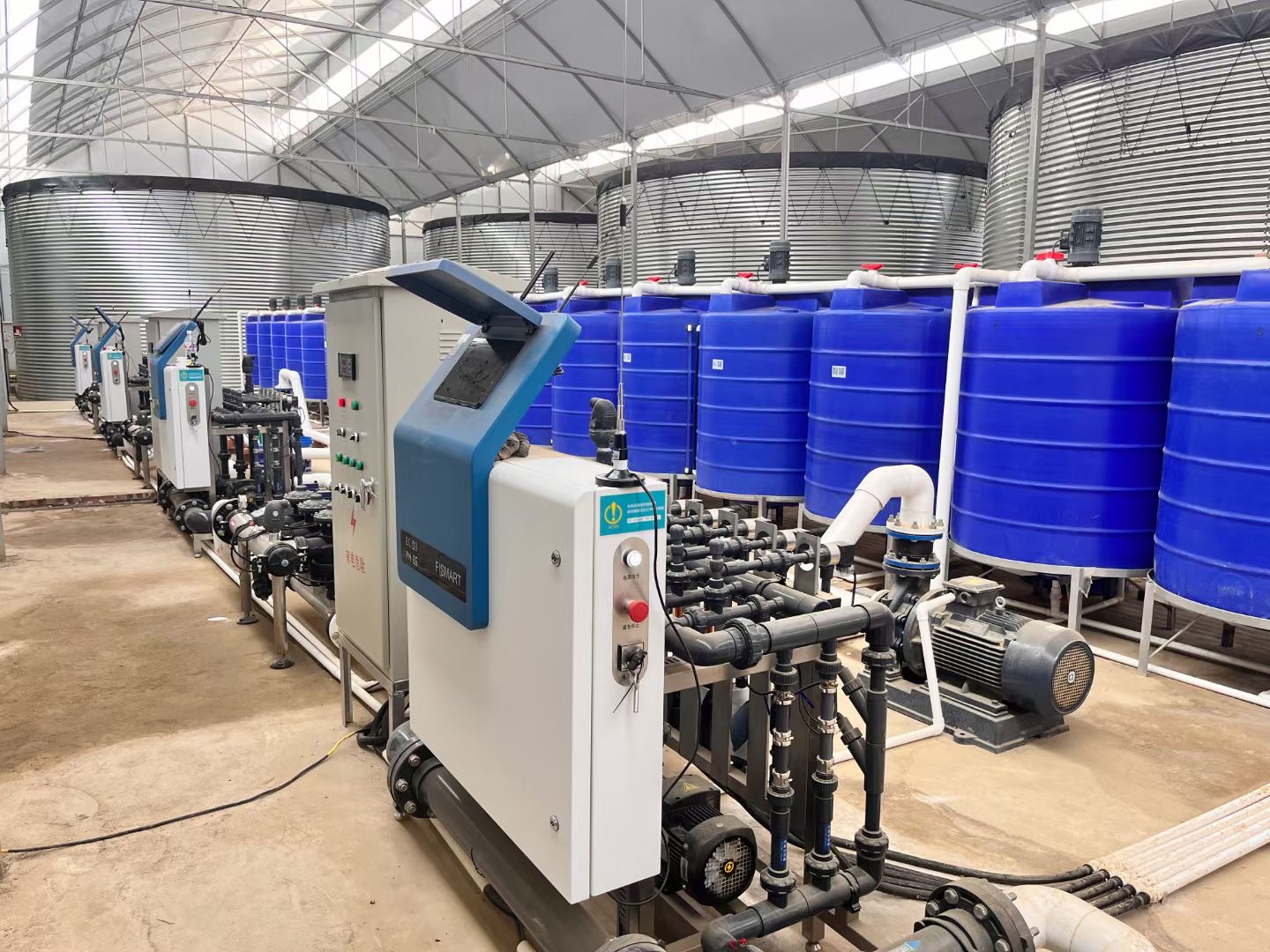
Calculate flow, pressure and irrigation zones
The pump must deliver the required flow at the pressure needed by the operating zone after all losses are considered. Those losses include elevation, pipe friction, filters, valves, backflow devices, injectors and treatment equipment. A pump selected only by maximum flow can still fail to deliver the required pressure at the far end of the greenhouse.
The hydraulic calculation should document:
- Daily crop-water demand and the design peak period
- Number and flow of emitters, nozzles or outlets per zone
- Zones that may run at the same time
- Required operating pressure at the device
- Elevation change and pipe-friction losses
- Pressure loss through filters, injectors and valves
- Pump duty point, motor power and control method
- Mainline, submain and lateral sizes
- Pressure regulation, air release, isolation and flushing points
Dividing a large greenhouse into sensible zones makes pressure easier to control and allows different crops or growth stages to use different schedules. Too many small zones, however, add valves, wiring and control complexity. Zone design should balance hydraulic performance with how the production team actually operates the greenhouse.
Turn a flow specification into a checkable dose
Nominal zone flow = number of operating outlets x rated flow per outlet. Add the zone flows that will run together, plus any separately calculated simultaneous demand. The rated flow applies only within the manufacturer’s stated pressure and operating conditions. Ask the designer to check the result against available source flow, storage and the pump’s operating curve, not its maximum-flow label. University of Georgia’s irrigation assessment explains why pressure requirements, elevation and distribution losses belong in pump selection.
At commissioning, collect water from selected outlets for a recorded interval once pressure has stabilized. Measured outlet flow in litres per hour = collected litres x 60 / collection time in minutes. Label each outlet’s position and pressure so a low result can be traced back to a location. For short pulses, also measure the complete operating event: filling, draining and start-up delay can make a steady-flow calculation overstate the dose reaching the plant.
Do not turn this arithmetic into a universal watering schedule. The required dose and interval still depend on crop stage, substrate water storage, weather and observed root-zone response. The UF/IFAS greenhouse vegetable production handbook illustrates why a timer set for sunny conditions can overwater substrate crops on cloudy days. Its production-system examples are not instructions to copy a Florida schedule into another project.
Drip irrigation for commercial greenhouses
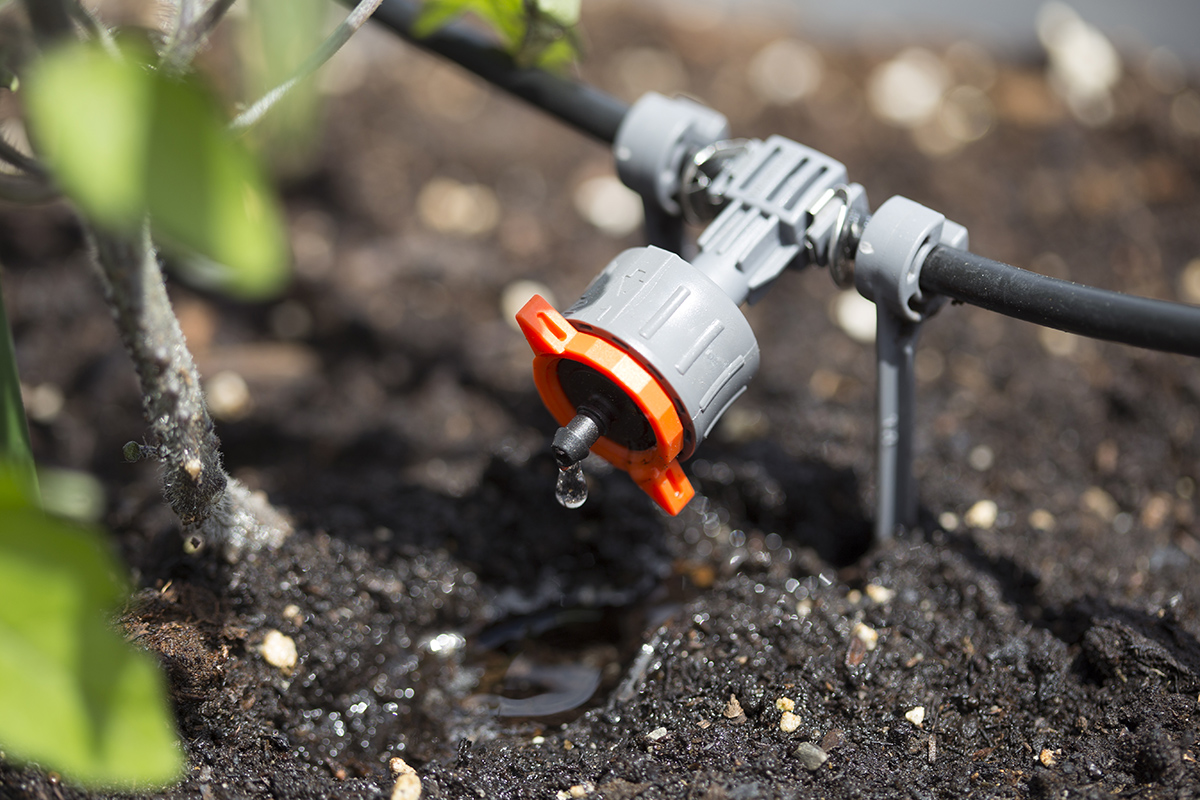
Drip irrigation delivers water or nutrient solution to individual plants, bags or rows. It is widely used for vine crops and substrate production because each root zone can receive a controlled dose without wetting the entire crop canopy.
A commercial drip design needs more than tubing and emitters. Check emitter flow and pressure range, lateral length, pressure compensation, filtration, flushable line ends, chemical compatibility and the method used to inspect blocked or damaged outlets. The crop layout should also allow workers to replace components without disturbing production.
Short, frequent irrigation events may be appropriate for some substrates and crop stages, but the schedule must be set from root-zone conditions and drainage response. A fixed timer copied from another project is not a design basis. For a focused equipment review, see the greenhouse drip irrigation buyer checks.
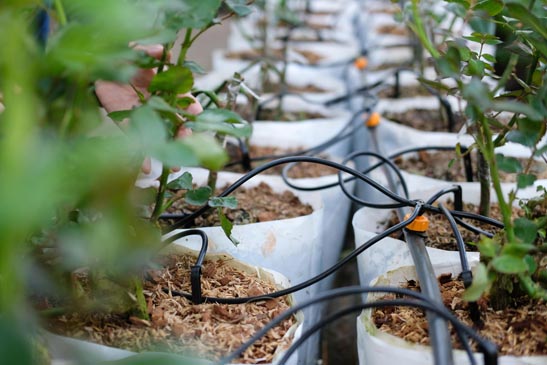
Atlanta ginger and tomato cultivation center
At CFGET’s Atlanta ginger and tomato cultivation center, substrate grow bags are arranged in long production rows with irrigation lines routed to individual root zones. The layout leaves room for crop work and line maintenance while keeping each delivery point close to the plant.
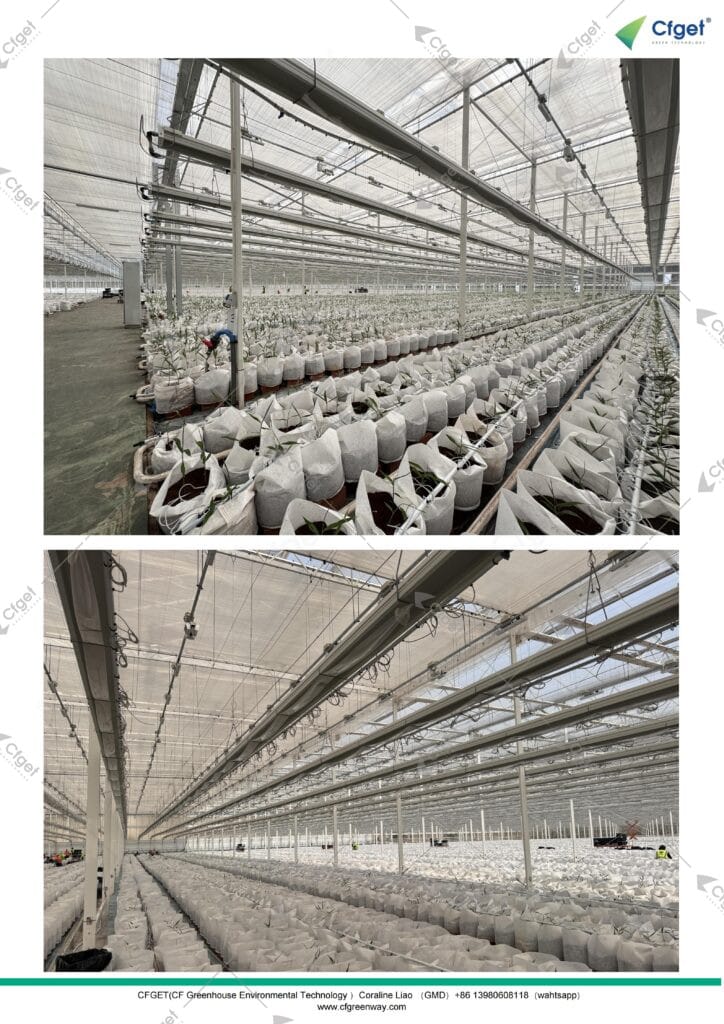
The photograph shows the physical layout, not the design duty. Emitter flow, operating pressure, filtration and fertigation settings still have to be specified from crop demand, water analysis and hydraulic calculations for the site.
Micro-sprinkler and overhead irrigation
Micro-sprinklers and overhead nozzles can irrigate beds or groups of containers with fewer delivery points than a drip system. They may also be useful where the crop arrangement changes frequently.
The main engineering question is distribution uniformity across the actual growing area. Nozzle type, spacing, mounting height, operating pressure, overlap, greenhouse airflow and obstructions all affect the result. Crop sensitivity to wet foliage and the time required for the canopy to dry must also be considered.
Uniformity should be measured during commissioning with catch containers placed across representative zones. The test is more useful than assuming the manufacturer’s nominal radius will produce even application inside a greenhouse.
Irrigation booms
An irrigation boom moves nozzles across a bay or bench, which can provide repeatable application over regular production areas. It can be useful in container, seedling and nursery operations where fixed overhead patterns are difficult to keep uniform.
The boom and greenhouse layout must be designed together. Confirm rail alignment, structural support, travel clearance, hose or cable management, end stops, travel speed, nozzle spacing and safe maintenance access. The controller should prevent operation when workers or equipment obstruct the travel path.
Ebb-and-flow benches or floors
Ebb-and-flow systems irrigate containers from below by temporarily filling a bench, tray or floor zone and then draining the solution. Recovered water may be reused if the project includes suitable storage, monitoring and treatment.
Key design checks include surface level, fill time, drain time, storage capacity, pump duty, isolation between crop zones and cleaning access. Reuse creates a water-saving opportunity, but it also connects crop areas through a shared solution. Sanitation and disease-risk controls need to be part of the operating plan.
Fog and mist systems
Fog and mist are often specified for propagation or humidity support. They should not automatically be treated as the primary root-zone irrigation method for a commercial crop. The objective needs to be clear: maintaining cutting turgor, supporting propagation, adding humidity or assisting evaporative cooling are different control tasks.
Water quality, nozzle orifice, pressure, droplet behavior, ventilation and sensor placement affect performance. A poorly matched system can wet surfaces without supplying the root zone or can keep the crop environment wet for too long. Propagation controls should be commissioned under real airflow and crop-loading conditions.
Recirculating hydroponic irrigation
NFT, deep-water culture and other recirculating systems deliver water and nutrients as part of the growing system itself. Their design must address circulation, storage, oxygenation, solution temperature, pH, EC, sanitation, drainage and failure response.
The irrigation package should therefore be selected with the hydroponic growing system, not added after the channels, rafts or tanks are fixed. Critical pumps, sensors and control components may also need alarms or backup procedures appropriate to the crop’s tolerance for interruption.
Integrate fertigation, filtration and backflow protection
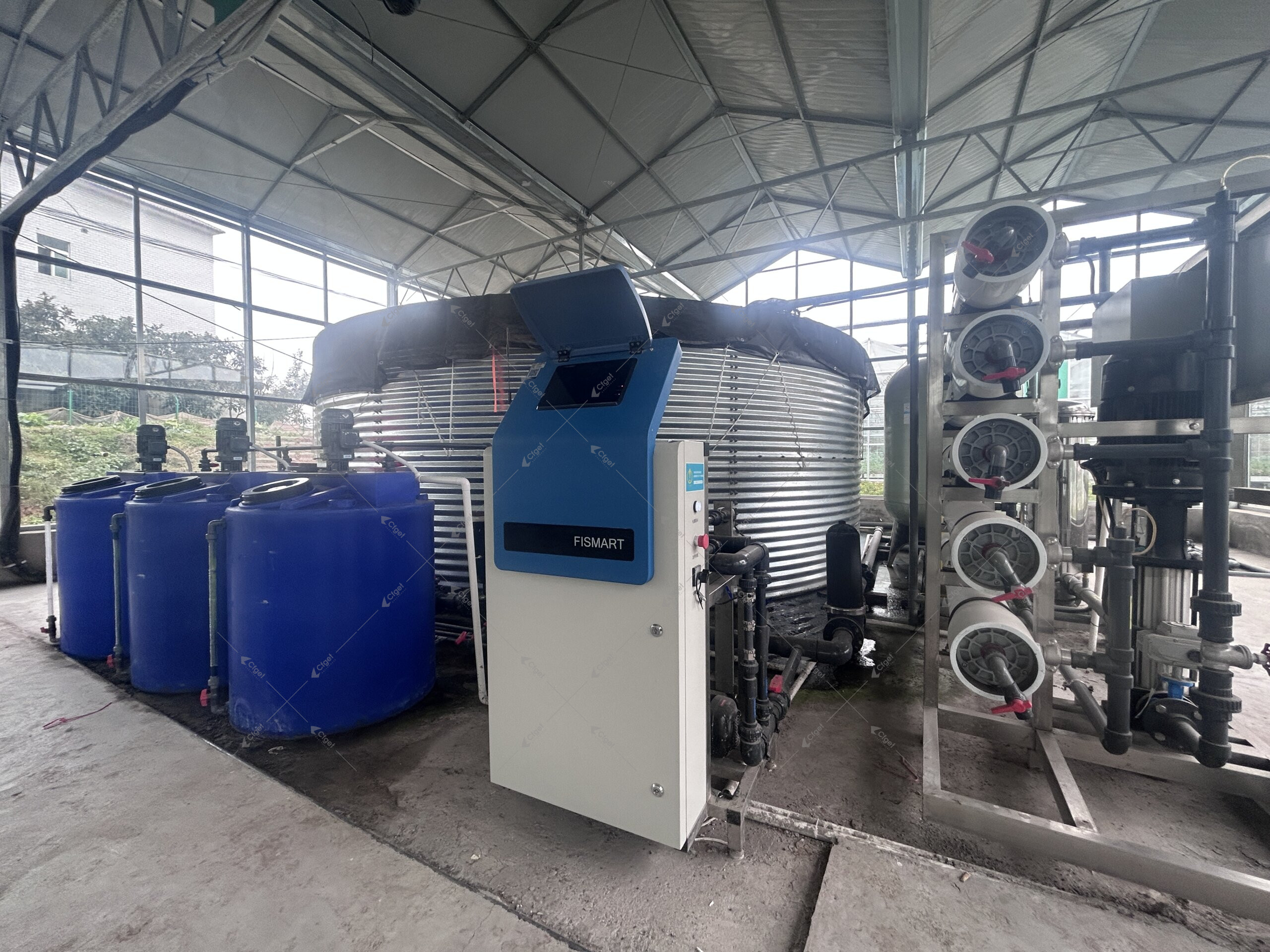
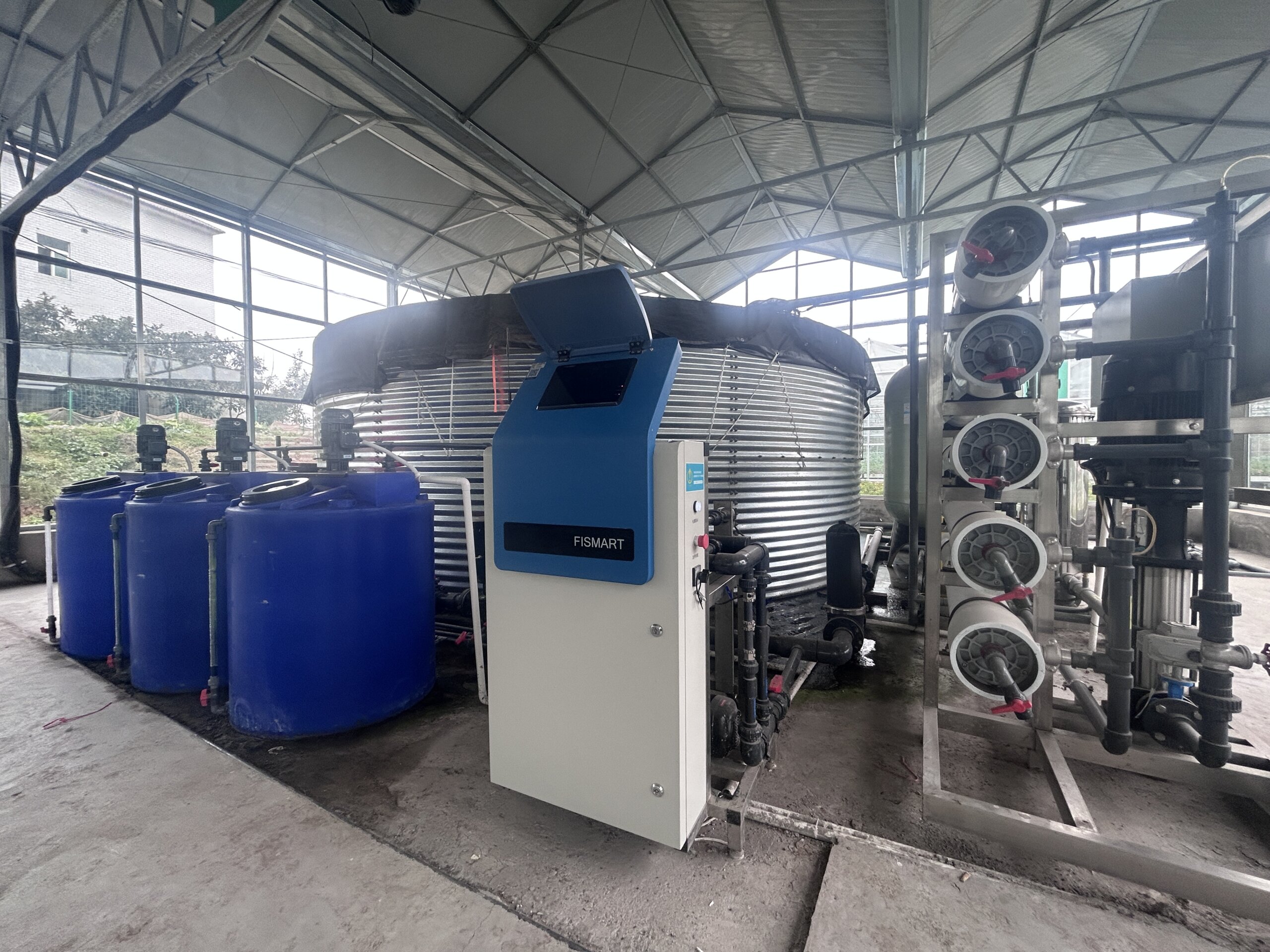
Fertigation, the delivery of fertilizer with irrigation water, changes the hydraulic and chemical design. The supplier needs the crop recipe, target pH and EC, stock-solution arrangement, injector method, expected zone flow and required dosing accuracy. Concentrated fertilizers that react with one another should be kept in compatible stock arrangements, and the system needs a defined mixing and flushing sequence.
Backflow protection helps prevent fertilizer or treatment chemicals from reaching the source-water system. The required device and installation standard depend on local regulations and the project configuration, so they should be confirmed by the responsible local engineer or installer.
CFGET’s irrigation and fertilization system scope can include water-source analysis, treatment, fertigation, irrigation-return flow, disinfection, zoning and control functions. The final equipment schedule should still be based on the crop plan, water report and site calculation.
Use automation to control a verified irrigation process
Automation can operate valves, pumps, injectors and treatment equipment by time, sensor input or a crop strategy. It can also record alarms, irrigation events and selected water or climate measurements. These functions are useful only when the underlying hydraulic system is stable and the sensors are installed, calibrated and maintained correctly.
Choose control points that support a decision. Common examples include tank level, line pressure, flow, pH, EC, substrate moisture, drainage volume and weather or radiation data. Decide who receives alarms, what happens after a sensor failure and whether local manual control remains available. See CFGET’s automated irrigation control and monitoring options for the wider controls context.
Commission the system before crop risk increases
Commissioning should prove that the installed system matches the design, not simply that the pump turns on. Record the test conditions and retain the results as an operating baseline.
- Measure pressure at the pump, zone inlet and representative endpoints
- Measure emitter flow or sprinkler catch volumes across representative zones
- Verify filter pressure gauges and the cleaning or backwash process
- Test valve sequencing, pump protection and low-water safeguards
- Calibrate pH, EC, flow and moisture sensors where installed
- Confirm injector operation, stock selection and flushing
- Test alarms, data logging, manual override and restart behavior
- Confirm drainage, recovery and disinfection operation where included
- Train the operating team and provide a spare-parts list
After planting, review crop response and drainage under normal production conditions. Controller settings may need adjustment, but changes should be recorded so the team can separate crop strategy from equipment faults.
Use the test pattern to decide what to check next
Agree the sampling locations, test duration, normal zone combinations and acceptance tolerances before handover. Include the inlet, remote ends, elevation changes and visibly weak positions; do not test only the nearest emitters. For overhead watering, UMass Extension recommends a grid of collection cups and checking nozzle pressure and coverage. A test record should retain individual readings, not just an average.
| Observed pattern | Possible cause to investigate | Next check before changing the schedule |
|---|---|---|
| Flow is low across the whole zone | Supply, pump, filter or regulator limitation | Measure inlet and endpoint pressure, filter pressure drop and actual zone flow at the same time |
| Remote outlets receive less than nearby outlets | Pressure loss, elevation or a restriction along the route | Map pressure and collected volume by position; compare with the design calculation |
| Scattered outlets receive little water despite suitable local pressure | Blocked, damaged or mismatched outlets | Inspect outlet type and condition, flushing records and water quality; remeasure after correction |
| Long tests look even, but short pulses do not | Unequal filling, draining or valve response | Collect a complete normal pulse and compare it with the steady-flow test |
| Overhead collection has dry strips or wet edges | Nozzle pattern, spacing, obstruction or airflow | Plot the cup readings against the crop layout and check conditions during the test |
These are diagnostic starting points, not proof of a fault. Increasing every irrigation event may hide a weak zone while overwatering plants elsewhere. Correct the delivery problem, repeat the affected test, and only then adjust the crop schedule. Retain the readings as a baseline for maintenance; no CFGET test result or universal pass percentage is asserted here.
What determines commercial greenhouse irrigation cost
There is no useful universal price per square meter for greenhouse irrigation. Cost changes with water treatment, greenhouse area, crop density, number of zones, pump duty, pipe routes, fertigation level, automation, drainage recovery, local installation and commissioning scope.
When comparing quotations, ask each supplier to state the same scope:
- Design basis and calculation deliverables
- Water treatment and storage
- Pumps, filters, valves, regulators and pipework
- Emitters, nozzles, booms, benches or hydroponic interfaces
- Fertigation equipment and stock tanks
- Sensors, controller, cabinet, software and communications
- Drainage, recovery and disinfection
- Freight, taxes, installation, supervision and commissioning
- Training, warranty, spare parts and exclusions
This scope comparison is more reliable than choosing the lowest equipment total. It also helps the buyer identify work that must be completed by a local electrical, plumbing or civil contractor.
RFQ checklist for an irrigation supplier
Send the following information with a request for quotation:
- Country, project location and site plan
- Greenhouse dimensions, bays and irrigated area
- Crop, planting density and production stages
- Soil, substrate, pots, benches or hydroponic method
- Water source, test report, available flow and storage
- Elevation information and intended equipment-room location
- Drainage, discharge or recovery requirement
- Target fertigation and automation functions
- Available power and backup requirement
- Expected supplier scope for delivery, installation and commissioning
Include photographs or drawings where available. If the project is still at concept stage, label assumptions clearly and ask the supplier which site data must be confirmed before final design. Relevant examples can be reviewed in CFGET’s commercial greenhouse system projects.
Frequently asked questions
What is the most efficient irrigation system for a commercial greenhouse?
No single method is most efficient for every commercial greenhouse. Drip can provide direct root-zone delivery, while subirrigation can recover solution and a boom can improve uniformity over benches. Efficiency should be evaluated as usable water delivered to the crop, crop response, drainage, energy, labor and maintenance under the specific project conditions.
Is drip irrigation better than sprinklers in a greenhouse?
Drip is often a better fit for individual plants, rows and substrate bags. Sprinklers can be more practical for beds, pots or production areas that change layout. The crop’s tolerance for wet foliage, required uniformity, water quality and maintenance capacity should decide the choice.
What water data does an irrigation supplier need?
The supplier normally needs the water source, reliable flow, available storage and a representative laboratory analysis. The test scope commonly includes pH, EC, alkalinity, hardness, suspended solids and relevant ions, with biological testing where the source or reuse plan creates that risk.
Can one irrigation system serve several crops?
It can, but crops with different root zones, growth stages or nutrient strategies should usually be separated into controllable zones. The common pump and treatment equipment must be sized for the planned simultaneous operation, and the controller must prevent incompatible recipes or schedules from being applied to the wrong zone.
How should a buyer compare irrigation quotations?
Compare the design basis, pump duty, zones, treatment, filtration, fertigation, controls, drainage, installation, commissioning, training and exclusions. Two quotations with similar equipment names may cover very different scopes.
Prepare the system around the crop and site
A reliable commercial greenhouse watering system starts with crop requirements and measured site data. Water analysis, hydraulic calculations, zoning and commissioning are as important as the chosen emitter or nozzle. Preparing those inputs before requesting a quotation produces a clearer design, a more comparable budget and a system the operating team can maintain.
Technical limits
This guide helps commercial buyers prepare project inputs and compare irrigation quotations. A final specification still requires crop data, a representative water test, hydraulic calculations and the locally required engineering review.
Before requesting an irrigation design, prepare a crop-and-zone sketch, a water laboratory report and the reliable source flow. For an existing system, add pressure and collected-volume readings from both strong and weak positions. Send these through the CFGET contact page and ask which hydraulic, treatment or control questions must be resolved before equipment can be selected.