Greenhouse circulation fans mix the air inside the growing space. They do not replace exhaust fans, roof vents, cooling equipment, heating capacity, or dehumidification. A useful HAF fan quotation states the greenhouse geometry, crop obstruction, required air pattern, fan duty, electrical load, controls, mounting, guards, maintenance access, and commissioning test.
The old page treated fans as a guaranteed way to raise yield and prevent disease. Air movement can improve environmental uniformity, but it cannot guarantee a crop result or eliminate a pathogen. The design task is to create a measurable circulation pattern without drying one crop zone, short-circuiting between fans, or fighting the ventilation system.
Separate circulation from ventilation
Circulation fans move air within the greenhouse. Ventilation exchanges inside air with outside air. Exhaust fans are built to move air against system resistance such as louvers, while HAF fans usually operate in open air at low static pressure. The equipment, controls and acceptance tests are therefore different.
| Function | Main job | Buyer evidence |
|---|---|---|
| HAF circulation | Mix air and reduce persistent temperature or humidity differences | Fan curve, watts, layout, measured air pattern and obstruction assumptions |
| Mechanical ventilation | Exchange greenhouse air through fans and inlets | System airflow at stated resistance, inlet area, staging and weather basis |
| Natural ventilation | Use roof and side openings with wind and buoyancy | Clear opening, net resistance, actuator duty, controls and low-wind plan |
| Cooling or dehumidification | Remove sensible or latent load under defined conditions | Capacity, design condition, water or energy duty and control sequence |
The Farm Energy Extension article by greenhouse engineering contributors explains that correctly selected and placed HAF fans keep a coherent air mass moving with modest added energy. Its guidelines also distinguish circulation fans from exhaust fans. Treat its numerical rules as design starting points that need verification in the actual greenhouse.
Build the fan schedule from the greenhouse layout
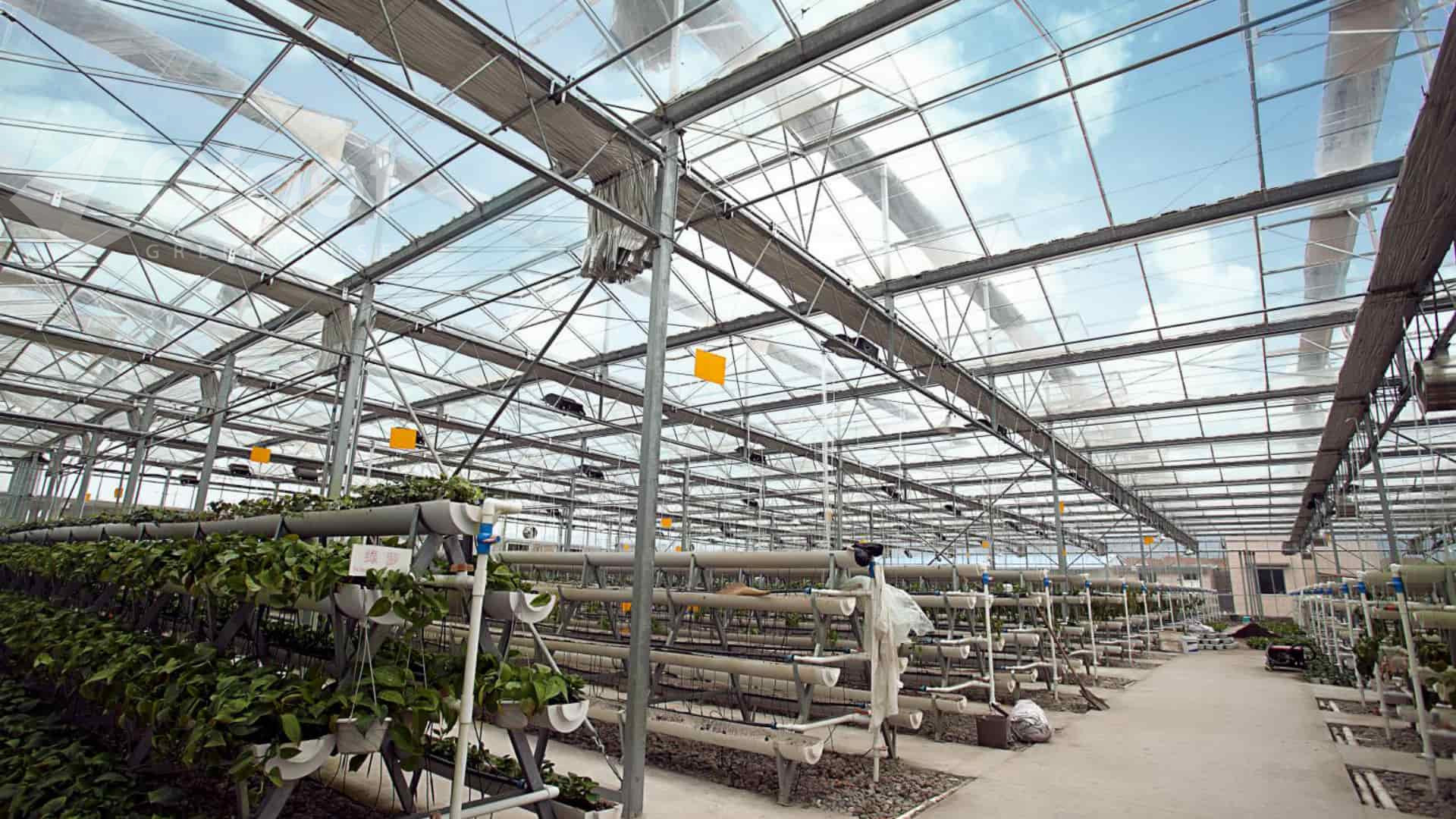
Send the supplier the internal dimensions, gutter height, bay count, partitions, crop height, crop density, hanging baskets if any, thermal screens, lights, ducts, heaters, benches, curtains and doors. Mark fixed obstructions and seasonal changes. A fan schedule based only on floor area can miss the resistance created by a mature crop.
For each proposed fan, request model, diameter, airflow at the intended operating point, input watts, current, voltage, speed options, motor type, guard, ingress rating, noise information, mounting method and service clearance. The schedule should show quantity, location, direction and circuit assignment.
| Design input | Why it matters | RFQ output |
|---|---|---|
| House geometry | Sets the length and shape of the circulation loop | Plan and section with fan coordinates and directions |
| Crop obstruction | Tall or dense crops shorten the useful air throw | Stated crop condition and allowance for seasonal growth |
| Screens and curtains | Can split the greenhouse into separate air volumes | Fan position for screen-open and screen-closed modes |
| Ventilation sequence | HAF operation may need to change when vents or exhaust fans run | Control narrative, interlocks, delays and fail state |
| Power | Continuous operation can make efficiency important | Total connected load, protection, switching and energy calculation |
Use extension rules as a starting point, not a guarantee
Farm Energy and UMass Extension describe a commonly used starting point of total fan capacity near two cubic feet per minute for each square foot of floor area, with a coherent horizontal pattern and typical target air movement of 50 to 100 feet per minute. They also note that tall crops and hanging baskets can require adjustment. These values come from greenhouse trials and field experience, not from a universal code.
The old article stated one cubic foot per minute for each ten square feet, which is far below the extension rule cited above. It also mixed fixed spacing and mounting values with promises of yield and disease reduction. The revision removes those unsupported promises and requires the designer to state the basis for every selected quantity.
Fan spacing depends on fan throw, the greenhouse width, crop resistance and the intended loop. UMass describes placing the first fan near an end wall and subsequent fans at intervals that keep the air mass moving. A smoke or tracer check can reveal short circuits and stagnant corners. The final acceptance test should use the installed crop or a realistic obstruction condition where practical.
Avoid direct jets and opposing fans
Pointing a fan down at the crop can create local drying instead of useful mixing. Fans that blow directly against each other waste energy and form turbulent zones. Loose chain mounting can let a fan turn away from its intended direction. Specify rigid or restrained mounts, safe clearance, guards and access for cleaning.
Write controls around greenhouse operating modes
A control narrative should cover heating, closed-house circulation, low-stage ventilation, full ventilation, screen operation, irrigation events, maintenance and emergency modes. State whether HAF fans run continuously, change speed, or stop when exhaust fans or vents reach a defined state. The correct sequence depends on the greenhouse and crop.
Do not rely on one room sensor to prove uniformity. Compare representative crop zones and known problem areas. Trend temperature and humidity differences, fan status, vent position and alarms. If variable-speed fans are used, record the minimum stable speed and confirm that the selected motor and controller are compatible.
| Operating mode | Control question | Failure check |
|---|---|---|
| Heating | How do fans distribute heat without creating crop-level drafts? | Failed fan, failed heater fan and uneven zone temperature |
| Closed house | What minimum circulation maintains the intended mixing pattern? | Stagnant corner, screen compartment or blocked fan |
| Ventilation | Should HAF fans continue, slow or stop as vents and exhaust fans stage? | Fans fighting the inlet path or short-circuiting exhaust flow |
| Alarm | Which loss of status, current or environmental difference triggers action? | No alarm destination, excessive delay or unsafe manual override |
The smart control page covers control integration. The commercial greenhouse overview helps identify the structure and bay arrangement. Use the contact page to submit a measured layout rather than requesting fans from area alone.
Commission the installed HAF system
Before testing, confirm fan identity, direction, mounting, guards, electrical protection, current draw and controller status. Run every control mode. Observe the air pattern with a safe tracer method accepted for the facility. Check corners, end walls, crop rows, under screens, beside partitions and around large equipment.
Record measured air movement and environmental differences at agreed points. The goal is not the highest velocity at the nearest fan. It is a stable circulation pattern without persistent dead zones or damaging direct flow. If the pattern fails, change direction, spacing, mounting or quantity and repeat the test.
Maintenance should include cleaning blades and guards, checking mounts and direction, verifying current draw, inspecting cables and confirming the control sequence. Dust and a shifted fan can reduce performance without producing an obvious alarm. Add a periodic field check after crop height or screen use changes.
RFQ inputs for greenhouse circulation fans
- Greenhouse plan, section, bay count, dimensions and internal partitions
- Crop, mature height, density, support system, benches and hanging equipment
- Screen, curtain, lighting, heater, duct and service obstructions
- Existing hot, cold, humid or stagnant zones and available trend data
- Vent, exhaust, heating, cooling and CO2 operating sequences
- Required fan model data, airflow, watts, voltage, guard and motor information
- Mounting coordinates, direction, service access and safe clearances
- Control modes, interlocks, variable-speed duty, alarms and manual operation
- Electrical circuits, protection, disconnects, backup and installation boundary
- Tracer test, measurement points, acceptance criteria, records and training
Technical references
- Farm Energy Extension: Horizontal Air Flow is Best for Greenhouse Air Circulation
- UMass Extension: Horizontal Air Flow is Best for Greenhouse Air Circulation
Send the plan, crop obstruction and operating modes with the RFQ. Ask the supplier to return a fan schedule, control narrative and commissioning sheet beside the price.