Full slip is useful only when the named melon cultivar develops the relevant separation behavior. It is not a universal maturity test, and easy detachment does not establish every aspect of saleable quality. When cultivars change, review the harvest cues before carrying the old picking rule into the new crop.
This article concerns Cucumis melo, including muskmelon/cantaloupe, honeydew and modern shelf-life types. Watermelon is a different crop with different harvest cues.
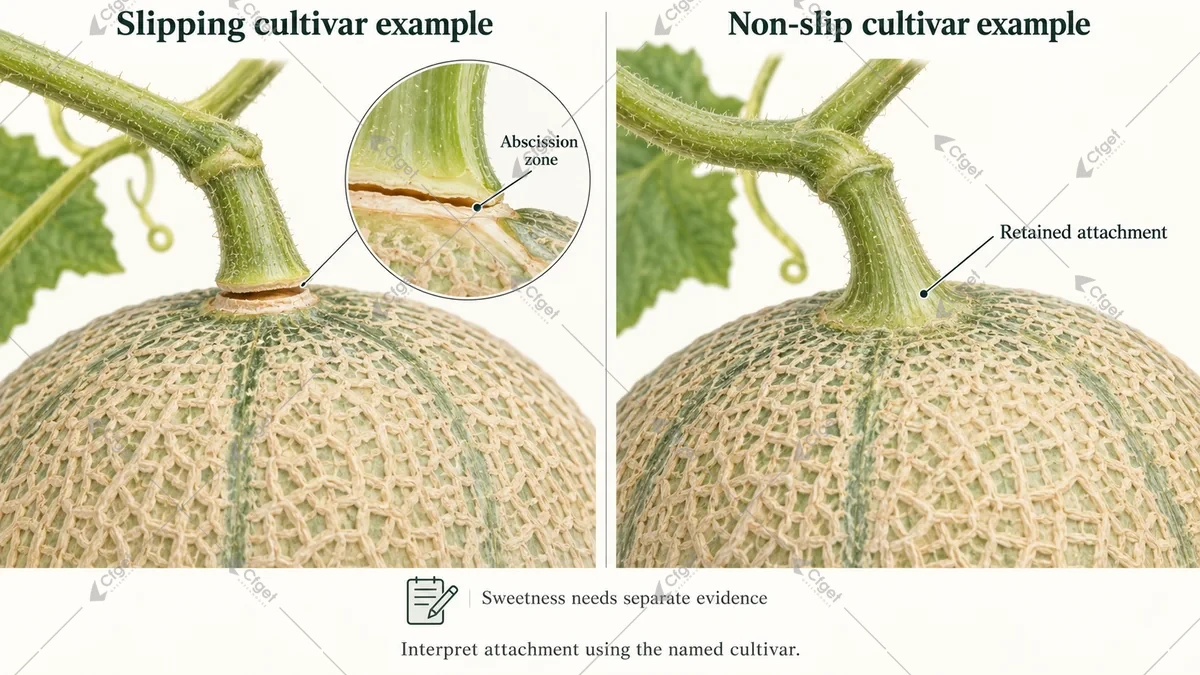
Match attachment behavior to the named melon cultivar
In a slipping cultivar, an abscission zone develops where the fruit joins its peduncle, or fruit stem. As separation develops, the attachment can release readily. Missouri Extension’s high-tunnel melon guide describes this mechanism. It is a developmental feature to interpret, not a reason to force a firmly attached fruit away from the plant.
Some melon types retain attachment at commercial maturity. Bayer’s melon production overview explains that many long-shelf-life cultivars are non-slip and that some retain a green background color. Those categories help frame the question, but the actual cultivar description must decide which cues apply.
Even a familiar group name can conceal an exception. Missouri’s guide includes a honeydew cultivar, Early Dew, described as slipping at maturity, alongside broader honeydew guidance. Minnesota Extension also emphasizes variation within melon groups. Avoid turning a group summary into “every cantaloupe slips” or “no honeydew can ripen after harvest.”
Keep attachment and internal quality on separate axes
Record attachment state on one axis and supported internal-quality evidence on the other. Rind appearance or netting, aroma, flesh firmness and soluble solids are separate observations. They need not move together or answer the same commercial question.
| Attachment observation | Internal-quality evidence supports the intended specification | Internal-quality evidence is missing or conflicts |
|---|---|---|
| Easy separation in a documented slipping cultivar | Attachment and quality evidence can be considered together under that cultivar’s harvest description | Slip alone cannot close the quality question |
| Firm attachment in a documented non-slip cultivar | Firm attachment does not, by itself, invalidate the maturity evidence | Obtain the missing cultivar-specific evidence; waiting for slip is not a supported substitute |
This is an interpretation sketch, not a grading score or lot-release matrix. If the observed attachment conflicts with the cultivar description, first resolve identity and the meaning of the observation with the supplier or crop specialist. Do not average conflicting clues into an invented “ripeness percentage.”
Softening after harvest does not supply missing sugar
The UC Davis cantaloupe fact sheet distinguishes continued ripening after harvest from increased sugar content: cantaloupes can ripen after picking without becoming higher in sugar. Its honeydew fact sheet distinguishes mature-unripe fruit from immature fruit and uses maturity observations beyond clear slip.
These are commodity references dated February 1997, not current buyer specifications for every cultivar. Their distinction remains useful: a change in texture or aroma is not proof that an insufficiently sweet harvest has gained the missing sweetness. Do not plan to solve a harvest-maturity gap merely by holding detached fruit.
Apply the distinction when the cultivar changes
In a fictional greenhouse, the team previously used detachment as one cue for a slipping muskmelon. It then plants an identified non-slip cultivar with a supplier-defined harvest description. A firm attachment in the new crop cannot alone justify delaying harvest until separation occurs. The team should use the new description and supported quality observations, and clarify any contradictions before applying the old rule.
In a second fictional case, a slipping melon has detached and later becomes softer during handling. Its harvest-quality evidence did not support the intended sweetness requirement. Softening has not demonstrated that this gap disappeared. The next action is to review the harvest evidence and buyer requirement, rather than promise that a texture change corrected sweetness.
Neither example chooses a color, soluble-solids threshold, harvest age or sale decision. The useful change is in the inference: identify what each observation can establish before using it to support a commercial commitment.
Download the cultivar harvest-cue map. This manual tool has no formulas or universal ripeness score. Import the UTF-8 comma-separated file, widen columns and wrap text, then save a working copy. Use a separate row for each identified cultivar observation, retaining the date and source. Keep attachment, rind/netting, aroma, firmness and already-supported soluble-solids evidence in separate columns. Complete the interpretation fields without turning a single observation into a whole-lot approval.