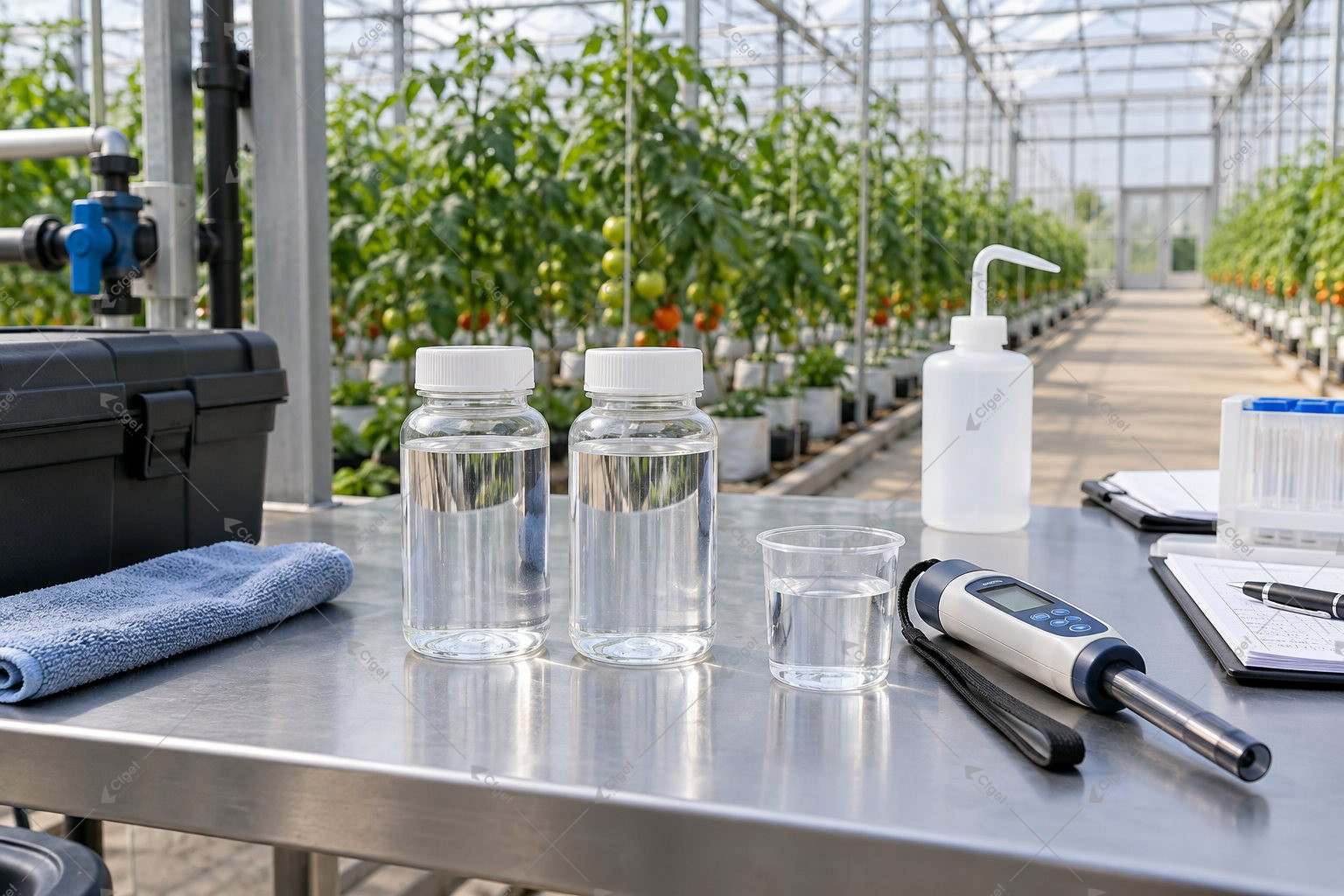
When the feed reaching a crop is weaker or stronger than intended, rewriting the fertilizer recipe may hide the cause. First check whether the injector draws the intended amount of stock solution at the irrigation flow actually used. Then check stock preparation and the delivered solution.
Two measurements answer different questions. A volume test checks the dilution ratio. An EC check compares the conductivity of delivered feed with the source water and the fertilizer manufacturer’s information. Agreement in one test does not excuse a problem in the other.
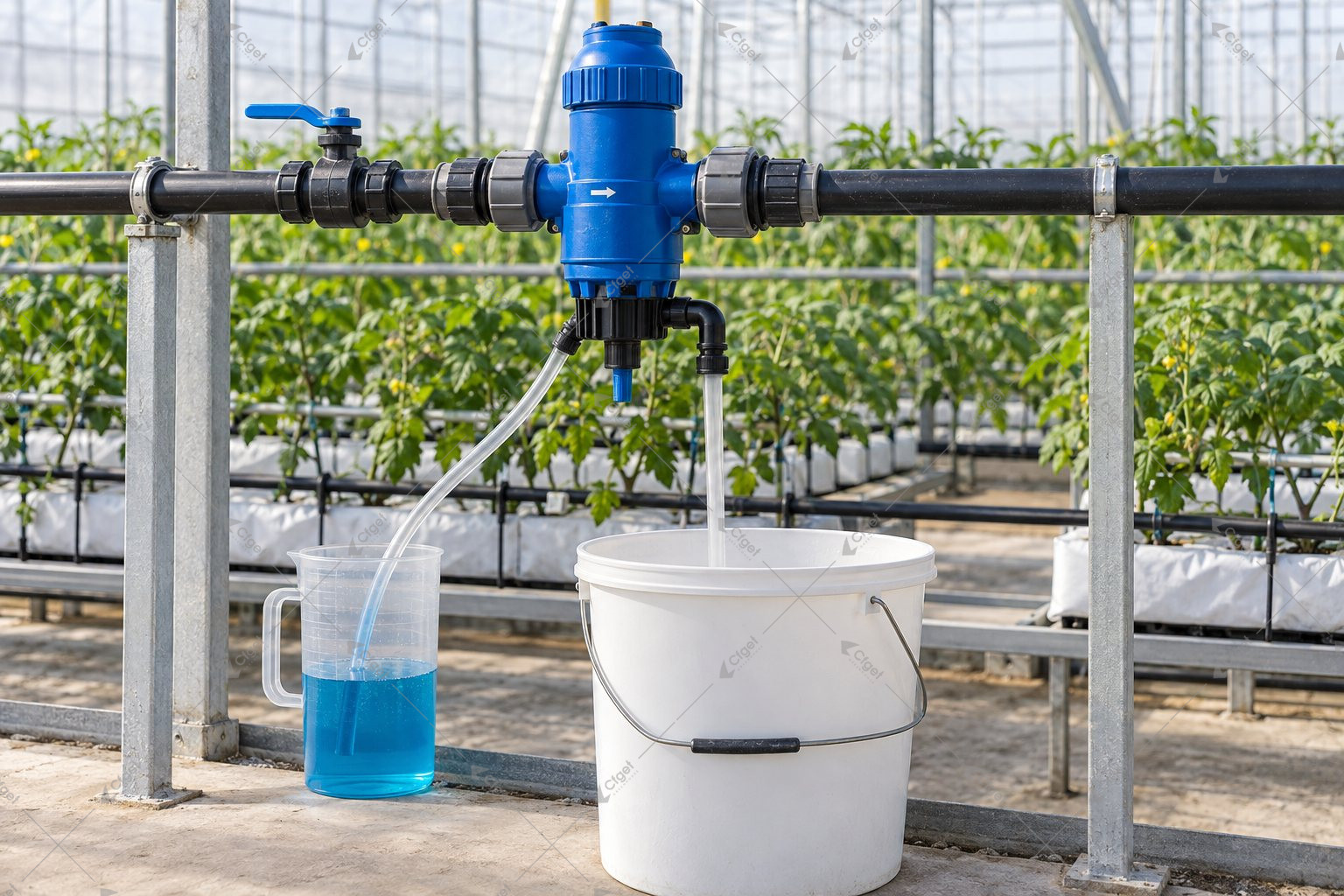
Measure the ratio under an operating condition you can repeat
UNH Extension describes volume and EC methods for injector calibration. For the volume method, compare the measured final diluted output with the stock volume consumed, using the same units. Follow the equipment manual for the test setup, permitted fluids, priming and safe discharge collection.
Illustrative calculation: if 20 litres of final diluted solution are collected while 0.20 litre is drawn from the stock vessel, the measured ratio is 20 / 0.20 = 100, expressed here as 1:100 stock to final solution. If stock draw is 0.25 litre for the same final output, the ratio is 1:80. With unchanged stock strength, that second case delivers more fertilizer per litre.
Check the manufacturer’s ratio convention before interpreting a label. Do not substitute inlet-water volume for final output without accounting for the distinction. Avoid reading a tiny stock change from a large poorly graduated tank; measurement resolution can overwhelm the error you are trying to detect.
Test the small zone as well as the large one
A dosing system can appear satisfactory at one flow and behave differently near the edge of its operating range. Select representative normal irrigation states with the operator, including the smallest and largest zones that the injector is intended to serve. Record the flow, pressure, ratio setting, priming state and any suction-line bubbles.
Do not disconnect a pressurized line or redirect crop feed casually. Arrange the test during a safe operating window with collection and disposal defined. Isolate equipment according to its manual when inspection requires access.
| Finding | Next check |
|---|---|
| Ratio changes between zones | Compare each zone with the injector’s permitted flow and pressure range; inspect the installation with the supplier |
| Ratio repeats, but delivered EC differs | Check source-water EC, stock concentration, product identity and mixing volume |
| Unstable draw with visible air | Investigate priming, suction connections and permitted suction lift before changing the recipe |
| Results vary between repeat tests | Improve collection timing and volume measurement before calling the variation equipment failure |
Subtract the background before comparing fertilizer EC
Measure source-water EC and delivered-feed EC with a checked meter. The difference is useful when compared with the exact fertilizer product’s conductivity table and its stated preparation conditions. It is not a universal conversion from EC to nitrogen concentration, and it cannot identify every ion in a mixed recipe.
For example, a hypothetical source-water EC of 0.4 mS/cm and delivered EC of 1.3 mS/cm give an increment of 0.9 mS/cm. Whether that is appropriate depends on the product and target concentration. The subtraction alone does not establish that a tomato or seedling crop is receiving the right nutrition.
The fertigation system guide covers the wider equipment arrangement. Use the measured ratio and zone-flow range from this check when reviewing that arrangement.
Check the final stock volume
Virginia Tech’s fertilizer-calculation guide explains that the final volume of stock solution matters. Adding fertilizer to a tank already filled with the full intended volume of water can give a different final concentration from making the solution up to a marked final volume.
Record product name, batch, measured mass, final stock volume, mixing date and measured ratio. Retain the original settings before making a correction. After adjustment, repeat the volume check and verify the delivered solution before returning the system to normal crop use.
For a new fertigation installation, ask CFGET and the dosing supplier to show accessible sampling outlets, a usable collection arrangement and the intended zone-flow range on the drawings. Calibration becomes a practical routine only when the installation gives staff a safe way to do it.