The nutrient-solution EC is close to the crop’s target, yet growth or root-zone observations have changed. That reading is useful, but it does not establish that each nutrient is present in the intended concentration. Before adding more fertilizer to chase the same number, investigate the solution’s composition and how it changes through the system.
In a recirculating greenhouse, the practical task is to connect source water, prepared feed, a representative root-zone sample and collected return with the operating records that explain them. Laboratory results and crop-adviser interpretation are needed before deciding whether nutrition should change.
What the meter can establish
Electrical conductivity describes how readily a solution conducts electricity. It is a useful indicator related to dissolved ions, but it does not identify their individual concentrations. The University of Missouri’s Hydroponic Nutrient Solutions guidance explicitly notes that EC can be on target while the nutrient balance is unsuitable.
The same guide emphasizes source-water testing and analysis of individual elements. Water arriving from the source already contributes to the solution. Reaching a target EC after fertilizer addition does not demonstrate that every contribution matches the intended crop recipe.
Do not convert this limitation into an immediate diagnosis. An unusual crop appearance can have more than one cause. Record the observation, its location and timing, then ask the crop adviser which laboratory and crop evidence will help distinguish the possibilities.
Write down the specific question
A useful request might be: “Has the source contribution changed?” or “Does the collected return show a composition that differs from the prepared feed?” Those questions lead to a more focused sampling request than “Please test the tank because the plants look wrong.”
Identify the crop, cultivar, stage and affected zone. State whether the concern is widespread or limited to a location. Add the dates of source changes, nutrient-product changes, tank top-ups and other relevant operating events. Keep observations separate from suspected causes.
Missouri’s hydroponic farming guidance explains that nutrient-solution properties change as plants use water and nutrients. For the investigation, preserve both the composition results and the history of the water and additions associated with them.
Agree the sample set before filling bottles
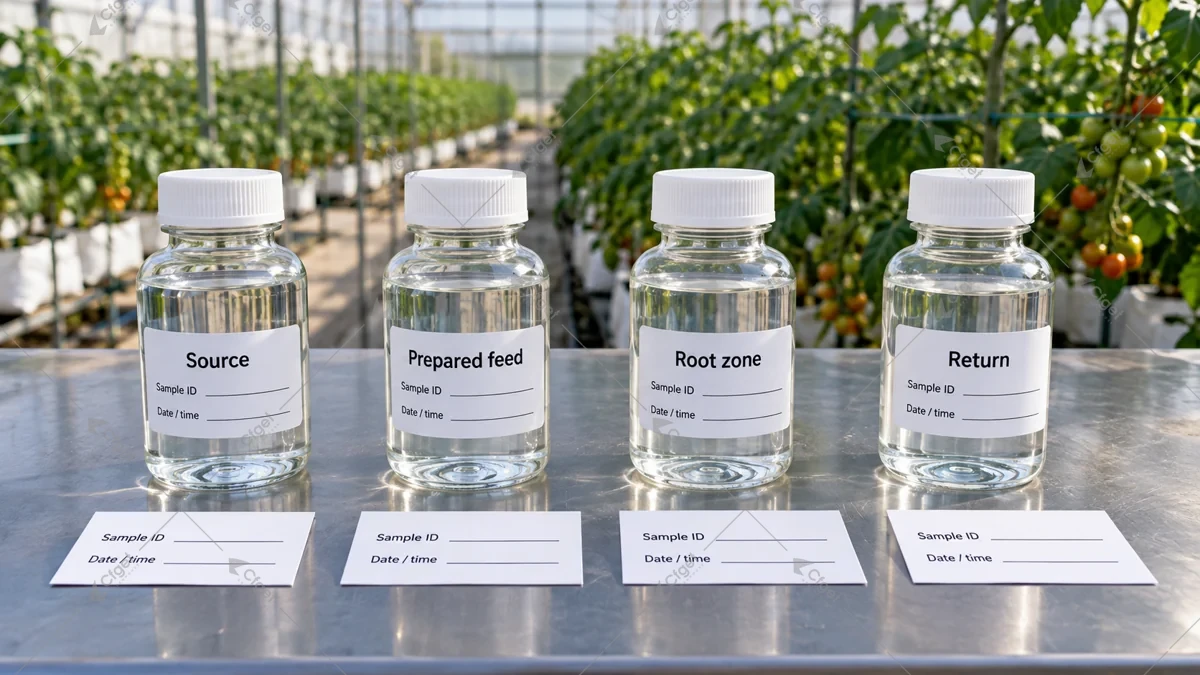
Ask the laboratory and crop adviser to define the sampling locations, containers, handling, requested analyses and timing. Include these four roles where they are relevant to the system:
- Source: the water actually entering preparation or top-up, identifying any treatment or blending before that point
- Prepared feed: the solution supplied to the crop under a recorded operating state
- Root zone: a representative sample collected by a named method appropriate to the growing system
- Return: collected solution from an identified zone or mixture of zones, before or after a clearly named treatment step
Synchronize the investigation period, but do not assume simultaneous samples are the same parcel of water. Feed can take time to reach the root zone and return tank. Ask the adviser how that timing, mixing and any shared return should affect the sampling plan.
Keep root-zone extraction methods distinct. Record the method so the laboratory can interpret the result. This investigation does not make a root-zone extract directly interchangeable with a feed-water sample.
Use a linked sampling request
| Field | Entry | Link or clarification needed |
|---|---|---|
| Investigation ID and linked sample IDs | ________ | ________ |
| Investigation question, crop and stage | ________ | ________ |
| Zone, tank and sample role | ________ | Source / feed / root zone / return |
| Sample ID, location, date and time | ________ | ________ |
| System state and relevant mixing or travel time | ________ | ________ |
| Sampling or extraction method | ________ | Laboratory instruction reference |
| Tank volume or level and recent volume changes | ________ | Measured or estimated basis |
| Water additions, nutrient additions and product identity | ________ | Amounts, units and timestamps |
| Field EC, temperature information and meter check | ________ | Original unit and instrument record |
| Requested individual ions or elements | ________ | Adviser-selected panel, including relevant source contributions |
| Laboratory result, unit and reporting basis | ________ | Element or compound basis where relevant |
| Sample handling and receipt information | ________ | ________ |
| Crop observations and related tissue analysis, if requested | ________ | ________ |
| Adviser interpretation and unresolved question | ________ | ________ |
Use a separate record for each sample and link them with an investigation ID. Ask explicitly whether the analysis includes the ions relevant to the question, such as sodium or chloride where source and return conditions make them relevant. Do not assume a package called “nutrient test” includes every requested component.
Reconcile results before changing the recipe
Keep laboratory units and reporting bases visible. Ask for clarification where one result is expressed as an element and another as a compound. Do not compare unlabeled “ppm” values from different reports or devices as though they necessarily describe the same quantity.
Check whether a sample was taken before or after an addition, top-up or treatment. A difference between source and feed should be reviewed alongside the recorded additions. A difference in return needs the crop, contributing zones, water-volume history and sampling method. None of these comparisons should be reduced to a single EC reading.
If a record is missing, identify what cannot yet be concluded. It may be better to repeat a properly defined sample set than to build a correction around uncertain sample identity.
Leave the corrective decision with the crop team
Ask the adviser to state the supported interpretation, the remaining uncertainty and the next action. This article supplies no universal sodium limit, fertilizer recipe, replacement interval or instruction to discharge solution. Any proposed change must account for the crop, laboratory evidence, equipment and applicable environmental requirements.
If a change is authorized, retain the previous records and define how the team will check the outcome. Keep meter trends, individual-element results and crop observations together. That makes it possible to learn whether the original concern was resolved rather than simply whether the EC returned to a familiar number.
The useful conclusion is specific: which parts of the composition are supported by evidence, which inputs explain them and what still needs investigation. A target EC remains a valuable operating reference, with its limits understood.
Download the working files
Use these CSV files with the instructions in this article.