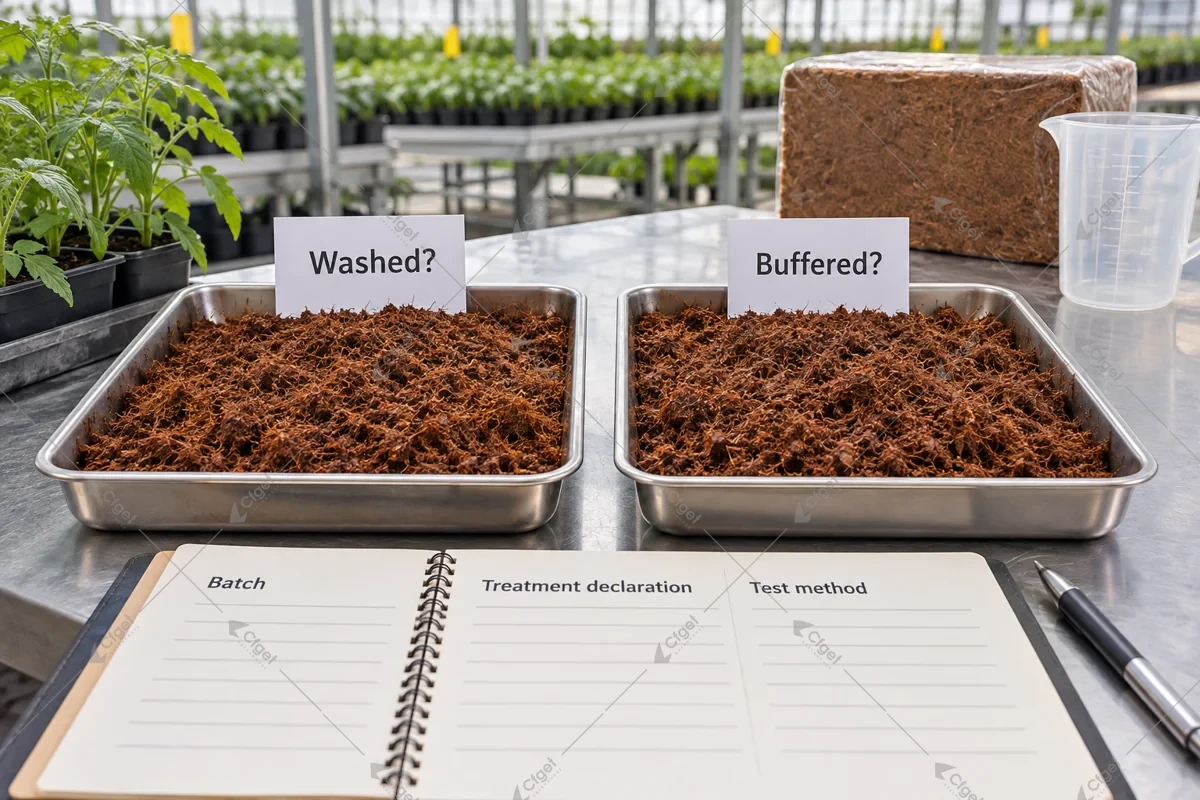
A low electrical-conductivity result does not, by itself, establish that coco coir has been buffered. For a commercial buying decision, ask for two kinds of evidence: what treatment the supplier declares for the product, and what the relevant batch tests actually measured.
Keep those records attached to the delivered lot. The question is whether this batch is suitable for your crop and irrigation program, with any remaining preparation clearly identified. A generic “washed and ready to grow” description leaves too much of that decision unstated.
What is the difference between washing and buffering?
Washing removes soluble salts through water treatment. Buffering addresses the cations, or positively charged ions, associated with the coir’s exchange sites. In its Soilless Substrates fact sheet, Perennia distinguishes washing to reduce salt content from a buffering process that replaces potassium at exchange sites with calcium. It explains why washing alone does not answer the buffering question.
That distinction gives the buyer a way to read the documents. A washed declaration describes a treatment. An EC result describes conductivity under a stated test method. Neither is a complete description of the exchange-ion condition.
Ask what the supplier means by “buffered,” which product specification defines it and what batch evidence supports the declaration. Avoid interpreting the word as a promise of zero sodium, a complete nutrient recipe or automatic suitability for every crop.
Start with the batch, not the brochure
Match the delivery label to the product code, batch number and certificate of analysis, often shortened to COA. Check the sample date, report date, laboratory or testing organization, and whether the report identifies the shipment you are reviewing.
A typical-value sheet can help describe a product range, but it does not establish what was measured in a particular delivered lot. If the supplier provides a representative report from another batch, identify it as such and ask what evidence applies to this delivery.
Keep the product form and declared blend in the record. Note the proportion or specification for pith, fiber and chips where supplied, the package format, and the stated hydrated volume with its measurement basis. Do not let an identical brand name conceal a different product variant.
Photograph the lot labels before distributing material through the greenhouse. Retain the association between the packaging, delivery paperwork and sample identity. That gives the crop adviser a defined batch to discuss if further review is needed.
Ask what the laboratory result can establish
Request the extraction method, sample preparation, units and reported results. For chemical review, ask the adviser which ions are relevant, such as sodium, chloride, potassium, calcium and magnesium, and which measurements would answer the outstanding question.
Be specific about whether a report describes ions in an extract or an assessment of exchangeable cations. A number headed “calcium” without its method and basis is incomplete evidence. Ask the laboratory to interpret the scope of its test rather than inferring that it proves the supplier’s whole treatment process.
Compare results only on an appropriate method basis. The substrate EC test-method guide covers why different extraction methods can produce different numbers. For this purchasing decision, record the method and let the laboratory or adviser resolve comparability. Do not create an informal conversion factor from two unrelated reports.
Set acceptance criteria with the crop adviser using the crop, water analysis, intended nutrient program and relevant product specification. A low number is not a universal pass, and a value should not be rejected simply because it differs from a test performed by another method.
Use a batch-evidence review sheet
Download the coco coir batch-evidence worksheet. Copy it for each product and lot. Enter the original supplier wording separately from your interpretation, and leave missing results marked “not supplied.”
| Evidence group | Record | Question to close |
|---|---|---|
| Identity | Supplier, exact product, batch and delivery reference | Does the report match the delivered material? |
| Treatment declaration | Washed or buffered wording, specification revision and batch linkage | What process and completion evidence does the supplier declare? |
| Test basis | Sample plan, preparation, extract method, units, dates and testing organization | What was actually measured? |
| Chemistry | EC, pH and the relevant ion results with method references | Are the results sufficient for the intended review? |
| Product form | Particle blend, package format and hydrated-volume basis | Is this the agreed product variant? |
| Crop fit | Crop, water and nutrient-plan references; agreed acceptance criteria | Who has assessed suitability and any remaining preparation? |
| Disposition | Accept, hold for clarification or reject under agreed terms; approver and date | Which questions remain unresolved? |
If independent sampling is needed, agree the plan with the laboratory and supplier before collecting material. Record which packages were sampled and how the sample relates to the lot. Do not treat a convenient handful from one accessible bag as proof of a whole shipment.
What should an incomplete answer trigger?
Washed declaration and EC only: ask whether buffering was performed and what documentation addresses the exchange-ion question. Do not silently relabel the product as buffered.
Buffered declaration without batch evidence: request the applicable specification, traceable treatment declaration and the testing information needed by the adviser. A marketing claim and a laboratory result serve different purposes.
Conflicting reports: check identity, dates, methods and units before concluding that the material changed or a laboratory is wrong. Have the relevant parties resolve the discrepancy in writing.
A result outside the agreed requirement: hold the buying or planting decision for the authorized review and follow the purchase terms. Keep any proposed remedy specific to the batch, crop and environmental requirements.
Keep preparation advice separate from a purchasing label
Do not improvise a buffering recipe or a calcium dose from the word “coir.” Ask the supplier and crop adviser to state any required preparation and how completion will be assessed. This review sheet does not prescribe chemical treatment or fertilizer changes.
Retain the accepted specification and batch records after planting. Record where the lot was used so a future observation can be linked back to the correct material. Supplier or product changes should reopen the evidence review rather than inherit a previous batch’s acceptance.
The practical distinction is straightforward: washing and buffering answer different questions, and a batch release needs evidence relevant to both the product declaration and the intended crop. That is the information to resolve before the crop depends on the substrate.