Water barrels can store heat and release some of it later, but they do not create heat. Whether they protect a greenhouse crop depends on how much the water warms during the day, how much usable cooling is available overnight, and how quickly the greenhouse loses heat. A fixed number of barrels per floor area cannot answer all three questions.
The useful starting point is an energy calculation followed by measurements. It can show that a proposed store is too small even before you spend money or give up growing space. It cannot, by itself, predict the minimum leaf temperature on a freezing night.
Start with the temperature change in the water
For liquid water over an ordinary greenhouse temperature range, an approximate sensible-heat calculation is:
Stored heat (kWh) = water mass (kg) × 4.186 × temperature change (°C) ÷ 3,600
The approximation uses a specific heat capacity of 4.186 kJ per kilogram per degree Celsius and approximately one kilogram per litre of water. Use the actual filled volume. A tank label describes capacity, which may differ from the volume you put into it.
Consider an illustrative 200-litre store that can cool from 25°C to 15°C. The calculation is 200 × 4.186 × 10 ÷ 3,600 = 2.33 kWh. That is the theoretical energy in the specified temperature interval. It is not a CFGET trial result, a guaranteed overnight contribution or an estimate of your local weather.
If the same water starts at 17°C and only a 2°C drop is useful, the energy falls to about 0.47 kWh. The container did not change; its useful charge did. A cloudy day therefore belongs in the design case, not just a sunny demonstration.
Compare energy with the heat required over time
A heat loss of 1 kW maintained for ten hours represents 10 kWh. In that deliberately simplified example, the 2.33 kWh water store is much smaller than the overnight requirement. Dividing 2.33 kWh by 1 kW gives 2.33 hours as an energy-only upper bound, before considering incomplete heat transfer and other losses.
Real heat loss changes with indoor-outdoor temperature difference, wind, leakage and covering conditions. Do not adopt 1 kW as a greenhouse specification. Obtain an appropriate heat-loss assessment or measure the energy needed to hold a chosen temperature under recorded conditions.
Keep power and energy separate when comparing equipment. A heater’s kW rating describes a rate; a tank’s kWh describes an amount stored within stated temperature limits. A large tank that releases heat too slowly can leave the crop cold despite containing energy.
Heat must reach the store and return to the crop
The US Department of Energy’s passive-design explanation describes the temperature differences needed to charge and discharge thermal mass. A container hidden where it receives little useful heat should not be assigned the same daily temperature rise as a well-coupled store.
The University of Minnesota deep winter greenhouse programme uses an integrated building and heat-storage approach, including fan-driven transfer to insulated soil or rock storage in its described designs. That is materially different from putting a few loose barrels into an otherwise unchanged greenhouse.
When comparing options, draw the actual heat path. Identify how the store receives energy, how it exchanges heat with the greenhouse at night, and which surfaces or air leaks bypass the intended insulation. More storage volume does not automatically fix a weak transfer path.
Run a measurement trial that can answer a decision
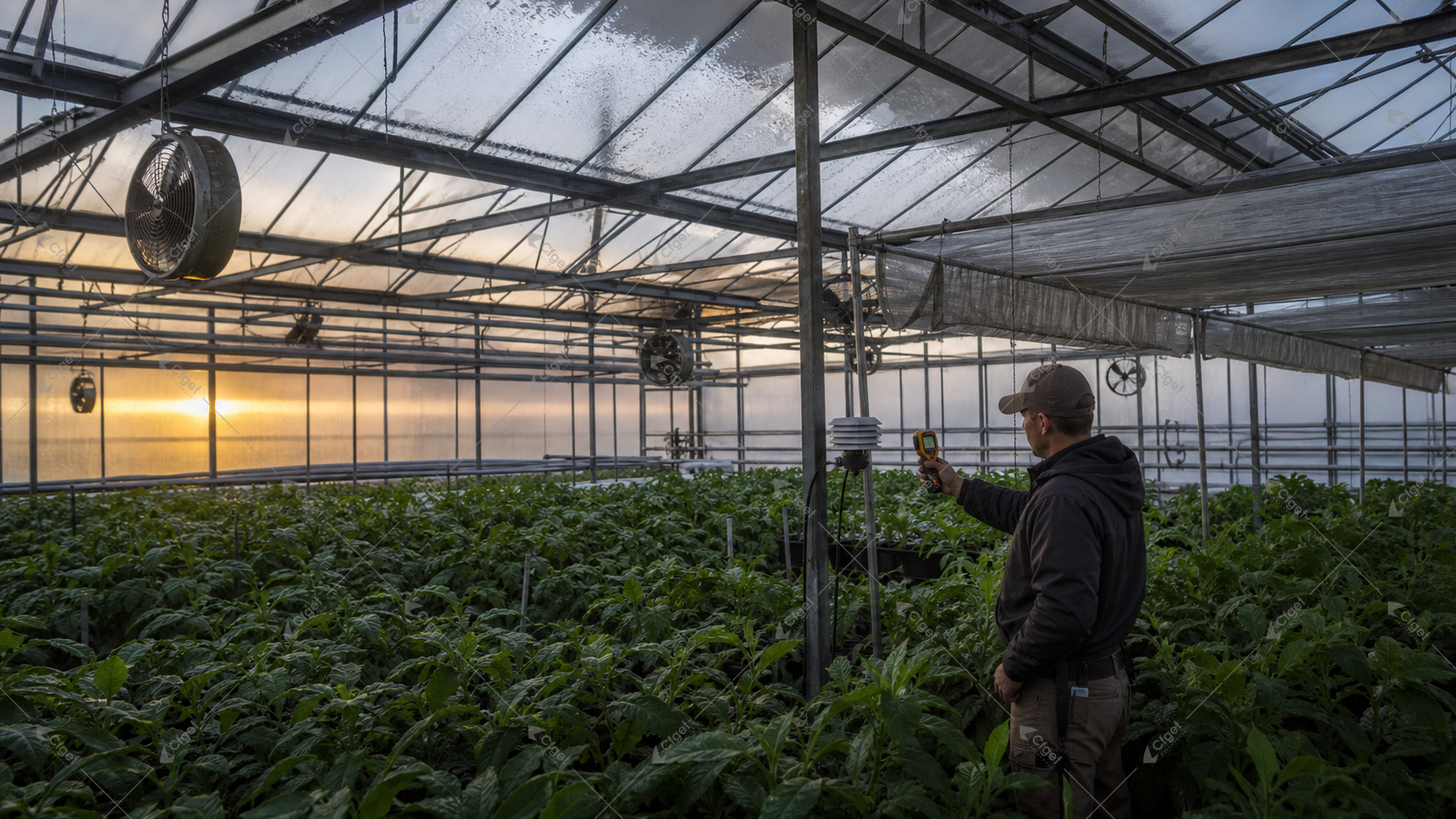
Log outdoor temperature, representative crop-height air temperature and water temperature at consistent locations. Record water volume, heater operation, shading and ventilation state. If the tank is large, ask whether one water measurement adequately represents it; temperature can vary within a store.
Choose the question in advance. You might be testing whether the store delays a heater start, reduces measured heater energy during similar conditions, or raises the minimum temperature in one crop zone. These are different outcomes. A warmer reading at sunset does not establish frost protection before dawn.
Compare several relevant nights and include the weather leading into each one. An unusually sunny day followed by a mild night is a poor basis for an all-winter promise. Keep backup heat available for vulnerable crops while the trial remains uncertain.
Include the practical costs of the space
A filled 200-litre container adds roughly 200 kilograms of water, plus the container itself. Confirm the supporting surface, stability, access and containment arrangements before filling it. Use suitable containers and retain the headspace and handling provisions their maker requires. Do not add automotive antifreeze to improvise a crop-area heat store.
Also count the crop area and maintenance access occupied by the installation. The useful comparison is between complete options under the same conditions: storage, insulation, active heat and the crop temperature you need. CFGET’s greenhouse systems overview provides broader planning context; any site-specific performance figure still needs its own calculation and verification.