A higher support wire does not, on its own, turn an umbrella cucumber crop into a workable high-wire system. The change affects how growth is retained, which jobs repeat through the crop, how workers reach the canopy and how the harvest develops over the season.
Compare two complete crop-system packages before deciding to convert. Keep the cultivar, product, season and evidence boundaries explicit. The right outcome may be to retain the current system, obtain missing evidence or proceed to a detailed conversion assessment.
Define the architecture behind each name
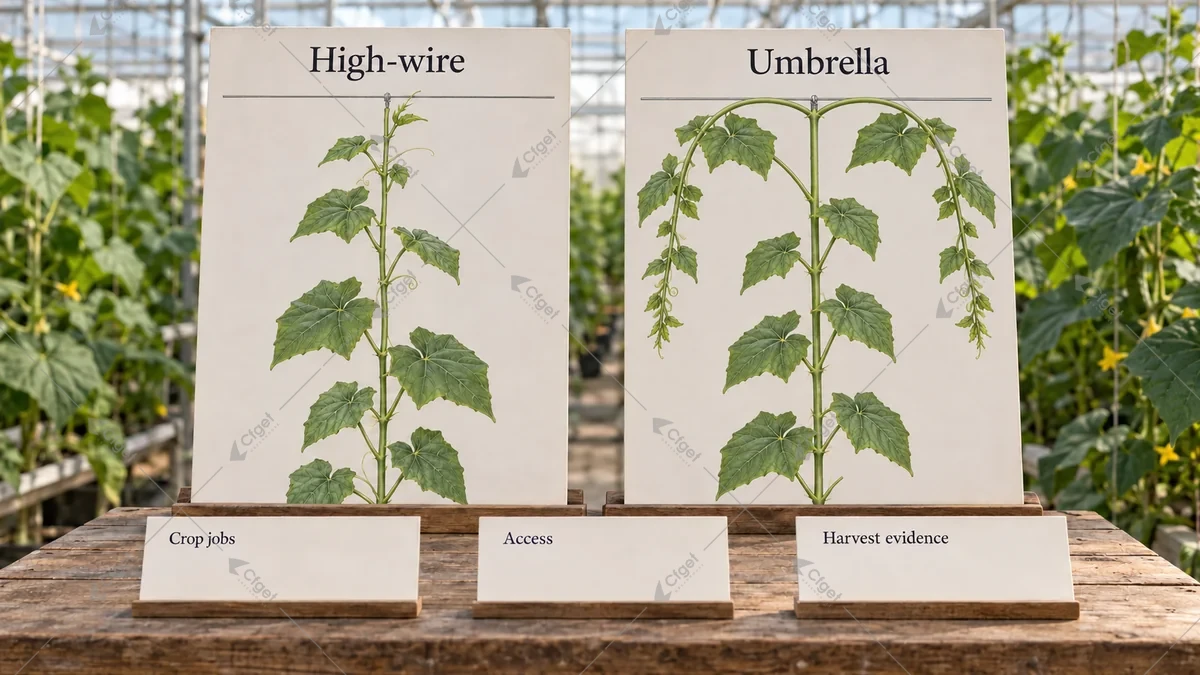
“Umbrella” covers variations. In a commonly described arrangement, the original main growing point is stopped at the support and subsequent growth is carried by laterals that drape down. High-wire proposals commonly retain a continuing main growing point while managing the older stem through lowering or layering. Ask the crop adviser to describe the exact version being compared.
Alabama Cooperative Extension’s cucumber guide discusses umbrella variations and methods retaining the growing point. It also limits the regional evidence for high-wire systems. Those descriptions explain the biological distinction; they do not supply a universal wire height, plant density or pruning prescription.
Record the proposed architecture in ordinary words and attach the adviser’s crop plan. A label such as “Dutch system” or “high technology” cannot replace that description. Confirm the cucumber product and cultivar first, including the expected market presentation and crop period.
Compare two complete crop-system packages
The crop-system change map places the current umbrella program beside the proposed high-wire program. Fill both columns. An empty baseline makes every new feature look like an improvement because the current operation has not been described.
| Change to examine | Evidence needed for the actual crop |
|---|---|
| Growth and crop duration | Defined architecture, intended crop length and replacement or renewal events. |
| Recurring jobs | Actual crop-work sequence, frequency assumptions, required competence and consumables. |
| Canopy and light | Evidence relevant to the cultivar, season and proposed arrangement. |
| Access equipment | Required working envelope and a documented route to equipment and track acceptance. |
| Harvest | Distribution through the intended selling period and evidence of the required grades. |
| Engineering | Unresolved support, structure, access and system interfaces with responsible reviewers. |
Use existing staffing observations and crop-work records as inputs. This comparison should expose a new recurring task or a changed working position; it should not assume an advertised labor saving. Identify which tasks move in time as well as which tasks appear or disappear.
Likewise, treat consumables as part of the proposed package. A different support or handling method may change what is bought and used through the crop. Have the supplier specify the actual items and the grower explain their role before budgeting them.
Ask what each published comparison actually tested
The UK Cucumber & Pepper Growers Association’s Highwire Project summary describes a commercial-scale comparison. In that project, the reported yield improvement did not offset higher labor, consumable and energy costs. It is evidence that a production gain can coexist with an unattractive whole-system result, not a verdict against every high-wire crop.
Estidamah’s 2019 on-farm comparison took place in a Saudi med-tech glasshouse with soil cultivation and a named cultivar. That is a different context. Its web table also contains duplicated headings and inconsistent unit presentation, so it should not supply an unqualified numeric conversion case.
Use the comparison evidence card to retain the source, season, cultivar, growing medium, density basis, crop duration and measured outcomes. If a comparison lacks the conditions needed to judge relevance, mark it as background rather than a prediction for the proposed greenhouse.
Do not select a universal winner by placing unrelated trials side by side. A result from another season or product can suggest a question worth investigating, but it cannot establish the outcome of your conversion.
A promising proposal can change too many things at once
Consider a hypothetical umbrella crop with an established product and selling period. The proposed high-wire package also changes the cultivar, extends the crop duration and uses a different plant arrangement. A presentation shows a larger total harvest for the proposed package.
That number cannot isolate the effect of the training system. It combines several changes. The useful response is to mark the changed inputs, ask which evidence supports each one and compare the resulting harvest distribution with the buyer’s actual demand window.
If the available evidence addresses only a different cultivar and season, the outcome is “obtain evidence,” not “convert.” If the crop package appears credible but the access equipment is unresolved, proceed only with the relevant conversion assessment. Do not treat a favorable crop result as acceptance of the machinery or structure.
Conversely, retaining the current system can be a supported decision when it meets the crop and market requirements and the proposed package leaves material questions unanswered. The comparison need not produce a change to be useful.
Check the space that people and equipment need
The working envelope includes more than the nominal wire height. Bring the proposed canopy, access equipment and relevant equipment positions into the greenhouse height and access review. Obtain the specific trolley, track and structural acceptance elsewhere in the project documents.
For a North American project, the commercial cucumber greenhouse design guide provides the wider site and system context. Use local requirements and actual project evidence rather than importing another region’s preferred structure.
Do not use a crop-system sketch as a support design or an instruction for working at height. The map should show the engineering question and its owner, not pretend that a crop adviser has approved the machinery.
Close with a decision the team can act on
Record the chosen outcome and the reason: retain the current program, obtain a defined piece of evidence, or assess a specified conversion package. Name the cultivar, season and architecture to which the conclusion applies.
A practical conversion brief should explain what changes in the crop, recurring work, access, consumables and harvest, and what still needs approval. That gives the grower and investor a decision they can examine before equipment is purchased or the next crop is committed.