Choose strawberry plants by their documented starting state and fit with your greenhouse planting window. “Tray,” “plug” and “frigo” are not enough to make the purchase decision. They can describe different aspects of an offer, and a nursery may use more than one of those words for the same product.
Keep the cultivar, rooted format, nursery grade, conditioning or storage history, and developmental evidence in separate fields. Then compare the confirmed arrival window with the crop plan and greenhouse readiness. A cheaper plant that cannot enter the planned crop on workable terms is not an equivalent offer.
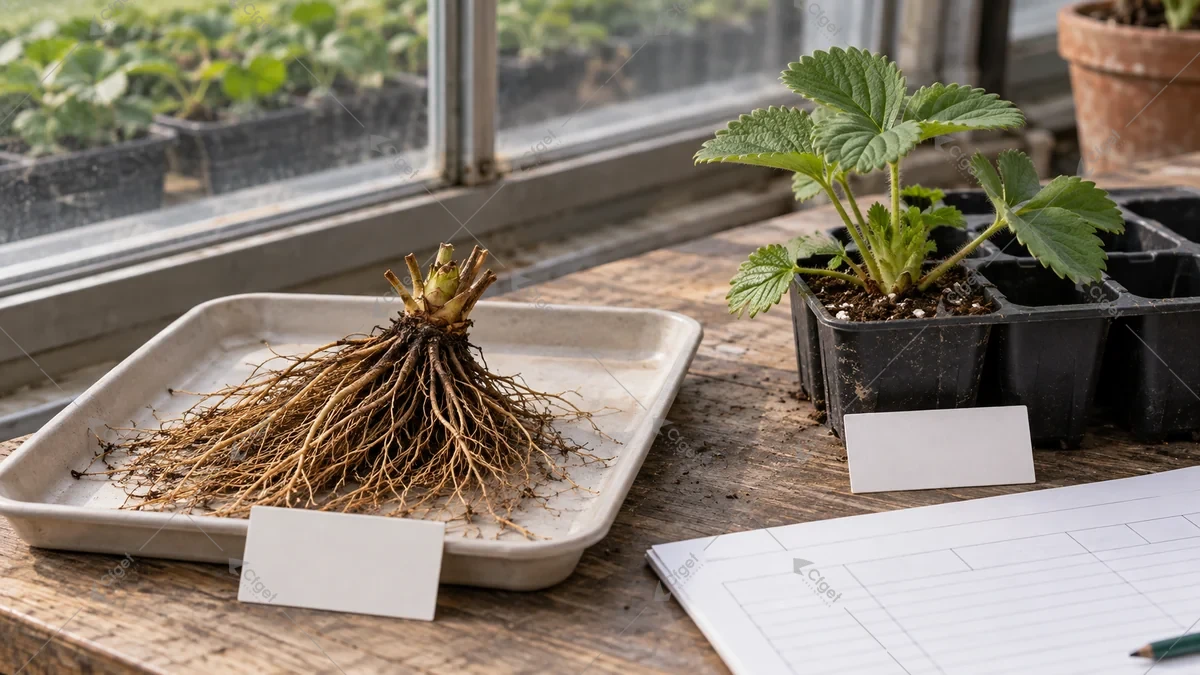
Separate the labels before comparing offers
NC State Extension’s Southern Regional Strawberry Plasticulture Production Guide describes bare-root material, rooted plugs, stored frigo material and tray plants. It provides useful vocabulary for asking what is being supplied. Its regional field-production dates and handling recommendations should not be turned into a global greenhouse schedule.
A practical starting distinction is whether the offered plant arrives bare-root or with a developed root ball. Separately, establish what nursery preparation and storage the supplier means by its label. The cultivar names the plant genetics; it does not define all the preparation that the nursery has already performed.
For a concrete example of overlapping wording, Augusta Plants lists a professional offer as “FLAIR (frigo, TRAY)”. This is evidence that these labels can coexist in an offer. It is not a recommendation of the cultivar, confirmation of current stock or evidence that all tray plants receive the same conditioning.
| Offer detail | Question to resolve |
|---|---|
| Cultivar and source | Which named cultivar and authorized source are being offered? |
| Supplier’s exact type wording | What does this nursery mean by each word, including combined labels? |
| Rooted format | Bare-root or rooted? If rooted, what root-ball volume and specification apply? |
| Grade | What is measured, how is it measured, and what tolerance is accepted? |
| Conditioning and storage | What relevant history will be supplied for this material? |
| Developmental evidence | What stage or flower-bud information was actually assessed, when and by which method? |
| Dates | Which order, dispatch, arrival and planting windows are confirmed? |
The same cultivar may be a different starting product
Imagine two hypothetical nursery offers for the cultivar already named in your crop plan. One specifies a rooted tray product with an agreed conditioning history. The alternative gives only a bare-root grade and the cultivar name. Even if both can arrive on the same day, you do not yet know whether they serve the same planned crop.
Do not fill the missing history by assuming the label means what it meant on a previous order. Send the two descriptions to the nursery and crop adviser. Ask whether the alternative matches the expected starting state, which differences require a change to the plan, and which questions remain unanswered. The result may be a suitable substitute, a different crop plan, or a hold on the substitution.
The same care applies within rooted products. A bigger root ball or a grade such as A+ is not, on its own, evidence of a specific harvest date. Ask for the supplier’s measurement basis and order specification. Kaack’s plant-type page and its 2022/2023 catalogue illustrate that plant formats and grades are described in supplier documents. Use the controlled specification for the actual order rather than treating an old catalogue value as an industry standard.
If a nursery supplies developmental or flower-bud evidence, retain its date, sampling or assessment method and the material it covers. If none was supplied, write that down. A photograph of visible flowers does not document all the information your adviser may need to assess the starting crop.
A complete specification can still arrive too late
Consider another hypothetical comparison. Both offers now satisfy the agreed plant description. Offer A has a confirmed arrival within the workable planting window. Offer B has a lower unit price but a dispatch window after that planting window has closed. B cannot be treated as an interchangeable purchase for the unchanged plan.
The next step is to check whether a revised crop window is agronomically and commercially workable, not to insert the lower price into the original budget. If no suitable revision is confirmed, retain the in-window offer or seek another source. This example assigns no price, yield penalty or universal number of days to a delay.
Ordering can also need to happen well before delivery. Kraege’s plant and order calendar separates ordering windows from delivery periods and distinguishes plant types. It demonstrates the planning issue; its dates are not a deadline for every nursery. Obtain current availability and the actual order deadline for your selected product.
Use one card for each offer and crop window
The plant-offer-to-crop-window card is a manual record with no automatic suitability score or harvest calculation. Complete the intended cultivar and planting window first. Enter the supplier’s exact description next, then add the documents supporting grade, history and developmental state. Finally, align dispatch and arrival with the greenhouse’s readiness and the crop adviser’s requirements.
Use a separate card if the same offer is being considered for a different planting window. That avoids carrying an earlier acceptance into a later crop without checking its assumptions. Keep unknowns visible, and identify who must answer each one before the order deadline.
Once the offer is selected, use the general transplant-receiving method to agree the receiving specification, with strawberry-specific criteria supplied by the nursery and adviser. The existing Netherlands strawberry planning example shows how plant type and crop calendar connect to greenhouse design; its local conditions are not universal.
Before committing, ask the nursery to return the card with the product definition, confirmed dates and unresolved substitutions clearly marked. You can then compare offers for the crop you actually intend to plant.