Specify pelleting and priming separately when buying lettuce seed for a commercial nursery. Pelleting concerns the physical sowing format. Priming concerns germination preparation. An offered lot can have both, one or neither; a pellet’s appearance does not confirm that the seed inside was primed.
For the nursery line, the purchase needs to answer two questions: will this physical product work with the intended sowing equipment, and is its documented preparation suitable for the planned sowing window and nursery conditions? Keep declared active treatments and handling restrictions explicit as well.
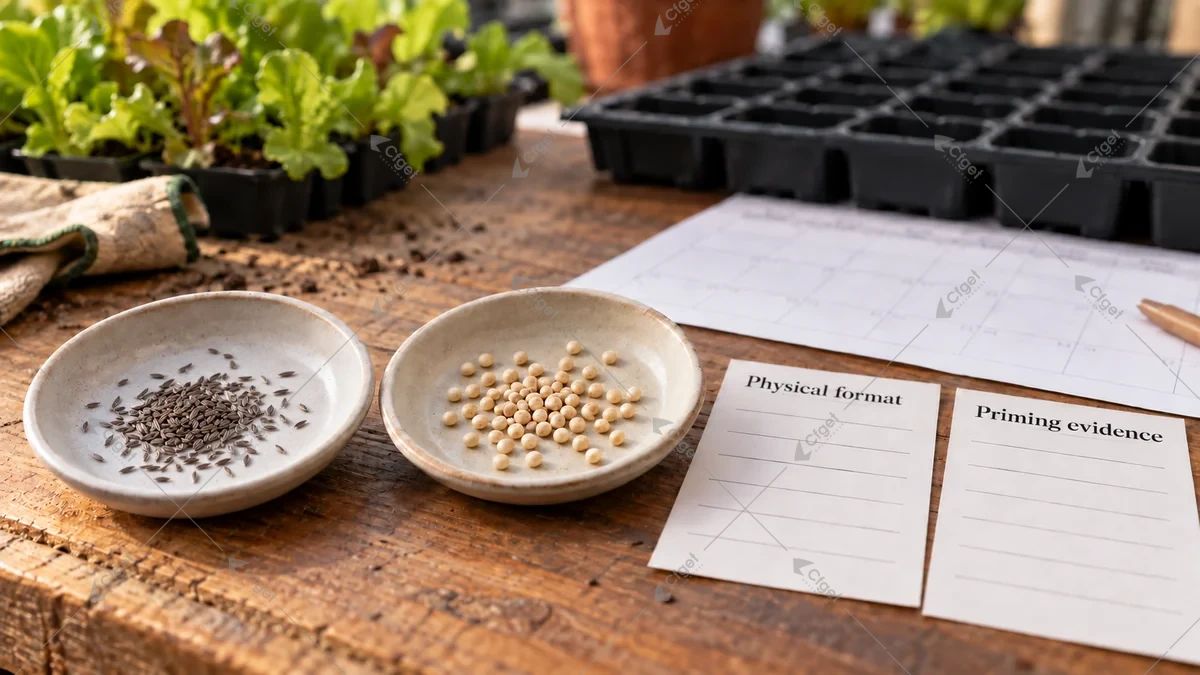
Read the offer on two separate axes
Johnny’s Selected Seeds explains that its pelleted lettuce may or may not be primed, and that this can vary by lot. Its guidance separates physical enhancements, active treatments and priming. That is a strong reason to obtain confirmation for the exact product and lot rather than carrying a previous purchase’s status forward.
Bayer’s lettuce-seed explanation describes pelleting as a way of changing the seed’s handling characteristics and priming as an enhancement related to germination behavior. These distinctions do not give a universal machine setting, storage life or nursery temperature.
| Axis | Record for the exact offer | Evidence still needed |
|---|---|---|
| Physical format and machine fit | Raw, coated, encrusted or pelleted form; supplier grade or dimensions; single- or multi-seed basis where applicable; package counting basis. | Seeder requirements and a supplier-supported sample-trial record for the actual format. |
| Preparation and timing | Confirmed priming status, purpose and relevant test conditions; declared active treatments; storage and use-by guidance. | Lot-specific documents and suitability for the planned sowing window and nursery conditions. |
Seed Dynamics provides a concrete combined-product example: Prep-Coat and Prep-Coat Special are described as primed and pelleted products with physical variants. This demonstrates that the two features can be specified together. The product page does not verify compatibility with your machine or predict the output of your nursery.
Same cultivar, different evidence about priming
Imagine two hypothetical offers for the same lettuce cultivar. Both are described as pelleted, and both have a physical specification that the seeder supplier has accepted. Offer A confirms priming for the stated lot and includes the relevant supplier information. Offer B says only “pelleted.”
Do not record B as unprimed or as equivalent to A. Its priming status is unknown. Ask the supplier to clarify it for that lot. If the nursery’s plan requires a particular preparation, B remains unresolved until the evidence answers that requirement. If priming is not required for the plan, the purchase may be assessed on that different basis, with the decision written down.
Also ask what any “untreated” wording means in the supplier’s documentation. Do not use that word to infer the absence of physiological enhancement. Pellet color cannot establish active ingredients or their absence either. Retain the actual declaration and clarify unclear treatment status with the supplier or laboratory.
A confirmed priming treatment still does not certify the growing lettuce crop as heat-tolerant. Keep the supplier’s intended germination purpose and test conditions distinct from the greenhouse conditions in which seedlings will develop.
Priming confirmation does not settle machine fit
In a second hypothetical case, the supplier confirms that the lot is primed and pelleted, but the pellet grade is not specified. The existing sowing machine requires a defined physical format. That offer has answered the preparation question while leaving the sowing interface open.
Ask for the pellet specification and the seeder manufacturer’s compatibility requirements. Where the supplier supports a trial, retain the sample identity, machine configuration, conditions and observed placement result. Do not substitute a photograph of a round pellet for that evidence, or adjust equipment outside its approved instructions.
Separate a successful sample placement trial from future production output. It can support the physical fit under its stated conditions. It does not establish the number of healthy, uniform, on-time plants that will leave the nursery. Multiplying the purchased count by a laboratory germination percentage would skip the rest of that process.
Put the lot on the nursery calendar
Request storage and use-by guidance for the actual enhanced product, together with relevant dates and any restrictions. Match those to the intended sowing window and the nursery conditions the supplier expects. If delivery slips or seed is carried into a later cycle, revisit that match rather than assuming the first assessment remains valid.
Keep the package counting basis clear. Confirm whether the quantity refers to seeds, pellets or another stated unit, and whether a pellet is specified to contain one or multiple seeds. Do not generalize another crop’s multi-seed product description to the lettuce lot on the order.
Use the established method to plan nursery capacity for the sowing and delivery calendar. The seed specification is one input to that schedule; the purchased quantity is not the accepted-plant output.
Send a two-axis specification with the order
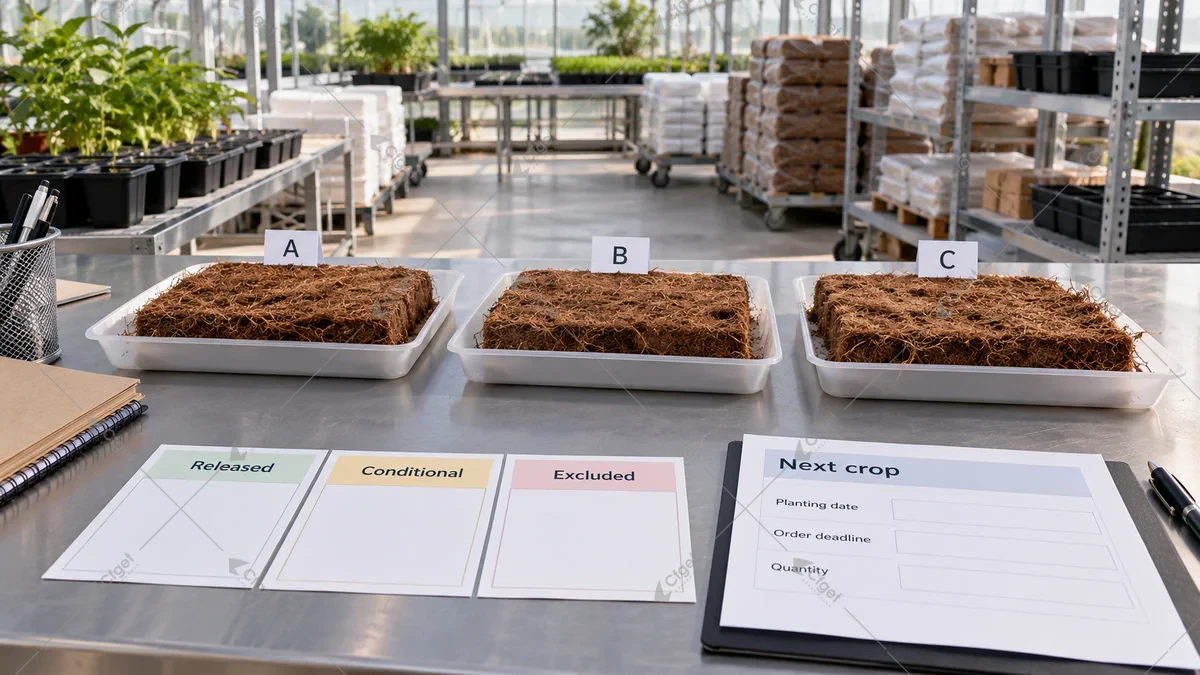
The lettuce-seed purchase comparison is a manual worksheet with separate physical-format and preparation sections. It has no automatic suitability score, chemical recommendation or seedling-output calculation. Enter the common nursery requirement first, then copy each supplier’s wording into its own column and identify the supporting document.
Leave an unanswered field marked “not confirmed.” For each axis, state what is established, what remains open, and who must reply. A confirmed physical match should not hide an unknown priming status, and a confirmed treatment should not hide an untested machine interface.
Before ordering, return the completed sheet to the seed supplier and the relevant machine or crop specialist. Ask them to close the specific gaps for the product, lot and sowing window you intend to use.