A residue report can help answer an EU herb buyer’s question only when the sampled product, tested analytes, reporting limits and result basis match that question. A long screening list or an “ND” entry does not settle the comparison by itself. If a required component or reporting detail is missing, ask for clarification before treating the report as adequate evidence.
Keep the buyer’s specification and the applicable legal requirement in separate fields. The report is an input to the responsible food-safety or import-compliance owner’s assessment. It does not, on its own, release a shipment or establish that every lot is safe or compliant.
Begin with the buyer question and the sampled product
Write down exactly what the buyer wants assessed, for which herb, product form, destination and relevant date. Preserve whether the product is fresh, dried or otherwise processed. Then identify the report’s sample, the lot or lots it is claimed to represent, the sampling and report dates, and any relevant history needed by the quality team.
If the link between sample and shipment is unclear, stop that part of the comparison. A precise laboratory result cannot repair an undocumented claim that the sample represents a different lot. Ask the appropriate laboratory or quality process to establish the sampling basis.
CBI’s fresh culinary-herb market-entry guidance identifies pesticide residues and buyer requirements as commercial concerns. Use that context to get the buyer’s current written specification. It is not a substitute for checking the applicable legal text or the laboratory’s analytical scope.
Three cases that change the next action
A result below a limit. Suppose a hypothetical report gives an entry below its stated reporting limit, while the buyer’s question concerns a lower level. The entry does not establish zero residue and may not resolve that lower-level question. Ask the laboratory what was measured and what the notation and limit allow it to conclude. Further clarification or analytical work may be needed; do not replace the entry with zero.
A large panel with a missing component. Suppose the panel lists many analytes, but the residue definition relevant to the question requires a component whose coverage is unclear. The total size of the panel does not close that gap. Ask the laboratory to map the reported analytes to the required definition and explain any missing coverage.
A buyer requirement that differs from the legal requirement. Suppose the buyer has a separately agreed purchasing specification. Record it alongside, rather than inside, the legal-requirement field. Evidence addressing one question does not automatically answer the other. Have the responsible owner determine which requirements apply and what further information is needed.
These are illustrative reasoning cases. They contain no actual pesticide result, numerical maximum residue level or shipment determination.
Preserve the laboratory’s wording
The European Commission’s SANTE 11312/2021 v2026 guidance, implemented from 1 January 2026, is written for laboratories involved in EU official controls. Its reporting provisions distinguish component analytes and residue definitions, while its glossary distinguishes reporting, quantification and screening concepts. It is useful context for questions to the laboratory, not a universal rulebook for interpreting every private report.
Copy each original result, notation and unit into the comparison. Ask what “ND,” “not tested,” “<RL,” “<LOQ” or “<SDL” means on that report. Do not make them interchangeable. Obtain the relevant analyte-specific limit or screening information and the laboratory’s explanation of its scope.
Leave composite residue definitions, conversions and measurement uncertainty to the qualified laboratory and compliance owner. This worksheet supplies no summation formula, automatic uncertainty deduction or enforcement calculation.
Find the applicable requirement without losing its date
The European Commission’s pesticides database page explains that the database is an information tool and that official information is published in the Official Journal of the European Union. Have the responsible specialist verify the relevant commodity classification, residue definition, applicable date and regulation reference.
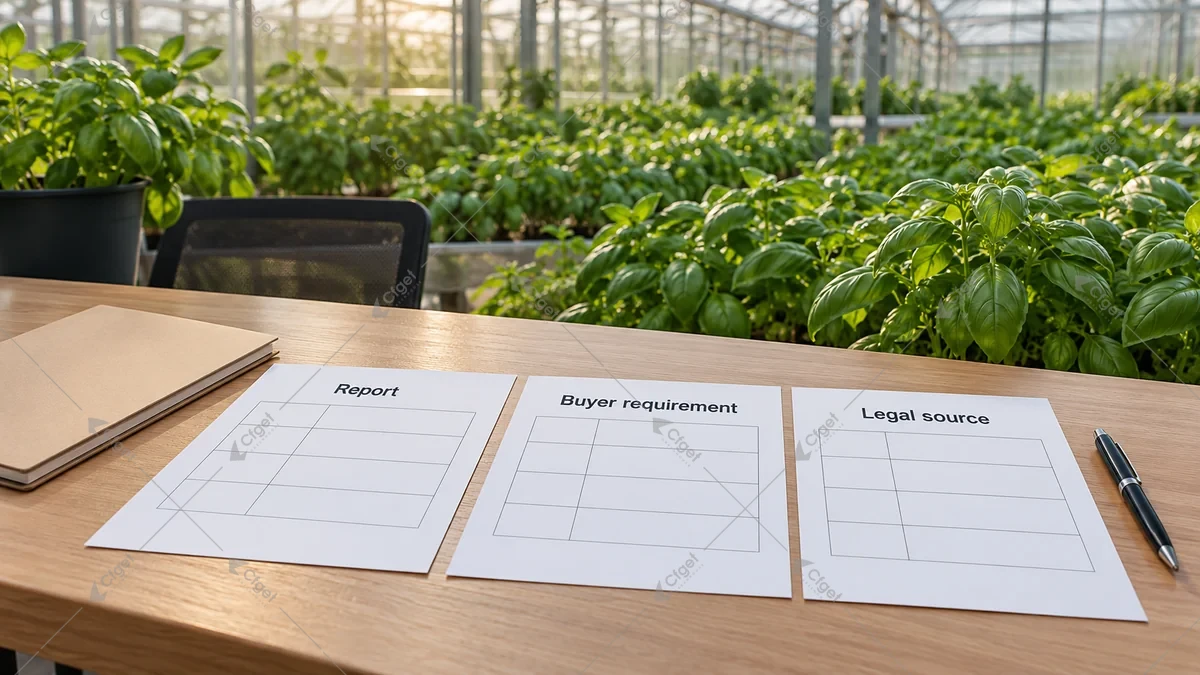
Record that legal source and version beside the question being assessed. Keep the buyer’s document, version and date in their own column. If either requirement is unclear, send a specific question to its owner rather than filling the gap with a remembered limit or another herb’s entry.
This article selects no pesticide limit and makes no determination about a product. The task is to prepare evidence that can be assessed against the correct requirement.
Build a short list of questions the report must answer
Start with the report context card to identify the product, sample, lot, destination and responsible decision owner. Then use the report-to-requirement matrix for the relevant residue questions. Both files are manual records with no pass formula or release function.
Use a separate matrix row for each required component that needs reconciliation. Keep a common requirement ID where several rows belong to one residue definition. Enter the report’s original wording, its analytical coverage and limit information, the buyer requirement and the verified legal reference. Record what the laboratory has clarified and what remains unresolved.
Send the resulting question list, original report and requirement documents to the qualified food-safety or import-compliance owner. The outcome may be sufficient evidence for their assessment, a request for clarification, or a need for additional work. It is not an approval generated by the worksheet.
For the wider crop and country context, see Kenya basil export planning. Residue evidence is one part of that export system. Close the identified report gaps before relying on it for the buyer’s stated question.
Official analytical guidance and database information checked 2 October 2026. Applicable legal and buyer requirements still need verification for the actual commodity, date and sales route.